Back pain: the 4 mistakes that make it worse and how to relieve it
Share
If you are currently experiencing lower back pain, tension between your shoulder blades, or morning stiffness, you are among the vast majority. According to a review published in The Lancet, up to 84% of adults will have back pain at least once in their lives. This staggering figure makes back pain the leading cause of disability worldwide, ahead of all other conditions. But this statistical normality should not be confused with inevitability. Understanding the mechanisms of your pain is already half the battle toward relief.
Three mechanisms, three types of pain
Not all back pain is the same. Muscle pain, the most common, results from a spasm of the paravertebral muscles. These muscles, constantly engaged to maintain posture, seize up due to sudden strain, prolonged poor positioning, or stress. The pain is then localized, sensitive to touch, and intensifies during rotation or flexion movements.
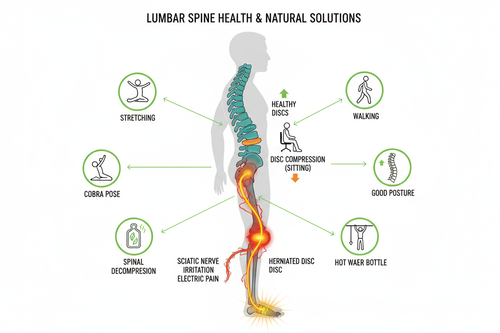
Disc pain stems from distress in the intervertebral discs, those shock-absorbing cushions located between the vertebrae. When these structures wear out, dehydrate, or crack, they generate a deep, dull pain, often aggravated by sitting and relieved by walking. A Danish study reveals that 40% of adults over 40 show signs of disc degeneration on imaging, even in the absence of symptoms.
Nerve pain, typically sciatica, occurs when a nerve root is compressed or irritated. This searing pain radiates along the path of the nerve, from the lower back to the foot, with sensations of burning, numbness, or tingling. Identifying the type of pain helps direct relief strategies toward the mechanisms actually at fault.
The six real causes of your back pain
Prolonged sitting crushes your intervertebral discs and weakens your deep muscles. Biomechanical research shows that sitting for more than four consecutive hours without a break increases intradiscal pressure by 40% and reduces muscle blood flow. Incorrectly carrying heavy loads, with a rounded back and straight knees, concentrates stress on the lumbar discs rather than distributing it across the thighs and pelvis.
Your mattress, if it is more than ten years old or unsuitable for your body type, keeps your spine in a strained position for eight hours. A mattress that is too soft allows the pelvis to sink, creating excessive curvature. A mattress that is too firm does not respect the natural curves. Chronic stress involuntarily contracts your trapezius and paravertebral muscles, creating painful tension points that persist even at rest.
A lack of deep musculature, particularly the transverse abdominal and multifidus muscles, deprives your spine of the natural corset that should stabilize it. An Australian study demonstrates that people suffering from chronic low back pain show a 30% atrophy of these deep muscles. Finally, your posture when using the phone, with your head tilted 60 degrees toward the screen, creates a 27-kilogram load on your cervical spine that reverberates throughout the entire spine.
The four mistakes that worsen your situation
Paradoxically, certain instinctive reactions to back pain worsen it in the long term. Prolonged complete rest beyond 48 hours weakens the muscles and stiffens the joints. A systematic review in the British Medical Journal establishes that maintaining moderate activity accelerates recovery compared to strict rest.
Excessive consumption of anti-inflammatories and painkillers temporarily masks the pain without treating the underlying cause, while exposing you to gastrointestinal and cardiovascular side effects. Avoiding all movement for fear of pain creates a vicious cycle where muscles stiffen, joint ranges of motion decrease, and pain intensifies. This kinesiophobia, a pathological fear of movement, is a major factor in chronicity.
Finally, passively waiting for the pain to disappear spontaneously allows harmful postural compensations to take hold. The body adapts its position to avoid the painful area, creating tension elsewhere that eventually generates new pain. What begins as a localized problem then becomes a global imbalance.
Seven natural strategies that can help
Regular movement is one of the most helpful tools. Getting up every hour to walk for two minutes boosts circulation and helps limit muscle stiffness. Your sleeping position significantly influences nighttime recovery. Sleeping on your side with a pillow between your knees maintains pelvic alignment and prevents lumbar twisting.
Morning and evening stretches, inspired by feline postures, gently mobilize the entire spine. Alternating flexion and extension stimulates disc nutrition through a pumping effect. Applying heat for twenty minutes dilates blood vessels, relaxes contracted muscles, and effectively relieves pain of muscular origin.
Strengthening the deep abdominals through thirty-second static core exercises creates the protective muscle corset for your back. Abundant hydration, beyond two liters daily, maintains the turgidity of the intervertebral discs, which are composed of 80% water. Finally, deep diaphragmatic breathing activates the parasympathetic system, reduces cortisol, and relaxes the entire back musculature.
When to consult a professional
Certain warning signs imperatively require medical advice. Pain persisting beyond six weeks despite self-care measures suggests a structural issue requiring investigation. Tingling or numbness in the legs indicates nerve compression that can progress to motor loss if left untreated.
Intense nighttime pain that systematically wakes you up, unrelieved by changing positions, may indicate an inflammatory or tumor pathology that must be ruled out. Loss of strength in the legs, difficulty standing on your tiptoes or heels, constitutes a neurological emergency.
Seek emergency care right away (call 911 in the US, or 15 or 112 in France) if you have bladder or bowel problems (trouble urinating, loss of control), numbness between your thighs or around the anus, a fever along with the pain, or if the pain follows a fall or injury. These signs may point to cauda equina syndrome, an infection, or a fracture. In these specific cases, a prompt consultation is required.
That said, most common back pain improves within a few weeks, and the tips presented here can help relieve it, alongside medical advice when needed. Consistency in their application largely determines therapeutic success.
For those who wish to improve their approach with natural anti-inflammatory supplements (highly bioavailable turmeric, omega-3, type II collagen) or postural support devices, talk to your healthcare professional. And if you desire personalized guidance to precisely identify the type of your back pain and develop a tailored protocol including targeted exercises and postural corrections, remote consultations are available on our site with postural analysis via video.
Want daily support? Le Terrier's personalized follow-up, at €10 per month, allows you to ask us questions in writing and progress at your own pace.