Cellulite: the scientific truth about reducing it naturally (without false promises)
Let's start with the most important truth, the one that should relieve many people: around 90% of women have cellulite, regardless of their weight, age, or level of physical activity. It is neither a flaw, nor a lack of discipline, nor a disease. And while we're at it, let's also say it frankly: the majority of products sold to "eliminate" it don't really work. Our promise here is simple and honest: to explain what cellulite really is, what modestly reduces it (it is possible), what is pure marketing, and above all, why trying to completely eliminate it is often a futile quest and a source of unnecessary suffering. Welcome to a scientific and compassionate approach.
Why do 90% of women have cellulite? A question of anatomy

The unique structure of female adipose tissue
Contrary to a persistent idea, cellulite is not an abnormal accumulation of fat: it is a matter of structure. Under the skin, fat cells are arranged in compartments separated by fibrous walls (septa). In women, however, these septa are mostly vertical, perpendicular to the skin: when fat cells swell, they push upwards between these septa, creating the famous dimpled appearance. In men, these septa are more oblique and crisscrossed, which distributes the pressure and makes cellulite much rarer (around 10%). This anatomical difference has been confirmed by imaging (Querleux et al., 2002).
The key role of estrogen
Female hormones, particularly estrogen, amplify this phenomenon. This is why cellulite often appears at puberty, can worsen during pregnancy, and changes during menopause. This hormonal link also explains why it affects thin and athletic women: it is not just a matter of weight, but rather of hormonal and structural predisposition.
The 3 types of cellulite (to better understand)
Three forms are commonly distinguished, often mixed together: aqueous cellulite (linked to water retention and sluggish circulation), adipose cellulite (linked to the volume of fat cells), and fibrous cellulite (older, "ingrained", sometimes sensitive to the touch). This classification, especially practical, helps to understand why the same approach does not yield the same results for different people.
What doesn't work: marketing myths
Anti-cellulite creams: the caffeine illusion
Creams, even with caffeine, are the classic example. Their effect? Essentially a temporary visual smoothing due to the hydration of the epidermis and a slight action on microcirculation (Lupi et al., 2007). In other words, they can temporarily improve the appearance of the skin, but they do not treat cellulite deeply, and the effect disappears when you stop using them. There is nothing wrong with using them for the pleasure of a moisturizing treatment, but without expecting a miracle.
"Special cellulite detox" supplements
Dietary supplements promising to "dislodge" cellulite have no serious evidence of effectiveness. Isolating a miracle ingredient has never replaced a comprehensive lifestyle. Therefore, be wary of promises that seem too good to be true.
The trap of restrictive diets
Beware of extreme diets Trying to "melt away" at all costs through highly restrictive diets is counterproductive, even aesthetically: severe restriction causes muscle loss, yet it is precisely the dense muscle under the skin that helps smooth the dimpled appearance. As a result, you can visually worsen cellulite while weakening your health. Cellulite is not fought with deprivation: yo-yo diets and extreme restriction harm both the body and morale. If your relationship with food is a source of suffering, talk to a professional.
Want an opinion on your situation? During a vitality assessment, we review together your diet, sleep, stress, and goals, then build a plan adapted to your pace.
The 4 science-backed approaches

Four approaches have a modest but real, documented effectiveness. Modest, we insist: they reduce, they do not eliminate.
1. Combined physical activity
This is the strongest approach. Combining cardio (which stimulates circulation) with muscle strengthening (which densifies the muscle under the adipose tissue) visibly improves the appearance of the skin: a toned muscle "tightens" the surface and reduces dimpling (Luebberding et al., 2015). The goal is not to lose weight at all costs, but to build muscle and move, for health before aesthetics.
2. Hydration and lymphatic movement
Well-hydrated skin looks smoother and more supple (Rawlings, 2006). But drinking water is not enough: it is movement (walking, activity, massage) that activates the lymphatic system and helps eliminate excess fluids, which affects aqueous cellulite. Supporting natural drainage fits into this logic, which we detail in our article on natural lymphatic drainage.
3. An anti-inflammatory diet
Without falling into restriction, a few practical adjustments help: limiting excessive intake of simple sugars (which promote glycation, a stiffening of collagen that accentuates texture) and excess salt (which promotes water retention). The idea is not to ban, but to rebalance toward a diet rich in plant-based foods, healthy fats, and sufficient protein. For the effects of sugar, see our article on the symptoms of excessive sugar intake. And be careful not to fall into the opposite excess with salt, as we explain regarding the dangers of a salt-free diet.
4. Mechanical massage (palper-rouler)
Firm massages and techniques such as palper-rouler or endermology have a real, but temporary, visual effect (Adcock et al., 2001). They stimulate circulation and temporarily soften the tissues. Incorporate them as a regular comfort treatment, knowing that the effect fades if you stop. It is a pleasant extra, not a permanent solution.
Want to incorporate these approaches into a realistic daily routine, without mental load or pressure? Join Le Terrier's personalized follow-up for ten euros a month: we build a compassionate lifestyle with you, focused on your health and well-being, not on an unrealistic aesthetic perfection.
Table: the real effectiveness of solutions
| Solution | Cost | Real effectiveness |
|---|---|---|
| Combined physical activity | Low | Modest but real and lasting |
| Hydration + movement | Low | Modest, improves appearance |
| Anti-inflammatory diet | Low | Useful underlying support |
| Palper-rouler / massage | Medium | Real but temporary |
| Caffeine creams | Medium | Temporary visual effect (hydration) |
| "Cellulite detox" supplements | High | No serious evidence |
| Highly restrictive diets | Low | Counterproductive (muscle loss) |
Changing your perspective: cellulite is not a disease
The most important message of this article Cellulite is not a health problem. It is a perfectly normal morphological trait, present in the vast majority of women, whether thin or not, athletic or not (Avram, 2004). Reducing it slightly is possible; eliminating it completely is, in most cases, illusory. And chasing this perfect elimination can generate a great deal of distress and dissatisfaction, for an almost unattainable result. Taking care of your body through movement, a good plate, and proper hydration makes sense, for your health and energy. Doing it to achieve perfectly smooth skin imposed by retouched images, much less so. Your value has nothing to do with the texture of your skin. Changing this perspective may be the greatest care you can offer yourself.
Dry brushing, a little extra
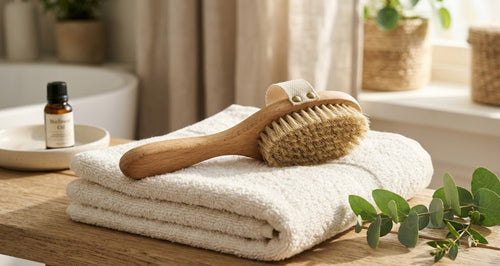
Dry brushing consists of massaging the skin with a natural bristle brush, from the feet up the body, before showering. It stimulates circulation and lymph, and smooths the skin's surface. It does not make cellulite disappear, but it complements physical activity and palper-rouler well. We explain the technique in our article on dry brushing.
Cellulite FAQ
Can cellulite be completely eliminated?
No, let's be honest: in the vast majority of cases, cellulite cannot be completely eliminated, because it is due to the very structure of female adipose tissue and the hormonal predisposition. Its appearance can be modestly reduced with a good lifestyle, but aiming for complete disappearance is unrealistic and a source of frustration. The healthiest thing is to seek to feel good and fit, rather than to erase a normal body trait.
Are anti-cellulite creams effective?
Their effectiveness is very limited. Creams, even with caffeine, mainly offer a temporary visual smoothing due to skin hydration, and the effect disappears when you stop using them. They do not treat cellulite deeply. There is nothing stopping you from using them for the pleasure of a moisturizing treatment, but without expecting a lasting result. Your money will often be better invested in physical activity, which has a real and lasting effect.
Does exercise make cellulite disappear?
Exercise does not make it disappear, but it is the most effective approach to reduce it. By combining cardio (circulation) and muscle strengthening (which densifies the muscle under the skin and "tightens" the surface), the dimpled appearance visibly improves. The goal is not to lose weight at all costs but to build muscle and move. It is beneficial for cellulite, and above all for your overall health, energy, and morale.
Is palper-rouler really effective?
Yes, but temporarily. Firm massages and palper-rouler (or endermology) stimulate circulation and soften the tissues, improving the appearance of the skin in the moment. However, the effect fades if you stop the sessions. It is therefore a pleasant comfort treatment to incorporate regularly, not a permanent solution. Consider it an extra, complementing a good lifestyle.
Does intermittent fasting help with cellulite?
There is no evidence that intermittent fasting specifically targets cellulite. It can fit into a lifestyle for some people, but it is not suitable for everyone and is not an anti-cellulite solution in itself. Above all, avoid making it a tool for severe restriction: muscle loss worsens the appearance of cellulite. If you wish to try fasting, do it in a supervised way and never with a logic of deprivation.
Should you stop taking the pill because of cellulite?
No, you should not stop contraception for an aesthetic reason. While hormones play a role in cellulite, stopping the pill is not a validated anti-cellulite strategy, and it would probably have only a marginal, if not zero, effect. Any decision regarding your contraception must be made with your doctor or gynecologist, for good medical and personal reasons, never on an aesthetic whim.
Can thin women have cellulite?
Yes, absolutely, and it is very common. Cellulite is not a matter of weight but of adipose tissue structure and hormonal predisposition. Very thin and athletic women have it, just like women with fuller figures. This is precisely why it is futile to believe that "losing weight is enough" to eliminate it. Cellulite is part of the normal morphology of the vast majority of women.
Is cellulite a health problem?
No. Cellulite is a normal morphological trait, not a disease or a sign of poor health. It requires no medical treatment. The only vigilance to have: if you notice unusual pain, asymmetrical swelling, a sudden skin change, or sudden and painful dimpling, consult to rule out another cause. Otherwise, cellulite is simply a skin texture, to be welcomed with compassion.
Gentleness toward yourself, rather than the pursuit of perfection
Let's recap honestly and compassionately. Cellulite affects around 90% of women: it is a normal trait, linked to anatomy and hormones, not a disease or a fault. Its appearance can be modestly reduced thanks to four real approaches: combined physical activity (the most effective), hydration and movement, an anti-inflammatory diet without restriction, and firm massages (temporary effect). However, miracle creams, "detox" supplements, and extreme diets are mostly false promises, sometimes counterproductive. But the essential message goes beyond aesthetics: aiming for perfectly smooth skin is illusory and can cost a great deal in distress. Taking care of your body for your health and energy, yes; judging yourself for a perfectly normal skin texture, no. Let's remember: this content is educational and does not replace medical advice.