Pink residue in the shower: what is it and how to remove it
You must have noticed it before: this pinkish, sometimes orange film that settles at the bottom of the shower curtain, in the tile grout, around the drain, or around the faucet. The reflex is to assume it is soap residue or a tinted limescale deposit and to scrub it. But the truth is more surprising: this pink deposit is not a mineral, nor an inert residue. It is alive. It is a bacterial colony, more precisely a bacterium with the scientific name Serratia marcescens. Understanding what it is, why it settles, and how to eliminate it naturally and for the long term means turning a cleaning chore into a real environmental hygiene approach. Follow the guide.
What is this infamous pink deposit? (The scientific reality)
The soap residue myth
The most widespread misconception is that this pink deposit is a mixture of shower gel and shampoo residues and minerals from hard water. This is false. If you scrub it and it tirelessly returns to the same place in a few days, it is precisely because it is not an inert deposit that would passively accumulate, but a living organism that multiplies. Soap and residues play a role, but not the one we think: they do not form the deposit, they feed it. The pink deposit, meanwhile, is a bacterial colony in full proliferation.
Meet Serratia marcescens
The culprit of this coloration is Serratia marcescens, an extremely widespread bacterium in the environment (water, soil, damp surfaces). Its visual signature comes from a red-pink pigment it produces under certain conditions, prodigiosin. This pigment production is notably favored by moderate temperatures (around 25-30°C (77-86°F)) and the presence of light and oxygen, exactly the conditions of a bathroom. The molecular analysis of shower curtain biofilms conducted by Kelley et al. (2004), published in Applied and Environmental Microbiology, confirmed the frequent presence of this type of microorganism in these domestic environments. What you see is therefore not dirt in the classic sense: it is an organized microbial community.
The biology of biofilm: why does it take over our bathrooms?

The ideal conditions for proliferation
If Serratia marcescens loves our bathrooms, it is because it finds a perfect cocktail there. It does not live in isolated cells but organizes itself into a biofilm: a protective and slimy matrix that bacteria secrete to adhere to surfaces and protect themselves. This biofilm is the key to their resistance, it protects them from attacks and explains why a simple wipe with a sponge is not enough. Three factors feed this proliferation: constant heat and humidity (repeated hot showers), stagnant water (grout, curtain folds, damp bottoms), and abundant nutrients, the lipids from soaps and shampoos, as well as skin flakes and hair. The work of Feazel et al. (2009), published in PNAS, also showed how much the biofilms of showerheads concentrate opportunistic microorganisms.
The unsuspected hiding places
The shower curtain is only the visible part. Serratia marcescens and biofilms nestle in a multitude of damp places that are often neglected: the silicone joints of the tiles and bathtub, the perimeter and inside of faucets, the showerhead, but also places that we do not spontaneously associate with the bathroom, the bottom of the toothbrush glass, the base of the toothbrush, and even the pet water bowl. All these points share the same characteristics: persistent humidity, gentle heat, and organic residues. This is why a global hygiene approach of the damp environment is much more effective than treating only the curtain.
Want an opinion on your situation? During a vitality assessment, we review together your diet, your sleep, your stress, and your goals, then we build a plan adapted to your pace.
What are the health risks? (The preventive approach)
An opportunistic bacterium
Should we panic? No. Serratia marcescens is qualified as an opportunistic bacterium, and this term is essential to understand. This means that, for the vast majority of healthy people with a robust immune system, its presence in the bathroom does not represent a daily danger. It takes advantage of opportunities, a weakened immunity, an entry point, to become problematic, but does not attack a healthy and intact organism. Its presence is therefore above all a signal of environmental hygiene to be corrected, not an immediate health threat for most households. There is no need to give in to worry: it is about understanding and acting, not alarming.
The at-risk profiles
That said, vigilance is required for certain profiles. As detailed by Mahlen's (2011) review in Clinical Microbiology Reviews, Serratia marcescens can be involved in infections in vulnerable people. The profiles to watch are: immunocompromised people (heavy treatments, chronic pathologies), infants, frail elderly people, as well as anyone presenting an open wound in contact with the contaminated area. Contact lens wearers must be particularly attentive, because the bacterium can be involved in eye infections if lens hygiene is neglected in a contaminated environment. In these situations, or in case of signs of infection (redness, pain, discharge), a doctor's opinion is necessary.
The natural eradication protocol

Good news: no need for harsh chemicals. The effective strategy relies on three complementary actions that attack both the bacterium and its living conditions.
| Action | Means | Effect on biofilm |
|---|---|---|
| Chemical (natural) | White vinegar (acetic acid) | Lowers the pH and dislocates the biofilm matrix |
| Thermal | Washing at 60°C (140°F) (curtain, textiles) | Destroys bacteria with heat |
| Mechanical | Daily ventilation and drying | Removes the humidity the bacterium needs |
1. The natural chemical action: acetic acid
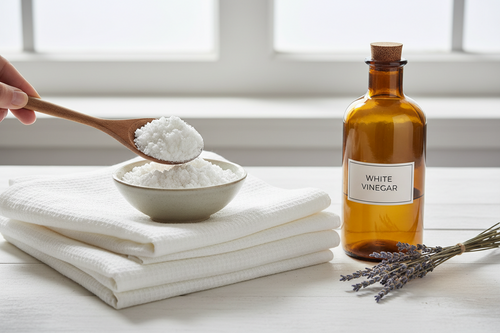
We often think of bleach by reflex. It is a false good idea: bleach whitens the pink coloration and disinfects the surface, which gives an illusion of cleanliness, but it acts poorly on the deep biofilm matrix, if the biofilm and humidity remain, the colony quickly starts again. White vinegar is more relevant here in a natural logic: its acetic acid lowers the pH and helps to dislocate the slimy matrix that protects the bacteria. In practice: spray pure white vinegar on the affected areas, leave to work for 15 to 30 minutes, then scrub with a brush and rinse. The mechanical action of scrubbing is essential to physically detach the biofilm.
2. The thermal action: washing at 60°C (140°F)
Heat is the enemy of the vegetative forms of the bacterium. For fabric shower curtains and bathroom textiles (bath mats, washcloths), a machine wash at 60°C (140°F) once a month effectively destroys established colonies, this is the principle of the thermal death point, the temperature at which bacteria do not survive. Simply check that the textile can withstand this temperature (most polyester curtains and cotton bath mats can tolerate it). For plastic curtains, cleaning with vinegar is preferable.
3. The mechanical action: drying
It is the simplest and most powerful weapon, because it is preventive. Serratia marcescens needs constant humidity to survive: deprive it of water, and it can no longer proliferate. Three daily gestures are enough: ventilate the bathroom for at least 15 minutes after each shower (window or mechanical ventilation), spread the shower curtain so that it dries flat rather than leaving it folded and damp, and pass a squeegee or a cloth over the walls and areas that retain water. A dry environment is an environment where the biofilm simply cannot settle.
The anti-pink deposit protocol in summary 1. Spray pure white vinegar, leave to work for 15-30 min, scrub and rinse. 2. Wash curtain and textiles in the machine at 60°C (140°F) once a month (or vinegar for plastic). 3. Ventilate for 15 min after each shower, spread the curtain, pass a squeegee over the walls. The regularity of daily drying is what prevents the deposit from coming back over the long term.
Our health begins with our environment
This little pink deposit teaches us a valuable lesson: our health is not only played out on our plate, but also in the invisible ecosystem of our home. Understanding that our interiors are populated by microorganisms, knowing which are harmless and which deserve vigilance, choosing gentle solutions (vinegar, heat, dry air) rather than saturating our environment with harsh chemicals: that is a coherent approach with a global vision of well-being. Reducing our exposure to everyday toxic substances is the whole spirit of our approach, which we also develop in our article on the reduction of the toxic load of our environment. Taking care of your home is taking care of yourself.
Want to relearn how to take care of yourself and your environment daily, with tailor-made support? Join Le Terrier's personalized follow-up for ten euros a month: concrete advice for a healthier lifestyle, from the plate to the home, adjusted to your daily life.
FAQ on the pink bathroom deposit
Is the pink deposit in the shower dangerous?
For the vast majority of healthy people, no. The pink deposit is due to Serratia marcescens, an opportunistic bacterium that generally does not pose a problem to a robust immune system. Its presence is above all a hygiene signal to be corrected. Vigilance is however required for immunocompromised people, infants, contact lens wearers and in case of an open wound. In case of signs of infection, consult a doctor.
What is the Serratia marcescens bacterium?
Serratia marcescens is a bacterium very widespread in the environment (water, soil, damp surfaces). Under certain temperature and light conditions, it produces a red-pink pigment called prodigiosin, which gives its characteristic color to the deposit. It organizes itself into a biofilm, a protective matrix that makes it resistant to simple cleaning. It is an opportunistic bacterium, harmless for most healthy people.
Why does the pink deposit always return after cleaning?
Because it is a living organism that multiplies, and not an inert deposit. If you only clean the surface without destroying the biofilm deeply or removing the humidity that feeds it, the colony reforms in a few days. The key to a lasting elimination is to combine the three actions: dislocate the biofilm (vinegar + scrubbing), destroy the bacteria (heat at 60°C (140°F)) and above all dry out the environment daily.
Is white vinegar effective against the pink deposit?
Yes. The acetic acid of white vinegar lowers the pH and helps to dislocate the slimy matrix of the biofilm that protects the bacteria. Spray pure white vinegar on the affected areas, leave to work for 15 to 30 minutes, then scrub with a brush and rinse. Mechanical scrubbing is essential to physically detach the biofilm. It is an effective natural alternative to harsh chemicals.
Why is bleach not the best solution?
Bleach whitens the pink coloration and disinfects the surface, which gives an illusion of cleanliness, but it acts poorly on the deep biofilm matrix. If the biofilm and humidity remain, the colony quickly starts again. Moreover, it is a harsh chemical for the respiratory tract and the environment. White vinegar associated with scrubbing and drying is a gentler and more lasting approach.
At what temperature should the shower curtain be washed?
A wash at 60°C (140°F) once a month effectively destroys the bacterial colonies established on fabric curtains and bathroom textiles (mats, washcloths). It is the temperature beyond which the vegetative forms of the bacterium do not survive. Check that the textile can withstand this temperature. For plastic curtains that do not go in the machine, a cleaning with white vinegar is preferable.
How to prevent the pink deposit from returning?
Prevention relies on drying, because the bacterium needs constant humidity to survive. Ventilate the bathroom for at least 15 minutes after each shower, spread the curtain so that it dries flat (never folded and damp), pass a squeegee over the walls and wipe the areas that retain water. A regularly dried environment prevents the biofilm from settling. It is the most effective preventive gesture.
Can the pink deposit appear elsewhere than in the shower?
Yes, everywhere where humidity, gentle heat and organic residues reign: tile joints, faucet perimeters, showerhead, but also the bottom of the toothbrush glass, the base of the toothbrush, and even the pet water bowl. Toilet bowls and soap dishes are also concerned. A global hygiene of the damp points of the home is more effective than treating only the shower curtain.
Understanding rather than disinfecting blindly
The pink deposit of the shower is neither inevitable, nor a threat to fear, nor a mystery: it is a colony of Serratia marcescens that takes advantage of the humidity, the heat and the residues of our bathroom to settle in biofilm. Understanding it changes everything, because we stop scrubbing in vain to act on the real causes: dislocate the biofilm with vinegar, destroy the bacteria with heat, and above all dry out the environment daily. This gentle approach, without harsh chemicals, perfectly illustrates our philosophy: the best hygiene is born from the understanding of ecosystems, not from permanent chemical warfare. Finally, let us remember that, for fragile people or in case of signs of infection, the opinion of a health professional remains indispensable.