Pink ham and nitrites: risks and how to choose your cold cuts wisely
Share
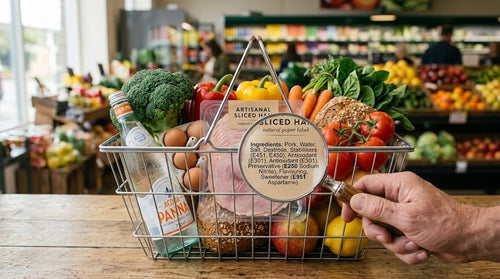
Why is your ham pink? The answer can be summed up in one code: E250.
Behind the bubblegum pink color of your supermarket ham slice lies an additive whose health effects have been debated for years. Let's take stock of sodium nitrite (E250): what it does, what health authorities say, and how to limit exposure.
The chemistry of danger: from nitrite to nitrosamine
To understand the problem, you have to forget marketing and look at biochemistry. Sodium nitrite (E250) is used for three reasons: it protects meat against certain dangerous bacteria (including botulism), it gives it its pink color, and it provides the typical charcuterie flavor.
The real danger lies not only in the nitrite itself, but in what it becomes once it enters your body.
The "toxic cascade":
When you swallow nitrite-cured ham, nitrites encounter two elements in your stomach:
-
Gastric acidity.
-
Amines (the natural components of meat proteins).
This encounter creates a chemical reaction that gives rise to Nitrosamines.
In 2015, the IARC (International Agency for Research on Cancer, attached to the WHO) classified processed meat, including charcuterie, as "carcinogenic to humans" (group 1), due to its link with colorectal cancer. Nitrites ingested under conditions that promote the formation of nitrosamines are themselves classified as "probably carcinogenic" (group 2A).
This classification indicates the strength of the evidence, not the extent of the risk: eating ham is not as dangerous as smoking. But the signal is serious. In 2022, Anses confirmed the association between exposure to nitrites and nitrates and the risk of colorectal cancer, and recommended reducing this exposure, particularly from charcuterie.
An alert dating back to the 1960s
In the 1960s, in Norway, sheep fed with nitrite-preserved herring meal developed severe liver damage. Researchers understood that nitrites had reacted with the fish proteins to form nitrosamines, which were highly toxic to the animals' livers. This observation launched decades of research on these compounds.
Since then, the doses of nitrites allowed in charcuterie have been regulated and lowered, but these additives remain authorized. In France, associations and organizations such as the Ligue contre le cancer, Foodwatch, or Yuka are calling for their ban, and public authorities have launched a reduction plan.
Practical guide: how to protect yourself daily?
Here are some simple guidelines for choosing your charcuterie and limiting exposure.
1. Learn to recognize "real" ham
Naturally cooked ham (without nitrites) is never pink. It is grayish, beige, or light brown, like the color of a roast pork you would cook in the oven.
-
The visual cue: bright pink almost always indicates the presence of nitrites (added or plant-based). Beige or grayish ham is a good sign.
2. Spot the deceptions on labels
Some claims can be misleading:
-
"No artificial preservatives": sometimes, they use celery juice or fermented vegetable juices. The problem? These juices are naturally saturated with nitrates that turn into nitrites during the process. The label looks more natural, but the result in the meat is similar.
-
Look for the strict wording: "No nitrite salts" or "Preserved without nitrites".
3. The vitamin C defense (the backup trick)
If you cannot avoid classic charcuterie (at a restaurant or at a friend's house), use science to your advantage.
-
The mechanism: antioxidants, such as Vitamin C, block the chemical reaction between nitrites and proteins in your stomach, thus preventing part of the formation of nitrosamines.
-
The action: always pair your charcuterie with a citrus fruit, raw peppers, or a generous portion of green vegetables.
Structure of a healthy choice (comparison table)
| Product | Color | Additive | Risk |
| Industrial Ham | Bubblegum pink | E250 / E252 | High (Nitrosamines) |
| Parma Ham | Dark red / Gray | Sea salt only | Very low |
| "No-Nitrite" Ham | Gray / Beige | None | Lower (charcuterie should still be limited) |
Want daily support? Le Terrier's personalized follow-up, at €10 per month, allows you to ask us questions in writing and move at your own pace.
FAQ: everything you need to know about nitrites and ham
1. Why is industrial ham pink?
Ham is pink because of the addition of sodium nitrite (E250). Without this additive, cooked pork takes on a natural gray or beige color, similar to that of homemade roast pork.
2. What exactly is E250?
E250 is the European code for sodium nitrite. It is a chemical preserving agent used to fix the color, extend shelf life, and prevent botulism.
3. Why are nitrosamines dangerous?
Nitrosamines form in the stomach when nitrites encounter meat proteins. The IARC classifies processed meat as carcinogenic to humans (group 1) and nitrites ingested under these conditions as probably carcinogenic (group 2A), mainly in connection with colorectal cancer.
4. Is "no-preservative" ham with celery juice safe?
Not necessarily. Celery juice is naturally rich in nitrates, which turn into nitrites during the manufacturing process. The health effect is often identical to classic E250.
5. How to recognize real no-nitrite ham?
Rely on the color: it should be gray or light brown. Also check the label: it should mention "no nitrite salts" and not just "no artificial preservatives".
6. Does Parma ham contain nitrites?
Real Parma ham benefits from an exemption and strict specifications: it is aged only with sea salt, without any added nitrite or nitrate.
7. Does vitamin C really block the danger?
Yes, partially. Antioxidants such as vitamin C (ascorbic acid) prevent the chemical reaction that forms nitrosamines in the stomach. It is a good reflex if you consume pink ham, without completely eliminating the risk.
8. How much charcuterie can you eat without risk?
Health authorities recommend not exceeding 150g of charcuterie per week (about 3 slices of ham) to limit the risk of colorectal cancer.