Cold-sensitive teeth: how to naturally remineralize your enamel?
Share
You know the feeling. You bite into an ice cream or take a sip of ice-cold water, and suddenly... BAM. An electric shock shoots through your jaw, instantly killing your desire to finish your dessert.
If you live with this tooth pain every day, your first instinct is often to panic, thinking of a deep cavity. Yet, in some cases, your teeth may be perfectly healthy... they're just "exposed." What you're feeling is tooth sensitivity, a warning signal sent by your body to tell you that your natural shield is thinning.
The good news: enamel is not a dead structure. With the right materials and an understanding of oral biology, it is possible to "reseal" these breaches. Here is why teeth become sensitive, and how remineralization can help restore comfort.
The anatomy of a sensitive tooth: what is enamel erosion?
To understand why the cold hurts so much, you have to look beneath the surface. Imagine your tooth as a castle.
The shield: enamel
The outer layer, the enamel, is the hardest substance in the entire human body (yes, harder than your bones!). Its role is simple: to protect the living parts of the tooth from thermal and bacterial attacks.
The porous layer: dentin
Hidden beneath this shield is the dentin. Unlike enamel, dentin is not solid. It is traversed by thousands of micro-channels called dentinal tubules. These small tunnels connect the outside of the tooth directly to the dental nerve located in the center (the pulp).
The mechanism of the "shock"
When enamel wears down or thins, these tubules become exposed, like pipes left out in the open. When they come into contact with cold or heat, the fluid circulating inside these tunnels moves abruptly. This fluid movement excites the nerve receptors at the base of the tooth. The result: you feel that famous electric shock.
Did you know? A sensitive tooth is often a tooth whose "doors" (the tubules) have remained open. Our goal will be to close them.
The 3 culprits of tooth sensitivity
Why does your enamel eventually wear away? It is rarely due to a single event, but rather to a combination of daily mistakes that we almost all make.
A. Acid erosion (the invisible enemy)
Every time you eat or drink something acidic (sodas, orange juice, wine, or even certain fruits), the oral pH drops. Below a pH of 5.5, enamel begins to demineralize: it becomes soft and porous. If you snack all day, your saliva never has time to neutralize this acidity, and your enamel eventually slowly dissolves.
B. Mechanical abrasion: "traumatic" brushing
It is a paradox: you want to do the right thing by brushing your teeth vigorously, but you are making the problem worse. Using a hard-bristled toothbrush or applying too much pressure (especially with a back-and-forth horizontal motion) acts like sandpaper. On enamel already softened by acidity, you are "sawing" away at the base of your teeth.
C. The "timing" factor
The most common mistake is brushing your teeth immediately after a meal. At that moment, your enamel is at its most fragile state because of the acidity of the food. By brushing right away, you are brushing your enamel itself instead of brushing the dental plaque. You must always give saliva at least 30 minutes to do its protective work before taking out the brush.
The natural remineralization protocol: the right materials
Once we have identified the aggressors, it is time to move on to the reconstruction phase. Contrary to popular belief, enamel can be supported and "strengthened" if you provide it with the basic building blocks it needs.
Hydroxyapatite: the biological "plaster" for your teeth
This is the major revelation of recent years in natural dentistry. Hydroxyapatite is the mineral that naturally makes up 97% of your enamel.
-
How does it work? In the form of microparticles in a toothpaste, hydroxyapatite settles directly into the exposed dentinal tubules.
-
The "filling" effect: it acts as a biological plaster, physically sealing the openings to the nerve. Studies show that it is as effective, if not more so, than conventional treatments for reducing hypersensitivity, while being perfectly biomimetic.
Saliva: your free remineralization laboratory
Your body has its own repair system: saliva. It is naturally loaded with calcium and phosphate, the minerals necessary for tooth hardness.
-
The key point: for saliva to be able to deposit these minerals, the oral pH must be neutral. By spacing out your meals by at least 3 hours, you allow your saliva to saturate the enamel and "repair" the micro-wear of the day.
Choosing a toothbrush: softness above all
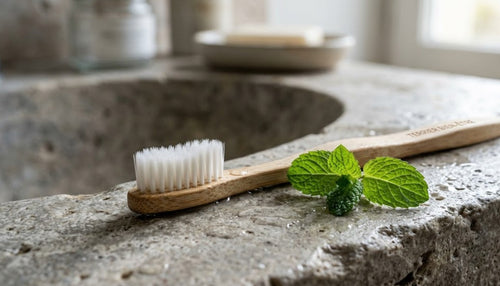
Switching to an extra-soft (or surgical) toothbrush is the simplest and most radical step. The soft bristles hug the shape of the tooth and clean the dental plaque without scratching the softened enamel. It is the best way to immediately stop mechanical abrasion.
3 daily tips for a resilient smile
To go further than simple brushing, here are three naturopathic habits that will make a major difference in the long term:
-
The 30-minute rule: after consuming an acidic food (coffee, vinaigrette, fruit), do not brush your teeth. Simply rinse your mouth with clear water to neutralize the acidity and wait half an hour for the enamel to harden again under the action of saliva.
-
Breathe through your nose: mouth breathing (sleeping with your mouth open) dries out the tissues. Without saliva to protect your teeth during the night, acidity rises and enamel demineralizes faster. A hydrated mouth is a protected mouth.
-
Focus on minerals: your dental health is also played out on your plate. Consume foods rich in magnesium, silica, and vitamin K2 (grass-fed butter, green vegetables, almonds). These nutrients guide calcium toward the teeth and bones instead of letting it circulate unnecessarily in the blood.
Regaining control over sensitivity
Tooth sensitivity is not an inevitability you have to learn to live with. By understanding that your teeth are living and porous structures, you realize that every action counts: from the choice of your toothpaste with hydroxyapatite to the timing of your brushing.
By restoring the ideal conditions to your mouth - a stable pH, mineral-rich saliva, and gentle cleaning tools - you allow your enamel to regain its role as a shield. No more electric shocks, make way for a calm and resilient smile.
Want to go further? Read our article on cavities, in which cases they can regress naturally or not, and our remineralizing toothpaste recipe. And if you would like complete naturopathic follow-up, feel free to book your first consultation.
Want daily support? Le Terrier's personalized follow-up, at €10 per month, allows you to ask us questions in writing and move at your own pace.