Children's plastic shoes: heat, components and alternatives
Share
Reading time: 10 minutes
Summer is approaching, temperatures are rising, and with them come those little colorful plastic foam shoes, ubiquitous on beaches, in parks, and by the pool. Practical, easy to wash in a flash, easy to slip on... They seem to be the perfect ally for busy parents.
Yet, from the perspective of toxicology and environmental health, these summer shoes hide an alarming biochemical reality.
After deepening my knowledge of environmental toxicology, my position is clear: I will never let my children wear this type of foam shoes all summer again. And after reading this article, you will understand why.
What most parents don't know is that the combination of summer heat, sweat, and these synthetic materials creates an effective toxic cocktail. Discover why science and health authorities point to certain components of these plastics, how your children's skin absorbs these toxins, and what the best natural alternatives are to protect their developing hormonal system.
The truth about EVA foam: a petrochemical derivative under your feet
The vast majority of "foam" shoes or colorful beach clogs are not made of natural rubber, but of Ethylene-Vinyl Acetate (EVA). It is a synthetic copolymer, a direct derivative of the petrochemical industry.
While this material may seem inert in its raw state and at controlled laboratory temperatures, its behavior changes radically when subjected to real summer conditions: direct sunlight, burning sand, white-hot asphalt.
The phenomenon of chemical off-gassing: formamide and VOCs
The major danger of EVA foam lies in its manufacturing process and in the additives used to make it flexible, lightweight, and airy.
One of the most commonly used blowing agents is formamide, a chemical substance classified as toxic for reproduction (reprotoxic category 1B) by the European Union.
The French Agency for Food, Environmental and Occupational Health and Safety (ANSES) has conducted in-depth investigations into EVA foam objects, notably the famous baby puzzle mats. Their work, which focused mainly on these puzzle mats, shows that such foams can emit volatile organic compounds (VOCs), including formamide. Shoes have not been assessed in the same way.
What is off-gassing?
Off-gassing (also called outgassing) is the physical phenomenon by which a solid material releases gas molecules trapped in its structure. This process is considerably exacerbated by heat.
The mechanism in summer conditions:
- The foam shoe remains in the sun (on the sand, asphalt, or by the pool)
- The material's temperature can reach 50-70°C (122-158°F) in the middle of summer
- Heat acts as a chemical catalyst
- The plastic releases its volatile components: formamide, residual solvents, phthalates
- These substances end up in the immediate air and on the surface of the material in direct contact with the skin
The illusion of "practicality" versus the precautionary principle
The industry highlights the durability, low price, and ease of maintenance of these shoes. "They dry quickly," "they wash with water," "they are lightweight"... These marketing arguments mask a worrying biological reality.
The problem with phthalates:
Phthalates are chemical substances used as plasticizers to soften certain types of polymer plastics often mixed with EVA. Contrary to what one might think, these molecules are not chemically bonded to the plastic matrix.
The consequence: they easily migrate out of the product, particularly under the effect of heat and humidity (sweat).
Given the hormonal health of our children in full development, the "practical" and washable side of a shoe should never take precedence over biological safety. It is a matter of applying the precautionary principle.
Biomechanics and toxicology: why the child's foot is a sponge
If the off-gassing of the shoe is already problematic in itself, it is the very physiology of the sole of the foot that transforms this contact into a toxic intrusion into your child's body.
Sweat glands and percutaneous absorption
The sole of our feet is an anatomical marvel, but also a unique area of vulnerability:
- It is one of the most richly innervated areas of the human body
- It has the highest concentration of eccrine sweat glands: more than 600 per square centimeter
- The pores there are particularly wide and reactive to temperature
The typical summer scenario:
In summer, enclosed in a non-breathable plastic clog, the child's foot:
- Heats up quickly (greenhouse effect of the plastic)
- Sweats abundantly (normal thermoregulatory response)
- Local humidity and heat cause vasodilation (dilation of blood vessels)
- The skin pores open to the maximum
It is precisely at this moment that percutaneous absorption (or "dermal uptake" in the scientific literature) occurs.
What science says:
Studies published in the Journal of Exposure Science & Environmental Epidemiology suggest that the skin, especially when it is damp and warm, can let some chemical compounds through.
A small share of the volatile compounds, residual solvents, or phthalates a hot shoe may release can cross the skin barrier (the stratum corneum) and enter the body. How much is actually absorbed depends on the product and contact time, and is not well documented for shoes.
Essential point: this route of skin absorption bypasses the protective hepatic filter of digestion. Substances absorbed this way do not go through the liver first, as they would after being swallowed, which is why researchers pay attention to this route of exposure.
The impact of endocrine disruptors on development (WHO)
What do these substances do once in the bloodstream? Many of these petrochemical compounds (phthalates, potential bisphenols, formamide, and its metabolites) are recognized or strongly suspected of being endocrine disruptors.
WHO definition:
An endocrine disruptor is a chemical substance of external origin to the body that mimics, blocks, or alters the action of the body's natural hormones.
The World Health Organization (WHO) regularly warns about early exposure to these molecules, particularly during childhood.
Why are children more vulnerable?
In a growing child, development is dictated by fragile hormonal balances:
- Thyroid hormones: regulate metabolism and brain development
- Growth hormone: drives bone and muscle growth
- Steroid hormones: influence future sexual development
The impact of chronic exposure (wearing these shoes for several hours a day, every day, all summer) can have invisible but lasting repercussions on:
- Neurological development
- Energy metabolism
- Maturation of the reproductive system
- Thyroid function
Take back control of your family's environment. Do you feel lost in the face of the omnipresence of toxins in our daily lives? Do you want clear protocols to detoxify your children's bedroom, diet, and environment? Join our private health support for only €10 per month. Get personalized follow-up and targeted advice in environmental health and naturopathy.
The alternatives guide: how to choose healthy shoes for your children?
Fortunately, it is entirely possible to combine summer comfort and toxicological safety. Natural alternatives exist, they protect your children's hormonal system, and some are even better for the development of their foot arches.
Comparative table of children's shoe materials
| Material | Safety Level | Breathability | Arch Impact | Price |
|---|---|---|---|---|
| EVA Foam / Plastic | Dangerous (VOC Off-gassing) | None (maceration) | Bad (too soft) | € |
| Natural Cork | Excellent | Very good (thermoregulator) | Excellent (fits the foot) | €€ |
| Vegetable-tanned Leather | Excellent | Good | Very good | €€€ |
| 100% Natural Rubber (Hevea) | Good (ideal for water/pool) | Average | Good | €€ |
| Barefoot | The ultimate | Maximum | Biomechanical perfection | Free. |
The naturopath's recommendations
For the beach and the pool:
Opt for sandals with soles made of real cork or 100% natural rubber (from hevea). These materials do not emit VOCs in heat and offer good grip on wet surfaces.
For the park and walks:
Small sandals in vegetable-tanned leather (without heavy metals or chrome) are ideal. Leather breathes naturally, adapts to the shape of the foot, and does not cause maceration.
The absolute golden rule:
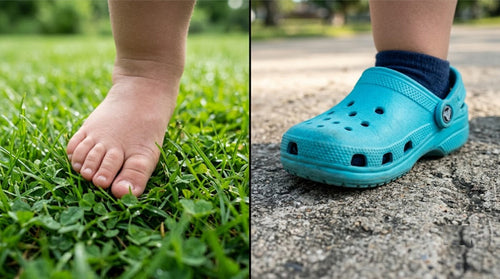
As soon as the environment allows it (clean grass, fine sand, garden lawn), let them walk barefoot.
It is the healthiest and most natural way to:
- Stimulate their neurological receptors (proprioception)
- Strengthen their developing foot arches
- Promote good postural development
- Allow a direct connection with nature (grounding/earthing)
How to recognize a healthy shoe?
Check these points before buying:
- Sole material: Cork, leather, or natural rubber (no EVA foam)
- Odor: A shoe that "smells like new plastic" = red flag (VOCs)
- Certification: OEKO-TEX, GOTS labels, or "phthalate-free" mention
- Leather tanning: Favor vegetable tanning (without chrome or heavy metals)
- Origin: European manufacturing imposes stricter standards
Want an opinion on your situation? During a vitality assessment, we review together your diet, sleep, stress, and goals, then build a plan adapted to your pace.
Protecting the metabolic terrain: a global health approach
Environmental hygiene does not stop at shoes. It is a global approach that consists of reducing the "toxic load" (the famous cocktail effect) that your child's body must manage daily.
The cocktail effect: the sum of small exposures
Each individual exposure (plastic shoes, conventional cosmetics, synthetic clothing, plastic toys, ultra-processed food) may seem "acceptable" according to regulatory standards.
But the child's body must manage the sum of all these exposures simultaneously. This is the cocktail effect, and this is precisely what regulatory studies do not measure.
Lighten the work of the elimination organs
The liver, the kidneys, and the lymphatic system of children already work hard to process the toxins from our modern environment. By eliminating direct and avoidable sources of exposure, you lighten their metabolism.
Concrete actions:
- Eliminate plastic foam shoes
- Avoid conventional cosmetics (favor natural/organic)
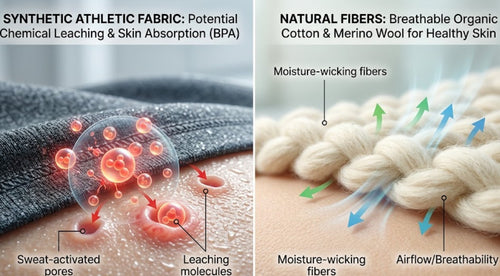
- Limit 100% synthetic clothing in direct contact with the skin
- Reduce soft plastic toys (favor wood, organic fabric)
- Ventilate bedrooms daily (VOC evacuation)
- Favor whole, organic food
The parent's role: protector of the environment
Your role as a parent is not to create a sterile bubble (impossible and counterproductive), but to intelligently reduce the most important and avoidable toxic exposures.
Plastic shoes heated by the sun, worn for hours every day all summer, represent a chronic, direct, and perfectly avoidable exposure. This is exactly the type of source to eliminate as a priority.
Precautions: what this article is not
This article falls under environmental and preventive health education. It is not medical advice and does not claim to diagnose or treat any pathology.
The goal is simple: to inform you about the biochemical and physiological mechanisms at play to allow you to make informed choices regarding your children's environment.
If you notice worrying symptoms in your child (skin reactions, suspected hormonal disorders, developmental delay), you must consult a doctor or pediatrician.
Is "practical" really worth it?
The question is asked directly: does the "practical" and washable side of a plastic foam shoe justify exposing your children's hormonal system to a cocktail of endocrine disruptors all summer?
The answer, from the perspective of environmental health and toxicology, is no.
Summary of actions to implement:
- Eliminate EVA/plastic foam shoes from the summer wardrobe
- Favor cork, natural rubber, or vegetable-tanned leather for sandals
- Let them walk barefoot as soon as the environment allows
- Never let plastic shoes heat up in the sun
- Apply the precautionary principle regarding petrochemical materials
- Inform other parents in your circle
Your role is to protect their environment to let their body grow healthily. The alternatives exist, they are accessible, and your children do not need "laboratory chemistry" to enjoy their summer.
Take care of them, naturally.