Microplastics: how to reduce your daily exposure (10 tips)
A study published in 2024 in PNAS caused quite a stir: using a new imaging technique, researchers estimated that one liter of bottled water contains around 240,000 plastic particles, the vast majority of which are nanoplastics. This is certainly enough to make us wonder, without panicking. Because we need to be clear from the outset, and this is the most important message of this article: we do not currently know how to "eliminate" microplastics already present in the body. No method, program, or supplement has demonstrated this. However, there are many simple, practical, and well-documented steps to reduce intake. And these are perfectly within your reach. Here are ten habits to adopt at your own pace, without guilt.
Understanding micro- and nanoplastics

Where do these invisible particles come from?
Microplastics (less than 5 mm) and nanoplastics (a thousand times smaller still) come mainly from the slow degradation of plastics: packaging, bottles, synthetic textiles, tires, paints. They are found in water, food, and the air inside our homes. Research has even detected plastic particles in human blood (Leslie et al., 2022), proving that they cross our biological barriers. We explain this finding in detail in our article on nanoplastics in bottled water.
What impact do they have on health and hormones?
Two distinct issues overlap, and it is useful to separate them. On the one hand, the particles themselves, whose long-term effects on the human body remain largely unknown. On the other, the chemical molecules associated with plastics, such as bisphenol A (BPA) and certain phthalates, which are better known: they are endocrine disruptors, capable of interfering with our hormones by mimicking or blocking their action. This is, in fact, why BPA was banned in food containers in France.
Let's keep a cool head, this is essential: the impressive figures (240,000 particles per liter, billions of particles released...) count particles, which does not indicate a level of risk in any way. To date, the health effects of chronic exposure to micro- and nanoplastics in humans have not been established: research is very active, but conclusions are still lacking. We are therefore neither in denial nor in a state of catastrophe: we are applying a reasonable precautionary principle. Reducing exposure is logical and has no downside, but there is no need to live in fear. For how to read this type of study, see our article on the reliability of scientific studies.
5 dietary habits
1. Give up plastic bottles This is the step with the best effort/benefit ratio. A stainless steel or glass water bottle instantly eliminates a major daily source of exposure, while also being more economical and eco-friendly. Avoid leaving plastic bottles in the sun or in a hot car: heat significantly promotes the migration of compounds.
2. Filter your tap water Reverse osmosis is the most effective home process: its very fine membranes retain almost all particles, including the smallest. Let's be honest that the rates often cited (99.9%) come mainly from industrial data, and that performance varies depending on the installations and their maintenance. It remains, however, the best technical option available for those who wish to invest.
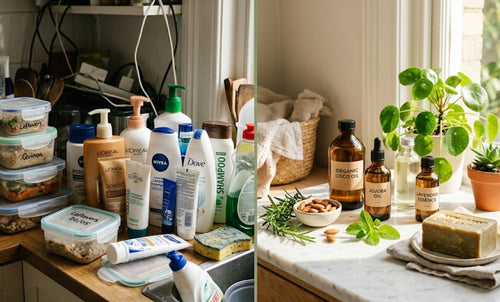
3. Never heat food in plastic This is probably the most cost-effective habit after the water bottle. Heat greatly increases the release of particles and compounds from plastic containers (Hussain et al., 2023). So: no reheating food in the microwave in a plastic container (even one labeled "compatible"), no hot drinks in a disposable cup. Glass, ceramic, or stainless steel only.
4. Switch to loose-leaf tea A Canadian study showed that a plastic tea bag (the famous pyramid bags made of nylon or PET) immersed in hot water releases billions of micro- and nanoparticles (Hernandez et al., 2019). The step is simple: prefer loose-leaf tea with a stainless steel ball or filter, or failing that, non-plastic paper bags. As a bonus, loose-leaf tea tastes much better.
5. Eat more fiber (for good reasons) Legumes, vegetables, whole grains, nuts: fiber is excellent for transit and the microbiota, and regular transit promotes the elimination of what passes through the digestive tract. Let's be honest, however: the idea that fiber specifically "traps" microplastics has not been demonstrated in humans. Eat fiber, absolutely, but for its very real benefits, not for an anti-plastic promise.
Two often-overlooked sources
Fast food packaging and gloves are a source of exposure to phthalates: an American study detected plasticizers, including DEHP, in a large part of the foods tested from major chains (Edwards et al., 2022). Detection does not mean a dangerous dose, but reducing fast food is still a good idea for many other reasons. As for chewing gum, its gum base is indeed a synthetic polymer; preliminary research presented in 2025 suggests that it could release microplastics. Let's take this information with caution: these results have not yet been published in a peer-reviewed journal.
Want an opinion on your situation? During a vitality assessment, we review your diet, sleep, stress, and goals together, then build a plan tailored to your pace.
Home and wardrobe: the air we breathe

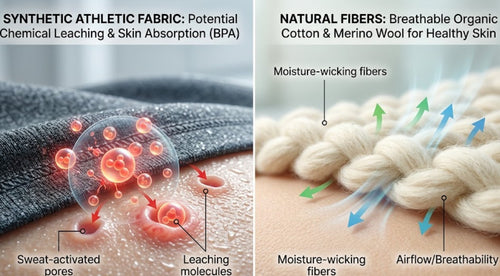
We rarely think about it, but indoor air is an important route of exposure: synthetic textile fibers (polyester, acrylic) are constantly shedding from our clothes, rugs, and curtains, and end up suspended in the air and then in dust (Dris et al., 2017). Machine washing also releases a lot of them into wastewater (De Falco et al., 2019). Two simple habits: prioritize natural fibers when possible, and ventilate your home daily, which remains one of the most underestimated health steps. It is the same reasoning we apply to sports clothes and endocrine disruptors.
| Use | To prioritize | To limit |
|---|---|---|
| Food containers | Glass, stainless steel, ceramic | Plastic, especially heated |
| Bottle / water bottle | Stainless steel, glass | Single-use plastic bottle |
| Clothing | Cotton, linen, hemp, wool | Polyester, acrylic |
| Tea and infusions | Loose-leaf, stainless steel filter | Plastic pyramid bags |
| Kitchen utensils | Wood, stainless steel | Plastic in contact with hot |
Want to move step by step toward a healthier daily life, without revolutionizing everything or breaking the bank? Join Le Terrier's personalized follow-up for ten euros a month: we move forward together, one habit at a time, with realistic priorities and zero guilt.
Can we really help the body eliminate them?
The crucial distinction, not to be confused: studies by the Genuis team (2011, 2012) measured the excretion of BPA and certain phthalates in sweat, sometimes at levels higher than those found in urine. In other words, sweating seems to help eliminate the chemical load associated with plastics. But beware: this does not concern the plastic particles themselves, which are far too large to pass through the pores of the skin. No method currently makes it possible to "flush" microplastics out of the body, and beware of any program or supplement that claims to do so.
Let's add a methodological nuance, in all honesty: these studies relied on small sample sizes and their methodology has been questioned (risk of contamination of sweat samples, lack of overall assessment). The idea is interesting and consistent, but it is not solidly established. What is well documented, however, are the general benefits of the sauna for cardiovascular well-being and relaxation (Hussain & Cohen, 2018). So take the sauna for what it is: a pleasant and generally beneficial relaxation time, with a possible bonus on the elimination of certain compounds. And let's not forget the basics: the liver and kidneys are responsible for the bulk of the elimination work, every day, for free.
Sauna: some essential precautions The sauna is safe for healthy adults, but it is not recommended in case of unstable cardiovascular disease, hypotension, during pregnancy, or when taking certain medications (especially those that affect blood pressure or sweating). Ask your doctor for advice if in doubt. In all cases: gradual sessions, no alcohol before or during, abundant hydration, and get out as soon as you feel unwell. The sauna is not a competition.
The baby steps method
Two or three changes are enough to start No one lives without plastic today, and that is not the goal. This article is not a list of demands or an invitation to feel guilty: it is a toolbox from which you pick what is realistic for you. Start with the two most cost-effective steps: the stainless steel water bottle, and never heat food in plastic. That is already a lot. The rest will come naturally, at your own pace and according to your budget. And if the subject worries you, remember that chronic stress itself has well-documented effects on health: two calm changes are better than ten anxious ones.
Microplastics FAQ
Can we eliminate microplastics already present in the body?
To date, no: no method, program, supplement, or practice has demonstrated its ability to remove plastic particles already present in the body. Beware of products that promise this. What is possible and useful, however, is to significantly reduce intake thanks to simple steps (stainless steel water bottle, not heating in plastic, loose-leaf tea). Your liver and kidneys also continuously perform their work of eliminating chemical compounds.
Does tap water contain microplastics?
Yes, microplastics have been detected in many drinking water networks, as in most aquatic environments. That said, the quantities measured in tap water are generally much lower than those found in bottled water, whose container is itself made of plastic. For the majority of households, switching to tap water in a stainless steel water bottle therefore already constitutes a clear improvement, and a high-performance filter can complete the process.
Does a charcoal filter pitcher retain microplastics?
At best, partially. Activated charcoal pitchers are designed to improve taste and retain chlorine or certain compounds, but they are not sized to filter the finest particles, especially nanoplastics. Reverse osmosis, with its very fine membranes, is significantly more effective for this use. Also note that most filter pitchers are themselves made of plastic: they need regular cartridge changes and should be kept cool.
Does sweating allow you to eliminate plastic?
Two things need to be distinguished. Studies have measured the presence of BPA and phthalates in sweat, suggesting that sweating helps eliminate these chemical compounds associated with plastics. But it does not remove the microplastic particles themselves, which are too large for the pores. Let's add that these studies are small and their methodology has been questioned. Sweat for pleasure and well-being, without expecting a "plastic detox".
What are the symptoms of an excess of endocrine disruptors?
There is no specific symptom chart that allows you to self-diagnose an "overload" of endocrine disruptors, and you should beware of the lists found online. These substances are studied for their possible effects at the population level (fertility, development, metabolism), not as an identifiable individual disease. If you have symptoms that worry you (persistent fatigue, cycle disorders, fertility difficulties), consult a doctor rather than looking for a single cause.
How do you know if plastic is really microwave-safe?
The "microwave-safe" pictogram means that the container will not deform, not that it will not release any particles or compounds. However, heat significantly increases this migration. The simplest advice is therefore radical and easy to remember: transfer your food to a glass or ceramic dish before reheating it. The same logic applies to scratched or damaged plastic dishes, which release more: it is better to replace them.
Are children more vulnerable to microplastics?
As a precautionary principle, yes: their body is developing, their exposure/body weight ratio is higher, and they carry more objects to their mouths. This is why it is reasonable to prioritize glass or stainless steel containers for them, avoid heating baby bottles and food in plastic, and ventilate rooms well. Without dramatizing: a few common-sense habits are enough, there is no need to panic daily.
How long do you need to spend in the sauna to "detoxify"?
There is no validated "dose" of sauna to eliminate toxins: it would be a false promise to give a figure. Common practices revolve around sessions of 10 to 20 minutes, one to three times a week, with good hydration. Consider the sauna as a relaxation time with documented cardiovascular benefits, not as a detoxification protocol. And respect the contraindications (unstable heart problems, pregnancy, certain treatments) by asking your doctor for advice.
Act on what depends on you
Let's summarize without catastrophizing. Microplastics and nanoplastics are everywhere, including in our water, our food, and the air in our homes, and they cross our biological barriers. Their long-term effects remain to be established, which warrants caution without justifying anxiety. The key takeaway: we don't know how to eliminate the particles already present in the body, and no one should sell you the contrary. What really depends on you is the point of entry: a stainless steel water bottle instead of a plastic one, never heated plastic, loose-leaf tea, natural fibers, a well-ventilated home. Add some exercise, a nice plate rich in fiber, and maybe a sauna for pleasure. Choose two or three habits, really establish them, then move on to the next ones. It's the quiet accumulation of small actions that makes a difference. Let's remind ourselves: this content is educational and does not replace medical advice.