Stroke: the 4 warning signs and how to prevent it naturally
Share
Reading time: 9 minutes
World Health Organization (WHO) statistics are clear: one in four people worldwide will have a stroke in their lifetime. It is one of the leading causes of death and major disability in adults. Yet, the severity of these figures masks a hopeful reality: the Fondation pour la Recherche Médicale (French Foundation for Medical Research) estimates that 80% of premature strokes could be avoided through lifestyle changes.
Our cardiovascular system is resilient when we take care of it every day. A stroke is not an inevitable disaster that falls from the sky; it is the result of silent stress placed on our blood vessels for years.
However, when an emergency strikes, naturopathy gives way to emergency medicine. Every minute lost corresponds to the destruction of millions of neurons. This is why this comprehensive guide is built around two fundamental pillars: knowing how to recognize the signs of a stroke to save a life, and understanding how to adapt your lifestyle to reduce the risk.
The 4 warning signs of a stroke (V.I.T.E / F.A.S.T. method)
INSERM (National Institute of Health and Medical Research) and international health authorities recommend the acronym V.I.T.E (or F.A.S.T. in English: Face, Arms, Speech, Time) to remember sudden neurological symptoms. The sudden appearance of just one of these signs should trigger an immediate alert.
1. Sudden facial drooping
If you ask the person to smile, you will observe a striking asymmetry. The mouth droops or falls to one side. This phenomenon, called central facial paralysis, is due to the interruption of the motor nerve signal that controls the facial muscles.
The test: ask the person to smile. If one side of the face remains immobile or "falls," it is a major warning sign.
2. Sudden visual disturbances
The person may report a loss of vision in one eye (amaurosis fugax), have suddenly blurred vision, or suffer from a loss of half the visual field (hemianopsia). The ophthalmic artery or the visual areas of the brain are often the first to suffer from a lack of oxygen.
Signs to watch for:
- Sudden double vision
- Black spots or a "curtain" in front of the eyes
- Total loss of vision in one eye
3. Aphasia and speech disorders
Speech suddenly becomes confused. The person can no longer articulate (dysarthria), struggles for words, or uses completely incomprehensible jargon. Sometimes, they no longer understand what you are saying. This is a sign that the Broca's or Wernicke's area, located in the left hemisphere of the brain, is affected.
The test: ask the person to repeat a simple phrase like "The sun is shining today." If the words are distorted or incomprehensible, alert someone immediately.
4. Hemiplegia: weakness and numbness
A sudden loss of strength, a feeling of heaviness, numbness, or total paralysis affecting an arm, a leg, or one entire side of the body. This symptom directly reflects damage to the motor areas of the brain.
The test: ask the person to raise both arms in front of them and hold them for 10 seconds. If one of the arms drifts down, it is an absolute life-threatening emergency.
The fatal mistake: what to do (and not do) when facing these symptoms?
If you witness any of these four signs, do not waste a second. The brain is the most oxygen-hungry organ in the human body. Deprived of blood, it dies at a rate of 1.9 million neurons per minute.
Errors to absolutely avoid:
- Do not take your car to take the person to the emergency room. Not all hospitals are equipped with Neurovascular Units (NVUs).
- Do not call your primary care doctor, you will lose precious time.
- Do not give them anything to drink or eat (risk of choking due to paralysis of the swallowing muscles).
- Do not give any medication, especially not aspirin (danger in the event of a hemorrhagic stroke).
The only right reflex:
Immediately call 911 (in France: 15 for SAMU, 18 for firefighters, or 112, the European number).
Describe the symptoms precisely using the words "suspected stroke" and note the exact time the signs appeared. Treatments (such as thrombolysis) are only effective if administered within the first few hours (generally less than 4 hours and 30 minutes) following the attack.
Understanding stroke: pathophysiology (ischemia vs. hemorrhage)
To properly prevent a stroke, you must understand its mechanism. A stroke occurs when blood circulation to a part of the brain is interrupted, depriving the cells of oxygen and essential nutrients. There are two major types:
Ischemic stroke (cerebral infarction), 85% of cases
It is caused by a blood clot (thrombus) that blocks a cerebral artery. This clot can form locally on an atherosclerotic plaque, or come from elsewhere in the body (embolism).
Main risk factors:
- Hypertension (chronic high blood pressure)
- Accumulation of atherosclerotic plaques (oxidized cholesterol)
- Chronic vascular inflammation
- Atrial fibrillation (heart rhythm disorder)
Hemorrhagic stroke, 15% of cases
Rarer but often more severe, it occurs when a cerebral blood vessel ruptures, causing bleeding in the brain. The accumulating blood compresses the surrounding brain tissues.
Main cause: uncontrolled high blood pressure weakens the walls of the small cerebral arteries until they rupture.
Want an opinion on your situation? During a vitality assessment, we review your diet, sleep, stress, and goals together, then build a plan tailored to your pace.
80% of strokes are preventable: naturopathic prevention
Once the emergency is ruled out, let's talk about the terrain. Your circulatory system is a complex machine that reacts directly to your lifestyle. According to the American Heart Association, the vast majority of strokes are linked to modifiable risk factors. Here is how to protect your arteries every day.
Protecting the vascular endothelium with omega-3s
The endothelium is the thin layer of cells that lines the inside of your blood vessels. If it becomes inflamed, it becomes rigid and promotes the formation of clots. Omega-3 fatty acids (particularly EPA and DHA) have an anti-inflammatory effect and reduce platelet aggregation. Regular consumption of fatty fish is associated with a lower cardiovascular risk.
In practice:
- Eat small fatty fish (sardines, mackerel, anchovies) twice a week
- Use first-cold-pressed flaxseed or camelina oil
- Eat nuts regularly
- In case of omega-3 supplementation, ask for advice if you take an anticoagulant
Cellular hydration and blood viscosity
Blood is composed of 55% plasma, which itself is made up of more than 90% water. Severe dehydration thickens the blood, which increases the heart's workload and can promote the formation of clots.
In practice:
- Drink at least 1.5 to 2 liters of pure or filtered water per day
- Spread your drinks throughout the day, a little more in hot weather
- Herbal teas traditionally used for blood pressure (hawthorn, olive leaf, hibiscus) can accompany this practice, with caution if you already take medication for hypertension
Heart coherence to control cortisol and hypertension
Chronic stress keeps your body in a state of permanent alert. The adrenal glands secrete excess cortisol and adrenaline, causing vasoconstriction (narrowing of the arteries) and an increase in blood pressure.
The French Federation of Cardiology recommends heart coherence to bring back calm. This rhythmic breathing technique stimulates the vagus nerve and activates the parasympathetic nervous system, which helps lower blood pressure and heart rate.
The 365 method:
- 3 times a day
- 6 breaths per minute
- For 5 minutes
- (Inhale for 5 seconds, exhale for 5 seconds)
Take your health into your own hands before your body screams. If you want to set up a targeted prevention routine (anti-inflammatory nutrition, stress management, adapted supplementation), join my personalized follow-up for only €10 per month. We concretely address how to improve your cardiovascular health every day.
Summary table: reacting vs. preventing
| Emergency Phase (In case of crisis) | Prevention Phase (Every day) |
|---|---|
| Recognize: Drooping face, heavy arm, speech disorder, visual disturbance | Nutrition: Adopt a diet rich in Omega-3, antioxidants, and fiber |
| Act: Call 911 (15, 112, or 18 in France) immediately | Hydration: Drink 1.5 to 2L of filtered water per day to thin the blood |
| Avoid: Taking the car, giving water, calling the family doctor | Stress management: Practice 15 minutes of heart coherence per day |
| Note: The exact time the first symptoms appeared | Movement: At least 30 minutes of active walking daily |
| Never give: Aspirin or any other medication | Monitor: Blood pressure, blood sugar, cholesterol |
Modifiable risk factors
To anchor prevention in your daily life, here are the main risk factors over which you have direct power of action:
- High blood pressure: the leading risk factor (regular monitoring recommended)
- Smoking: doubles the risk of stroke (quitting reduces the risk from the first few months)
- Type 2 diabetes: excess glucose damages blood vessels
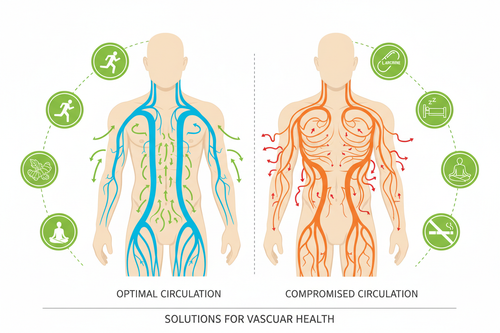
- Sedentary lifestyle: physical activity protects the vascular endothelium
- Pro-inflammatory diet: refined sugars, trans fats, ultra-processed foods
- Chronic stress: raises blood pressure and promotes systemic inflammation
- Excess alcohol: increases blood pressure and hemorrhagic risk
Your health is in your hands
Stroke strikes with lightning speed, but it is often prepared silently for decades. Sharing these 4 warning signs (Face, Vision, Speech, Motor skills) around you is a civic act that can save lives.
But adopting an anti-inflammatory lifestyle, protective for your vessels and soothing for your nervous system, is an act of respect toward yourself. The body has a good recovery capacity, provided you help it every day.
Summary of key actions:
- Memorize the V.I.T.E method and share it
- Integrate omega-3s into your daily diet
- Hydrate yourself sufficiently (1.5 to 2L/day)
- Practice heart coherence 3 times a day
- Move at least 30 minutes every day
- Have your blood pressure checked regularly
Put these changes in place today. Your heart and brain will thank you.