Facial massage: what science really says about its benefits
Share
The facial massage is all the rage: jade rollers, gua sha stones, and self-massage routines on social media. It is credited with everything from a healthy glow to the disappearance of wrinkles. What do we really know? Studies are still limited and often small, but they already help distinguish plausible benefits from exaggerated promises.
What massage really does to the skin
A boost for circulation
This is the best-documented effect. Massaging the skin dilates the small surface vessels and increases blood flow for a few minutes. A Japanese study published in 2018 measured an increase in facial blood flow after just five minutes of roller massage, and improved vessel responsiveness after five weeks of daily practice.
In practical terms, this results in a rosier and more radiant complexion immediately after the massage. The effect is real, but temporary: it generally fades after about an hour.
Less morning puffiness
Slow strokes from the center of the face toward the ears and then down the neck help move fluids that accumulate overnight. Many people notice less puffy eyelids and cheeks. This is the principle of manual lymphatic drainage, used in physical therapy. On the face of a healthy person, the evidence remains mostly based on experience, but the technique is gentle and generally safe.
Less tense muscles
Stress often settles in the face: clenched jaws, furrowed brows, and tightened eyebrows. Massage relaxes these areas, particularly the jaw muscles (the masseters), which are often tense in people who grind their teeth at night. This relaxation can soften facial expressions, without erasing established wrinkles.
Effects on stress and mood
Touch is soothing. Several small studies on massage in general show a reduction in perceived stress and sometimes in cortisol, the stress hormone. The face, which is very rich in nerve endings, is particularly well suited to this relaxing effect. For many, an evening self-massage becomes a real moment of unwinding before bedtime, which is already a benefit in itself.
And wrinkles?
In reality, no serious study shows that massage alone makes wrinkles disappear or boosts collagen production in a lasting way. The notable figures circulating on the internet are generally not supported by any verifiable publication.
An interesting lead comes from facial gymnastics. In 2018, a small study published in JAMA Dermatology followed middle-aged women who performed facial exercises for 20 weeks: evaluators observed slightly fuller cheeks and a face that appeared slightly younger. This study involved only 16 participants, so it requires confirmation.
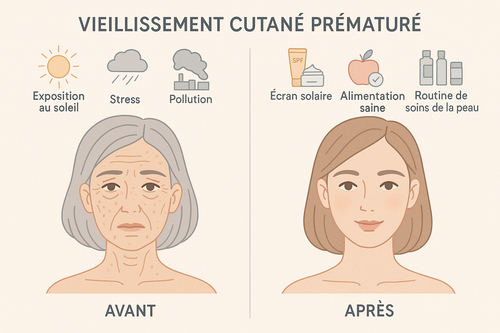
To protect collagen, the most effective methods are well known: protect yourself from the sun, do not smoke, get enough sleep, eat enough protein, fruit, and vegetables, and limit refined sugars.
Would you like an opinion on your situation? During a vitality assessment, we review your diet, sleep, stress, and goals together, then create a plan tailored to your pace.
Gua sha, roller, or bare hands: which should you choose?
- Hands: free, precise, and ideal for getting started. The warmth of the fingers helps oils penetrate.
- Roller (jade, quartz): pleasant, especially if kept cool. It is well suited for morning drainage.
- Gua sha: a flat stone that is glided over the skin. A 2007 German study showed that it significantly increases microcirculation in the treated area, but it focused on the back rather than the face. On the face, it is used with very light pressure.
Regardless of the tool, the benefits attributed to the stones themselves (lithotherapy) are not supported by any evidence. It is the technique that matters.
A simple 5-minute routine
- Cleanse your face and hands, or your tool.
- Apply a few drops of vegetable oil (jojoba, hazelnut, or rosehip) or your usual cream so that your fingers glide without pulling the skin.
- Start at the center of the forehead and smooth toward the temples, 5 to 10 times.
- Do the same under the eyes, very gently, from the inner corner toward the outside.
- Smooth the cheeks from the nose toward the ears, then along the jawline, from the chin toward the lobes.
- Finish with the neck, from top to bottom, to aid drainage.
- Apply gentle circular pressure to the jaw for a few seconds if it is tense.
In the morning, opt for quick strokes and a cool tool to reduce puffiness. In the evening, use slower strokes to relax.
Precautions to keep in mind
- Avoid massaging irritated skin, inflammatory acne, an eczema flare-up, or rosacea: rubbing worsens inflammation.
- Do not massage over a wound, herpes, or infection.
- After an injection (hyaluronic acid, botulinum toxin), wait for the practitioner's approval.
- Pressure should remain light: skin that becomes very red or shows marks is being overstimulated.
- Cleanse your tool after each use.
A pleasant ritual, without miracle promises
Facial massage provides real but modest benefits: a more radiant complexion for about an hour, less puffiness, relaxed facial features, and a genuine moment of calm. It is not a substitute for sun protection or a healthy lifestyle, which remain the best allies of healthy skin. If you enjoy it, it is an excellent habit to keep.
Would you like ongoing support? Le Terrier's personalized follow-up, at €10 per month, allows you to ask us questions in writing and progress at your own pace.