Phototherapy and skincare: what LED light can really do
In our ongoing quest for healthy, radiant skin, new technologies are regularly complementing the arsenal of traditional skincare. Among these innovations, light therapy is gradually establishing itself as a particularly promising and non-invasive solution that can help improve many skin concerns.
While we are already familiar with the benefits of light therapy for mood and the circadian rhythm, its application in dermatology reveals remarkable therapeutic potential. From beauty salons to bathrooms, this technology based on the power of photons is transforming our approach to skincare.
But how can simple beams of light really improve the condition of our skin? What are the biological mechanisms at work? And above all, what concrete results can you expect depending on your skin concern?
Here is an overview of the fascinating world of skin light therapy, its different applications depending on the colors used, and how this technology can be integrated into your daily beauty routine for visible and lasting results.
Understanding skin light therapy: science and principles
Skin light therapy, also known as photobiomodulation or LED (Light Emitting Diode) therapy, is based on a fundamental principle: our skin is capable of absorbing light energy and converting it into beneficial biochemical processes.

The mechanism of action: when light becomes skincare
Unlike laser treatments, which work through a thermal effect, light therapy acts at a cellular level without generating excessive heat. Its effectiveness is based on the ability of mitochondria, the "powerhouses" of our cells, to absorb certain wavelengths of light.
This process triggers a cascade of biochemical reactions:
- Increased production of ATP (adenosine triphosphate), the cellular "energy currency"
- Stimulation of fibroblasts, responsible for the synthesis of collagen and elastin
- Improved blood and lymphatic circulation
- Reduced tissue inflammation
- Modulation of sebum production
- Accelerated cell renewal
What makes this technology particularly interesting is its ability to positively influence cellular function without damaging tissues, unlike more aggressive approaches such as chemical peels or certain laser treatments.
The light spectrum and its skin applications
The effectiveness of light therapy depends essentially on the wavelength used. Each color of the light spectrum penetrates the skin to different depths and interacts with specific cellular targets.
Blue light (415-470 nm)
Penetrating approximately 2 mm into the skin, blue light is primarily known for:
- Its effective antibacterial action against Cutibacterium acnes (formerly Propionibacterium acnes), the bacterium responsible for acne
- Its ability to regulate excessive sebum production
- Its soothing effect on superficial skin inflammation
An open study published in the Journal of Dermatological Science (Kawada et al., 2002) observed a 64% reduction in acne lesions in people with mild to moderate acne, after blue light sessions twice a week for up to 5 weeks.
Red light (620-750 nm)
With deeper penetration (up to 8-10 mm), red light directly targets fibroblasts and offers:
- Significant stimulation of collagen and elastin production
- An acceleration of the healing process
- A reduction in chronic inflammation
- A visible improvement in skin texture
Several clinical studies have observed, after a series of red light sessions, an improvement in skin texture and fewer fine lines in some participants.
Yellow light (570-590 nm)
Located between blue and red in the spectrum, yellow light is particularly effective for:
- Reducing redness and couperose
- Stimulating lymphatic circulation
- Improving tissue oxygenation
- Evening out the complexion and reducing hyperpigmentation
Near-infrared light (750-1200 nm)
Invisible to the naked eye but particularly penetrating (up to 20 mm), this wavelength:
- Deeply stimulates cell regeneration
- Acts on subcutaneous tissues
- Significantly improves microcirculation
- Accelerates deep tissue repair
Therapeutic applications: targeted solutions for your concerns
The versatility of light therapy allows it to address a wide range of skin concerns with a personalized approach tailored to the specific needs of each skin type.
Acne treatment: the blue-red alliance
Acne, affecting both adolescents and adults, finds in light therapy a promising option, with few side effects.
The combination of blue and red light offers a comprehensive approach:
- Blue light directly eliminates the bacteria responsible for acne
- Red light reduces associated inflammation and accelerates healing
This dual action provides interesting results for mild to moderate acne, with few side effects. It can complement a treatment, but does not replace the advice of a dermatologist for severe or resistant acne.
Regular sessions of 15-20 minutes, 3 to 4 times a week for 8 weeks, clearly reduce inflammatory lesions in several studies, especially when blue and red light are combined.
Anti-aging and regeneration: the power of red and infrared
Skin aging, whether chronological or photo-induced, is mainly characterized by a decrease in the synthesis of collagen and elastin.
Red and infrared light therapy acts precisely on these mechanisms:
- Direct activation of fibroblasts to restart collagen production
- Improvement of the structure of the extracellular matrix
- Reduction of oxidative stress responsible for premature aging
- Improvement of deep skin hydration
A controlled study published in Photomedicine and Laser Surgery (Wunsch and Matuschka, 2014), involving 136 volunteers, observed after 30 sessions, twice a week:
- Fewer fine lines and less skin roughness
- An improvement in skin appearance, rated on photos by independent evaluators
- A measurable increase in dermal collagen density
Healing and skin repair: the light acceleration
Light therapy's ability to stimulate tissue repair processes makes it a valuable tool for improving the appearance of scars, whether recent or old.
Red and infrared light can:
- Reorganize disorganized collagen fibers in scars
- Reduce post-traumatic inflammation
- Improve the vascularization of repairing tissues
- Limit the formation of hypertrophic scars
Its post-intervention use (after micro-needling, peeling, or surgery) also helps significantly reduce recovery time and improve results.
Rosacea and skin sensitivity: light soothing
For reactive skin, prone to redness or affected by rosacea, light therapy offers a particularly gentle and effective approach:
- Yellow light specifically targets the dilated vessels responsible for diffuse redness
- Red light reduces the chronic inflammation characteristic of these conditions
- The combination of the two gradually strengthens the skin barrier, making the skin less reactive to triggering factors
This approach has the major advantage of being completely non-irritating, unlike many topical treatments that can exacerbate skin sensitivity.
Light therapy devices: from professional to home use
Technological evolution has helped democratize access to skin light therapy, once reserved for dermatology clinics and specialized institutes.

Professional devices: power and effectiveness
In a clinic or institute, professional devices stand out for:
- High light power (generally 100-150 mW/cm²)
- A large treatment surface allowing the entire face or body to be covered
- Sophisticated combinations of different wavelengths
- Personalized protocols according to concerns
These characteristics allow for faster results, generally with weekly or twice-monthly sessions of 20-30 minutes.
Home devices: accessibility and consistency
The real change comes from the emergence of devices intended for personal use:
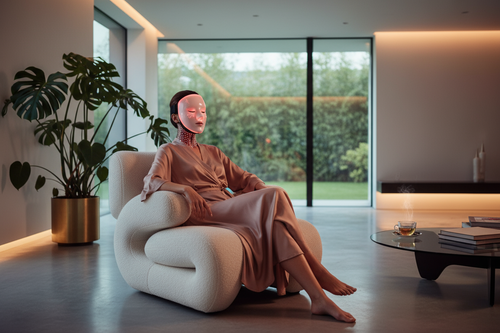
LED masks
Covering the entire face, these masks generally offer several selectable wavelengths depending on the targeted concern. They offer the advantage of an even treatment and hands-free use.
Targeted devices
More compact and often more affordable, these devices allow specific areas to be treated:
- LED pens for localized imperfections
- Medium-sized panels for areas such as the forehead or cheeks
- Specialized devices for the eye contour or décolletage
While home devices are generally less powerful than their professional counterparts (15-40 mW/cm²), they compensate for this difference with the possibility of more frequent, even daily, use, which often proves just as effective in the long term.

Want an opinion on your situation? During a vitality assessment, we review your diet, sleep, stress, and goals together, then build a plan tailored to your pace.
Integrating light therapy into your skincare routine
To maximize the benefits of skin light therapy, its optimal integration into your beauty ritual is essential.
Optimal skin preparation
Skin preparation is crucial to allow optimal light penetration:
- Cleanse your skin carefully to remove makeup, excess sebum, and impurities
- Ideally, perform a light weekly exfoliation to remove dead cells that could reduce treatment effectiveness
- Optionally, apply a conductive serum specifically designed to improve light penetration
Frequency and consistency: the keys to success
For visible and lasting results:
- Intensive phase: use your device daily for 4-8 weeks
- Maintenance phase: 2-3 weekly sessions are generally enough to maintain results
Consistency is more important than the duration of each session. Daily use for 10 minutes will be more beneficial than sporadic 30-minute sessions.
Synergy with your topical skincare
Light therapy can considerably amplify the effectiveness of your cosmetic products:
- Actives applied after a light therapy session generally penetrate the skin better
- Certain ingredients such as hyaluronic acid, peptides, or vitamin C have their effectiveness enhanced by prior cellular stimulation
- However, avoid photosensitizing products (such as retinoids) just before a session
Precautions and contraindications: a safe technology, but not universal
Although light therapy is considered particularly safe, certain precautions remain essential.
Main contraindications
Skin light therapy is not recommended in certain cases:
- Pathological or medication-induced photosensitivity
- History of skin cancer
- Pregnancy (as a simple precaution)
- Presence of undiagnosed skin lesions
- Photosensitive epilepsy (for certain pulsed devices)
Safe use tips
For an optimal experience:
- Always protect your eyes with the provided goggles or by closing your eyelids
- Start with short sessions to test your skin's reaction
- Consult a professional before starting intensive treatments
- Hydrate your skin abundantly after each session
- Avoid sun exposure immediately after an LED treatment
The bright future of skincare
Light therapy represents a major advancement in the approach to skincare, offering a particularly interesting alternative or complement to conventional treatments. Its non-invasive nature, infrequent side effects, and encouraging results from several clinical studies make it a technology of choice for many dermatological concerns.
The increasing accessibility of home devices now allows everyone to benefit from this technology in the comfort of their home, with results that, although more gradual than in an institute, prove just as significant in the long term.
Whether you are looking to combat persistent acne, reduce the signs of aging, calm reactive skin, or simply regain the radiance of a glowing complexion, light therapy could very well be the natural, effective, and lasting solution you are looking for.
In a world where non-invasive approaches that respect skin physiology are gaining importance, light therapy is establishing itself as a technology of the future, combining advanced science and ease of use to bring lasting change to our relationship with skincare.
Want daily support? Le Terrier's personalized follow-up, at €10 per month, allows you to ask us questions in writing and move at your own pace.