Cough syrups: why honey often works just as well
Share
Every winter, it’s the same ritual. At the first coughing fit, we rush to the pharmacy to buy a colorful, often expensive bottle that promises peaceful nights. Yet, behind the reassuring packaging lies a disconcerting reality: the majority of over-the-counter cough syrups have no proven effectiveness.
Our role is to help you decipher labels and understand how your body works. Here is what you need to know about an industry that relies more on sugar than on health.
1. The case of alpha-amylase: a biological aberration?
One of the most widely sold active ingredients in France for sore throats and coughs is Alpha-Amylase. On paper, it is an enzyme. In reality, its usefulness for your bronchial tubes is almost nil.
What is amylase?
It is a digestive enzyme naturally present in your saliva and secreted by your pancreas. Its sole role is to break down starch molecules (carbohydrates) to facilitate digestion.
The problem: a cough is an inflammation of the respiratory tract or a reflex reaction of the bronchial tubes. Applying a digestive enzyme to inflamed respiratory mucosa is like trying to repair a car engine with kitchen utensils: the tool is simply not suited to the task. This is why the French National Authority for Health (HAS) has often judged its medical benefit to be insufficient.
2. The “miracle” of sugar (€10 a bottle)
If you feel slight relief after taking an industrial cough syrup, it is generally not thanks to the active molecule, but to the texture.
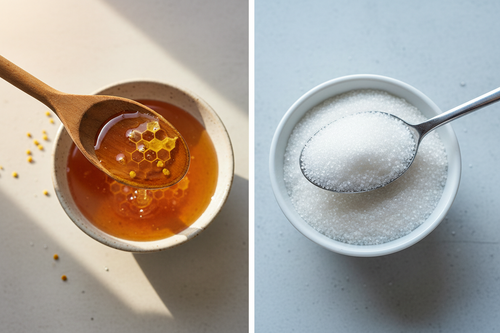
These syrups are made up of more than 70% glucose or sucrose syrup. This viscous liquid “coats” the cough receptors located in the back of the throat, creating a temporary mechanical barrier. But at €10 a bottle, a kilo of sugar becomes extremely expensive, not to mention the impact on your blood sugar and immune system (as sugar is pro-inflammatory).
Would you like an opinion on your situation? During a vitality assessment, we review your diet, sleep, stress, and goals together, then build a plan tailored to your pace.
3. What science says: honey, the big winner of clinical studies
Contrary to popular belief, choosing honey is more than a “grandmother’s remedy”: it is a recommendation backed by studies.
The Cochrane study: the global benchmark
The Cochrane Review, the most rigorous organization in medical meta-analyses, compared honey to classic cough suppressants (such as diphenhydramine). The verdict is clear: honey reduces the frequency and severity of coughing, especially at night, with an effectiveness often superior to synthetic medications.
Why is honey so effective?
- Antibacterial action: thanks to the glucose oxidase enzyme deposited by the bee, honey releases small amounts of hydrogen peroxide, a natural disinfectant.
- Healing properties: it promotes the regeneration of mucosa irritated by repeated coughing fits.
- Rich in polyphenols: its antioxidants help the body fight the viral infection that causes the cough.
4. Your healthy alternative: the “Phyto-honey” syrup recipe
Here is a simple recipe that takes advantage of these effects, without additives.
Ingredients:
- 150g of Thyme or Fir Honey: Recognized for their respiratory benefits.
- The juice of half a lemon: for vitamin C and its antiseptic action.
- Optional: a sprig of fresh thyme or a cinnamon stick to infuse additional antiviral properties.
Instructions: mix cold (to preserve the enzymes in the honey) and take a tablespoon as soon as your throat tickles.
Become an informed consumer
The next time a cough visits you, do not give in to the marketing reflex. Look in your kitchen. Nature, validated by modern science, often offers solutions that are more effective, cheaper, and without side effects (drowsiness, digestive issues).
Warning: never give honey to a child under 1 year old (risk of infant botulism). If the cough is accompanied by breathing difficulties or lasts more than 3 weeks, a medical consultation is essential.
Would you like daily support? The Terrier’s personalized follow-up, at €10 per month, allows you to ask us questions in writing and progress at your own pace.