

Deodorants and antiperspirants: which ingredients to avoid to protect your health?
Share
Reading time: 8 minutes
Every morning, the same automatic gesture. You raise your arm, apply your deodorant, and move on. Yet, this seemingly harmless ritual deserves a closer look: you are placing chemicals two centimeters from your lymph nodes and right next to your breast tissue.
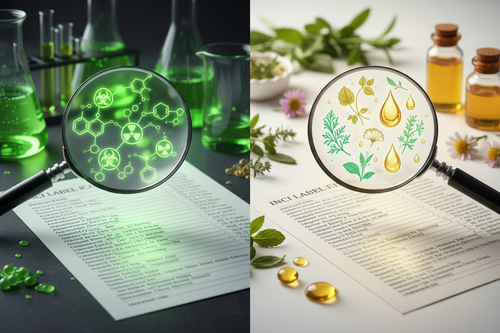
Have you ever turned your stick over to read the INCI list? Aluminum Chlorohydrate, Parfum, PEG-8, Triclosan... These intimidating names hide a reality that few consumers know.
This article is not here to make you panic. It is here to enlighten you. Because between contradictory studies, the alarmist shortcuts of social media, and the silence of manufacturers, it is difficult to find your way. We will decipher together, supported by scientific sources, what is really in your deodorants, and how to make more informed choices.
The physiology of the armpit: a critical absorption zone
Why is this area so special?
Before talking about chemistry, let's talk about biology. The armpit is not like any other patch of skin.
The stratum corneum, that protective layer covering our epidermis, is particularly thin there. Unlike the soles of the feet or the palms of the hands, axillary skin offers increased permeability to the substances applied to it. Add to this the heat, moisture, and constant friction: you get an area where skin absorption is facilitated.
But that's not all. The armpit houses an exceptional concentration of lymph nodes, those small organs that filter lymph and play an essential role in your immune system. Proximity to breast tissue adds another dimension to the consideration, especially for women.
Sweating: a vital process, not a problem
Here is a fundamental misconception that the cosmetics industry has perpetuated for decades: sweating is not the enemy.
Sweating serves two essential biological functions:
- Thermoregulation: your body releases excess heat through the evaporation of sweat
- Excretion: some metabolic waste is eliminated this way
Sweat itself is practically odorless. It is the bacteria present on your skin, mainly Corynebacterium and Staphylococcus, which, by breaking down the compounds in sweat, produce the famous body odors.
The essential distinction: A deodorant neutralizes the bacteria responsible for odors. An antiperspirant mechanically blocks your sweat glands. This is not the same physiological approach, and it does not have the same consequences.
Aluminum salts (Aluminum Chlorohydrate): beyond the controversy
The mechanism: how does it work?
Aluminum Chlorohydrate, the most common aluminum salt in antiperspirants, works through mechanical obstruction. Upon contact with sweat, it forms a gel that creates a temporary "plug" in the ducts of the eccrine sweat glands.
Result: you sweat less. But at what cost?
The "estrogen-like" effect: what research really says
The work of Dr. Philippa Darbre (University of Reading) sparked controversy in 2005. Her study published in the Journal of Inorganic Biochemistry showed that aluminum salts exhibited in vitro estrogen-like activity, meaning an ability to mimic the effect of estrogens in laboratory conditions.
Reference: Darbre, P.D. (2005). "Aluminium, antiperspirants and breast cancer". Journal of Inorganic Biochemistry, 99(9), 1912-1919. DOI: 10.1016/j.jinorgbio.2005.06.001
Should we therefore sound the alarm? Scientific nuance is essential.
A study by Mirick et al. (2002), published in the prestigious Journal of the National Cancer Institute, found no statistically significant association between the use of antiperspirants and the risk of breast cancer.
Reference: Mirick, D.K. et al. (2002). "Antiperspirant use and the risk of breast cancer". Journal of the National Cancer Institute, 94(20), 1578-1580
The official European position
The European Commission's Scientific Committee on Consumer Safety (SCCS) issued its opinion in 2020. It concluded that aluminum salts can be used without risk in antiperspirants up to certain concentrations, as skin absorption is very low.
The scientific debate is therefore largely settled. If you still prefer to limit your exposure, for personal reasons, the precautionary principle remains a legitimate approach.
Endocrine disruptors: the invisible cocktail
Parabens: found everywhere, closely studied
Methylparaben, Propylparaben, Butylparaben... These preservatives are ubiquitous in conventional cosmetics.
The study by Darbre et al. (2004), published in the Journal of Applied Toxicology, detected the presence of parabens in breast tumor tissues. Note: this does not prove a causal link, but it demonstrates that these substances enter the body and accumulate in it.
Reference: Darbre, P.D. et al. (2004). "Concentrations of parabens in human breast tumours". Journal of Applied Toxicology, 24(1), 5-13
The study by Routledge et al. (1998), meanwhile, demonstrated the in vitro estrogen-like effect of certain parabens.
Reference: Routledge, E.J. et al. (1998). "Some alkyl hydroxy benzoate preservatives are estrogenic". Toxicology and Applied Pharmacology, 153(1), 12-19
Triclosan: officially recognized as problematic
Unlike the controversies surrounding aluminum, the case of Triclosan is more definitive. The European Union first heavily restricted it with Regulation (EU) 2016/110, then banned it in cosmetic products with a 2024 regulation.
Why? Its endocrine-disrupting effect is documented, particularly on thyroid function. The study by Dann & Hontela (2011) in the Journal of Applied Toxicology compiles evidence of its environmental and biological toxicity.
Reference: Dann, A.B. & Hontela, A. (2011). "Triclosan: environmental exposure, toxicity and mechanisms of action". Journal of Applied Toxicology, 31(4), 285-311
Phthalates: the "fragrance" trap
Here is a labeling limitation: phthalates never appear by name on labels. They hide behind the generic term "Fragrance" or "Parfum", a regulatory catch-all that allows manufacturers not to disclose the exact composition of their fragrance mixtures.
Several phthalates are recognized as endocrine disruptors, and some are already banned in cosmetics in Europe.
The cocktail effect: when the dose is no longer the only factor
Here is the blind spot of current regulations: each substance is evaluated in isolation, at a given dose. But no one uses only one cosmetic product per day.
Shampoo, shower gel, moisturizer, deodorant, makeup... Daily exposure to dozens of endocrine disruptors, even at "low doses", creates a cocktail effect whose consequences are still poorly understood by science.
When it comes to hormones, the classic logic that "the dose makes the poison" no longer applies in the same way. Infinitesimal doses can have significant biological effects.
PEG and denatured alcohol: the silent accomplices
Polyethylene Glycols (PEG): opening the skin's doors
PEG-8, PEG-40, PEG-100... These surfactants have a concerning property: they increase skin permeability.
Simply put, they facilitate the penetration of other substances, including those you would not want to cross your skin barrier. PEGs act as "facilitators" that open the doors of your skin to other ingredients, toxic or not.
Denatured alcohol: irritation and a disrupted microbiome
Denatured alcohol (Alcohol Denat.) dries out and irritates the skin with every application. It can also disrupt your axillary microbiome, that ecosystem of beneficial bacteria that contributes to the balance of your skin.
A disrupted microbiome paradoxically means more unpleasant odors, more irritation, and more vulnerable skin.
Want an opinion on your situation? During a vitality assessment, we review your diet, sleep, stress, and goals together, then build a plan tailored to your pace.
Quick label reading guide
| INCI Name | Potential Risk | Natural Alternative |
|---|---|---|
| Aluminum Chlorohydrate | Obstruction of sweat glands, suspected estrogen-like activity | Natural Alum Stone (Potassium Alum) |
| Parabens (Methyl-, Propyl-, Butyl-) | Endocrine disruptor, accumulation in tissues | Natural preservatives (vitamin E, rosemary extract) |
| Triclosan | Proven endocrine disruptor, thyroid impact | Antibacterial essential oils |
| Fragrance/Parfum | May hide phthalates | Pure essential oils |
| PEG (followed by a number) | Increases skin permeability | Natural emulsifiers (beeswax, lecithin) |
| Alcohol Denat. | Irritation, disrupted microbiome | Natural fatty alcohols |
Toward a natural transition: how to choose your alternative?
Alum Stone: natural vs synthetic
Be careful not to confuse them. There are two types of alum stone:
- Potassium Alum (KAl(SO4)2): the natural alum stone, extracted from mines. It also contains aluminum, but mainly leaves an antibacterial saline film on the surface.
- Ammonium Alum: synthetic version, with different properties.
Always check the exact INCI name before buying.
Baking soda: effective but needs the right dosage
Baking soda has an interesting antibacterial action, as shown by the Drake (1997) study.
Reference: Drake, D. (1997). "Antibacterial activity of baking soda". Compendium of Continuing Education in Dentistry, 18, S17-S21
The trap: used pure or in too large a quantity, it can irritate sensitive skin because of its alkaline pH. The key lies in the right dosage and combining it with soothing ingredients (coconut oil, shea butter).
Palmarosa Essential Oil
Cymbopogon martinii is the botanical name of this Indian grass whose essential oil is particularly prized by naturopaths.
Its richness in geraniol (up to 80% of its composition) gives it remarkable natural antibacterial and fungicidal properties. It neutralizes the bacteria responsible for body odors without blocking sweat, thus respecting the natural physiology of your body.
Its floral scent, close to rose, makes it a pleasant option in homemade or natural deodorants, always diluted.
Note: like all essential oils, Palmarosa has contraindications (pregnant women, children, certain medical conditions). Always research before use.
Check your current products
Apps like YUKA (yuka.io) or INCI Beauty (incibeauty.com) allow you to scan your cosmetics in a few seconds and get a detailed analysis of their composition.
The axillary "detox" period: what you need to know
The bacterial rebound: an unavoidable stage
You switch to natural products and, disaster, you feel like you smell stronger than before? It's normal.
For years, antiperspirants have disrupted the balance of your axillary microbiome. When you stop, your skin goes through a rebalancing phase that can last from 10 to 21 days. This is the famous "bacterial rebound".
Practical tips for getting through this phase
- Green clay mask: apply a clay poultice to your armpits 1 to 2 times a week to "absorb" residues and purify the area
- Apple cider vinegar rinse: diluted in water, it rebalances the skin's pH
- Patience: your microbiome needs time to rebuild itself
What to remember
Science is clear on one point: we still lack long-term data on the effects of many cosmetic ingredients. The link between aluminum salts and breast cancer, for example, is not proven to date. But the absence of proof of danger is not proof of the absence of danger.
The precautionary principle is not paranoia. It is a philosophy of life that consists of making informed choices where science is still hesitant.
Your armpit is a sensitive absorption zone, close to important anatomical structures. The ingredients you apply there daily deserve your attention.
The good news: natural alternatives exist, they are effective, and they respect the physiology of your body.
So, what will you put under your arms tomorrow morning?
Want daily support? Le Terrier's personalized follow-up, at €10 per month, allows you to ask us questions in writing and move at your own pace.
FAQ: your questions about deodorants
What is the difference between a deodorant and an antiperspirant?
A deodorant neutralizes the bacteria responsible for bad odors without blocking sweat. An antiperspirant physically obstructs the sweat glands with aluminum salts to reduce sweat production. These are two fundamentally different approaches physiologically.
Do aluminum salts cause breast cancer?
To date, no study has proven a direct causal link between aluminum salts and breast cancer. However, research has shown an "estrogen-like" activity of these substances in vitro. The European scientific committee SCCS concluded in 2020 that their use in antiperspirants is safe up to certain concentrations.
What is an endocrine disruptor?
An endocrine disruptor is a chemical substance capable of interfering with the hormonal system. It can mimic, block, or modify the action of the body's natural hormones, even at very low doses. Parabens, triclosan, and phthalates are part of this category.
Is alum stone really safe?
Natural alum stone (Potassium Alum) also contains aluminum, in a different form from the salts in antiperspirants. It mainly leaves an antibacterial saline film on the surface. Always check the INCI: favor "Potassium Alum" and avoid "Ammonium Alum" (synthetic).
Why do I smell worse since I switched to a natural deodorant?
It's the "bacterial rebound", a normal transition phase that lasts 10 to 21 days. Your axillary microbiome, disrupted by years of antiperspirants, is rebalancing. Green clay masks and apple cider vinegar rinses can speed up this process.
Are phthalates listed on labels?
No, that's the main catch. Phthalates are generally hidden behind the generic term "Fragrance" or "Parfum", which allows manufacturers not to disclose the exact composition of their scent mixtures. To avoid them, opt for scented products with pure essential oils.
Is Palmarosa essential oil effective as a deodorant?
Yes, Palmarosa essential oil (Cymbopogon martinii) is rich in geraniol, a compound with antibacterial and fungicidal properties. It neutralizes the bacteria responsible for odors without blocking perspiration. However, it has contraindications (pregnancy, children, certain medical conditions).
How can I check the composition of my cosmetics?
Free apps like YUKA or INCI Beauty allow you to scan the barcode of your products and get a detailed analysis of their composition, with a quality score and the identification of potentially problematic ingredients.
Sources and bibliography
Aluminum and breast cancer
- Darbre, P.D. (2005). "Aluminium, antiperspirants and breast cancer". Journal of Inorganic Biochemistry, 99(9), 1912-1919. DOI: 10.1016/j.jinorgbio.2005.06.001
- Mirick, D.K. et al. (2002). "Antiperspirant use and the risk of breast cancer". Journal of the National Cancer Institute, 94(20), 1578-1580
- Scientific Committee on Consumer Safety (SCCS), Opinion 2020, European Commission
Parabens
- Darbre, P.D. et al. (2004). "Concentrations of parabens in human breast tumours". Journal of Applied Toxicology, 24(1), 5-13
- Routledge, E.J. et al. (1998). "Some alkyl hydroxy benzoate preservatives are estrogenic". Toxicology and Applied Pharmacology, 153(1), 12-19
Triclosan
- Commission Regulation (EU) 2016/110
- Dann, A.B. & Hontela, A. (2011). "Triclosan: environmental exposure, toxicity and mechanisms of action". Journal of Applied Toxicology, 31(4), 285-311
Baking soda
- Drake, D. (1997). "Antibacterial activity of baking soda". Compendium of Continuing Education in Dentistry, 18, S17-S21
Verification apps
- YUKA: yuka.io
- INCI Beauty: incibeauty.com


1 comment
merci bien