Hair Extensions and Wigs: Health Risks and Alternatives
Let's make one thing clear first, as this topic touches on something deeply personal and tied to identity: this article is not a lecture, and certainly not a judgment. If you wear extensions, wefts, or wigs - whether for style, habit, cultural reasons, after chemotherapy, or simply to try something new - you have every reason to do so. Our role at Le Terrier is not to tell you what to do, but to provide reliable information so you can make informed choices. And this information has just become essential thanks to a recent scientific study: the vast majority of extensions and wigs sold contain concerning chemicals, including those marketed as "natural" or "non-toxic." Let's look together, with rigor and compassion, at what science really says, and above all, what you can do about it.
Why Your Extensions Could Be Harming Your Health
The Silent Spring Institute's Findings (2026)
In February 2026, the Silent Spring Institute, an independent American research institute specializing in the links between chemicals and disease, published the most comprehensive analysis to date on the subject in the American Chemical Society's journal Environment & Health (Franklin et al., 2026). Researchers thoroughly examined 43 extension and wig products, both synthetic and human hair, purchased online and in stores. Using a "non-targeted screening" method capable of detecting even undeclared substances, they identified 169 distinct chemicals. The striking result: at least one substance linked to cancer or reproductive effects was detected in 91% of the samples. Even more striking, out of the 43 products, only two were found to be free of concerning substances, and those two were precisely labeled "non-toxic." All the others, including human hair sold as "virgin" or "raw," contained at least one.
An important and honest clarification: this study identifies the presence of these substances in the products. The exact amount that actually enters the body, and its long-term effects, remain questions that the researchers themselves believe need further investigation. In other words: the warning signal is serious and documented, but we are not saying that wearing extensions "gives you cancer." We are advocating for caution and reduced exposure, not fear.
Phthalates, Organotins, and Flame Retardants: The Hidden Cocktail
What are these families of substances? They include phthalates (such as dibutyl phthalate), well-known endocrine disruptors used as plasticizers; organotins, a class of compounds that interfere with the hormonal system (present in nearly 10% of the samples, sometimes at levels exceeding European health thresholds); flame retardants; pesticide residues; as well as styrene and naphthalene, which are on California's Proposition 65 list of carcinogenic substances. The underlying problem? These hair accessories are not subject to any strict regulation: unlike cosmetics applied to the skin, they are virtually unregulated, leaving consumers in the dark.
The Journey of Toxins: From Fiber to Your Body

Release Through Hot Water and Heat
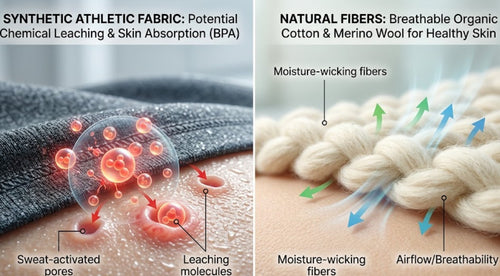
A logical question arises: do these substances remain trapped in the fiber, or can they escape? That is the key issue. Organotins and other compounds are not chemically "sealed" in the hair. Under the effects of heat (hot showers, flat irons, hair dryers) and moisture, they can gradually be released from the fiber. However, extensions or wefts are rarely worn for just a few hours: they are often worn continuously for several weeks, in constant contact with the scalp, in a hot and humid environment. It is precisely these conditions of prolonged wear that maximize contact between the substances and the skin.
Scalp and Lymphatic System: A Point of Entry
Why is this important? Because the scalp is one of the most richly vascularized areas of the body. A dense network of blood vessels and lymphatic vessels circulates beneath the skin. Hot skin, and especially skin that is slightly irritated or micro-injured (which happens under the tension of extensions), sees its permeability increase. Substances in prolonged contact can thus partially cross the skin barrier and enter the circulation and the lymphatic system, which is responsible for removing waste from the body. Supporting this elimination system is precisely part of a terrain-based approach, as we explain in our article on natural lymphatic drainage.
The Impacts on Hormonal and Hair Health
Endocrine Disruptors: The Silent Imbalance
The term "endocrine disruptor" comes up again and again, and rightly so. These substances (phthalates, organotins, etc.) have a sneaky peculiarity: their chemical structure resembles that of our hormones. They can thus mimic, block, or disrupt the action of our natural hormones, estrogens and thyroid hormones, by binding to their receptors. Since the endocrine system operates at minute doses, even small amounts can theoretically have effects. This is a mechanism found in many everyday objects, and which we detail in our article on endocrine disruptors in sportswear. The logic of reducing exposure applies to all of these cumulative sources.
The Studied Link with Breast Cancer Risk
This is the most sensitive point, and it requires great precision. In the 2026 study, 17 of the identified substances are associated with the risk of breast cancer in the scientific literature. Furthermore, previous research on other chemical hair products, the vast Sister Study (Eberle et al., 2020), and the work of Llanos et al. (2017), have observed correlations between the use of certain hair products (especially dyes and relaxers) and an increased risk of breast diseases. Let's be rigorous: these studies are about dyes and relaxers, not directly about extensions, and they are correlations, not evidence of direct causality. A statistical association is not a certainty. What needs to be remembered is not "extensions cause cancer," which would be false and anxiety-inducing, but that these products contain substances for which the literature recommends limiting exposure, as a precautionary principle.
Itching, Redness, and Traction Alopecia
Beyond long-term risks, the body sometimes sends immediate signals. Itching, redness, irritation, or unusual scalp sensations are frequently reported side effects of extensions and wefts. Added to this is traction alopecia: hair loss linked to the permanent mechanical tension exerted on the roots by the weight of extensions, especially when worn tightly and for prolonged periods. These signals deserve to be listened to: they are the way your body talks to you.
Want an opinion on your situation? During a vitality assessment, we review your diet, sleep, stress, and goals together, then build a plan tailored to your pace.
The Trap of Greenwashing in the Hair Care Industry
Perhaps the most confusing finding of the study is this: the only two "clean" products were labeled "non-toxic," but a host of other products bearing reassuring claims nevertheless contained concerning substances. Why? Because claims like "non-toxic," "phthalate-free," or "100% natural" are not, on these accessories, governed by any binding regulation. Any brand can use them. And even "virgin" human hair is actually treated with chemicals (for disinfection, coloring, shine, and preservation). The label reassures; biochemistry, however, sometimes tells a different story.
| What the label says | The possible reality |
|---|---|
| "100% natural / virgin hair" | Often treated (disinfection, coloring, shine) |
| "Non-toxic" | Unregulated claim, not third-party verified |
| "Phthalate-free" | May contain other concerning substances |
| "Hypoallergenic" | Marketing term without a strict legal definition |
| Full list of ingredients published | Sign of transparency to be prioritized |
4 Practical Steps to Protect Yourself (Without Giving Up Your Style)
While we wait for regulation to catch up with science, here are four simple, actionable steps to reduce your exposure while keeping the style you love.
1. Prioritize removable systems (clips, halos) Clip-in or halo extensions, put in the morning and removed in the evening, radically limit the duration of contact with the scalp compared to wefts or glued extensions worn continuously for several weeks. Less contact time means less cumulative exposure. You keep the volume and length without permanent wear.
2. The post-shower rinsing and drying rule After a hot shower, rinse your extensions thoroughly and let them dry completely. Since hot water and moisture promote the release of substances, a good rinse and careful drying reduce residual moisture in contact with the scalp. Avoid keeping damp extensions in place for hours.
3. Heat styling: ventilation and precautions Heat styling (curling iron, flat iron, hair dryer) can release fumes. Style in a well-ventilated room with an open window, and limit excessive heat. Ventilation allows volatile compounds to be expelled rather than inhaled in a confined bathroom.
4. Demand transparency from brands Be wary of unverified "non-toxic" or "phthalate-free" labels. Prioritize brands that publish their full list of ingredients and materials and demonstrate transparency. Your power as a consumer, by rewarding honest brands, is an effective lever for change.
Holistic Beauty: Rediscover the Vitality of Your Own Hair

It is worth highlighting here a dimension that the study clearly brings to the fore: these products are used far more frequently by certain communities, Black women in particular, of whom more than 70% report wearing extensions, often for legitimate cultural and personal reasons. They are thus disproportionately exposed, with fewer safe alternatives on the market. This is not a question of individual choice but of collective responsibility: it is up to the industry and regulators to offer safe products, not to people to give up their identity or style.
And ultimately, the most important message is one of gentleness. Reducing exposure does not mean giving up everything overnight. It may simply mean alternating, sometimes letting your scalp breathe, and rediscovering the texture, volume, and color of your own hair. Because if there is one certainty to share, it is that the most unique beauty is the one that already belongs to you. Your hair, with its unique character, often suits you better than you believe. The rest are just options.
Want to learn how to detoxify your routine, understand your body's needs, and naturally improve the vitality of your hair? Join Le Terrier's personalized follow-up for ten euros a month: compassionate naturopathic support to take care of yourself, from roots to ends, while gradually reducing your overall toxic load.
FAQ on the Dangers of Hair Extensions
Are human hair extensions safer than synthetic ones?
Not necessarily. The Silent Spring Institute study (2026) found concerning substances even in human hair sold as "virgin" or "raw." In reality, even human hair is often chemically treated (disinfection, coloring, shine, preservation). A "natural" origin therefore does not guarantee the absence of chemicals. A brand's transparency about its treatments matters more than the simple mention of "human hair."
What are the symptoms of a toxic reaction on the scalp?
The most frequent signals are itching, redness, irritation, a burning sensation, or unusual tingling on the scalp. Localized hair loss (traction alopecia) can also appear with tight and prolonged wear. These signs deserve to be listened to. In case of persistent irritation, an allergic reaction, or any concern, consult a dermatologist: they alone can make a diagnosis.
Can phthalates present in hair really penetrate the skin?
The scalp is very richly vascularized, and its permeability increases with heat and when it is slightly irritated. Substances in prolonged contact can partially cross the skin barrier. That said, the 2026 study mainly documents the presence of these substances in the products; the exact amount actually absorbed by the body remains a question that researchers believe needs further investigation. The precautionary principle invites limiting exposure.
How to wash new extensions to limit risks?
Before wearing them for the first time, wash and rinse your new extensions thoroughly with a mild shampoo, then let them dry completely. This pre-wash can help remove some surface residues. Then, after every hot shower, rinse and dry carefully, as residual moisture in contact with the scalp promotes the release of substances. Avoid keeping damp extensions in place for hours.
Does wearing a wig increase cancer risks?
It is important to be precise and not to cause anxiety. The study found 17 substances associated with the risk of breast cancer in the literature, and other research has linked certain hair products (dyes, relaxers) to an increased risk. But these are correlations on chemical products, not evidence that wearing a wig "gives you cancer." The amount actually absorbed and the long-term effects remain to be clarified. The reasonable approach is reduced exposure, as a precaution, without fear.
Are there any 100% certified safe extension brands?
There is currently no strict regulatory certification guaranteeing the total safety of these accessories, which are largely unregulated. Be wary of "non-toxic" or "phthalate-free" claims not verified by an independent third party. The best current guide is transparency: prioritize brands that publish the full list of their ingredients and materials. In the absence of reliable certification, transparency and removable systems remain your best allies.
What is an organotin compound?
Organotins (organotin compounds) are a family of tin-based chemical substances, notably used as stabilizers in certain plastics. They are considered endocrine disruptors, capable of interfering with the hormonal system. In the 2026 study, nearly 10% of the extension samples contained them, sometimes at levels exceeding the health thresholds set in Europe, where these compounds are regulated. This is one of the most concerning families identified.
How long of a break should I give my scalp between two installations?
There is no official rule, but common sense and dermatologists suggest regularly letting your scalp and hair breathe between installations, ideally for a few weeks, to allow the follicles to recover from traction and limit cumulative exposure. Alternating periods with and without extensions, and prioritizing removable systems, is good hair hygiene. In case of discomfort or hair loss, space them out further and consult if necessary.
When to consult This content is educational and does not replace medical advice. In case of persistent scalp irritation, allergic reaction, significant hair loss, or any health concerns, consult a dermatologist or your doctor. If you have a personal or family history of particular conditions, talk to a professional who will be able to advise you according to your situation.
Choosing knowingly, without guilt
The essence of this article lies in a balance: informing without frightening, empowering without guilt-tripping. Yes, a solid scientific study shows that the vast majority of extensions and wigs contain concerning substances, endocrine disruptors at the top of the list, and that reassuring labels are not reliable. Yes, the scalp is a point of entry that should not be overlooked. But no, it is not a reason to throw your extensions away in a panic: it is about intelligently reducing your exposure - removable systems, rinsing and drying, ventilation, brand transparency - while calling out an industry that must do better. And above all, reminding yourself that your beauty depends on nothing external: your own hair, just as it is, already looks magnificent on you. Take care of yourself, knowingly, and without ever judging yourself.