Pesticides on fruits and vegetables: baking soda, clay, which method?
Share
The Modern Plate Paradox
Take a moment to think about this biological absurdity: humans are the only species on Earth that poisons its food to prevent other species from eating it... only to eat it themselves.
Today, we are all aware that a plate filled with fresh produce is the foundation of optimal health. Official recommendations advise us to consume five servings of fruits and vegetables a day to get plenty of fiber, vitamins, and antioxidants. Yet, behind the shiny skin of a conventional apple or the vibrant green of a bunch of grapes lies an invisible chemical cocktail.
Exposure to pesticide residues does not occur through a sudden poison, but through slow, daily accumulation in low doses via our diet. Its long-term effects are the subject of extensive research.
The purpose of this article is not to make you fall into eco-anxiety or to push you to stop eating fresh produce (a conventional vegetable will always be infinitely superior to an ultra-processed product). My goal is to empower you to understand the biochemical impact of these toxins on your body, and above all, to share with you a scientifically studied washing method (baking soda), as well as a complementary option from naturopathy (green clay).
What is really hidden beneath the skin of your fruits and vegetables? (The chemical cocktail)
When you bite into an unwashed fruit or simply rinse it under a stream of water, you are not just ingesting the plant. You are ingesting the residues of an agricultural system that treats produce like an industrial product. Here is what is happening at the cellular level in your body.
Herbicides (e.g., glyphosate) and the death of the microbiota
Let's take the most widely used herbicide in the world. How can a molecule designed to kill weeds affect a human being? The answer lies in your intestines.
Glyphosate works by blocking a specific enzymatic pathway called the shikimate pathway. The chemical industry has long claimed that this molecule is harmless to humans because our human cells do not possess this famous shikimate pathway. This is true. But one detail matters: the bacteria in our intestinal microbiota do possess it. Studies, especially in animals and laboratories, suggest that glyphosate can alter the microbiota, with some beneficial bacteria like lactobacilli being more sensitive than certain pathogens. The effects at doses actually ingested by humans remain debated.
Fungicides and hormonal disruption
Fungicides are sprayed to prevent fungi from rotting crops (particularly strawberries, grapes, and citrus fruits). Unfortunately, many of these molecules are effective endocrine disruptors (EDCs).
-
Cellular mimicry: these chemical substances have a molecular structure that closely resembles your own hormones (especially estrogens).
-
Metabolic chaos: once in the bloodstream, they bind to your cell receptors, "scrambling" the signals of your thyroid and reproductive system. The journal Environmental Health Perspectives has extensively documented their role in eroding fertility and increasing metabolic disorders (PCOS, endometriosis).
Slow-burning neurotoxicity
Some insecticides (such as organophosphates) are designed to attack the nervous system of insects by blocking acetylcholinesterase, an enzyme vital for the transmission of nerve impulses. The collective expertise of Inserm published in 2021 links exposure to some of these insecticides, particularly during pregnancy, to neurodevelopmental disorders in children.
Synthetic waxes and coating agents
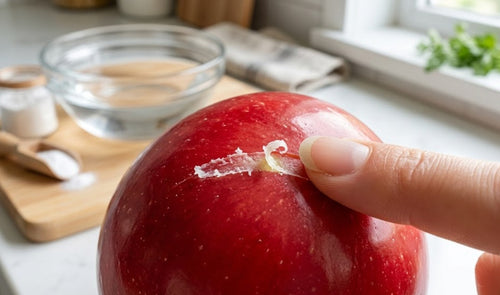
Have you ever noticed how shiny supermarket apples are under the fluorescent lights? It is not natural. To extend their shelf life and make them attractive, they are coated with industrial waxes (based on resins or morpholine derivatives). The major problem with these waxes is that they seal the pesticides against the fruit's skin, making a simple water rinse largely ineffective.
Why plain water and vinegar are not enough? (Myths and realities)
Faced with this invisible threat, the first instinct of most consumers is to put their apple or handful of cherry tomatoes under a stream of tap water, rubbing them slightly with their hands. Unfortunately, from a biochemical standpoint, this gesture is almost useless against modern agricultural chemistry.
The illusion of plain water
Agrochemical manufacturers are not naive. If they created water-soluble (hydrophilic) pesticides, the first spring rain would completely wash the fields, forcing farmers to treat them again. To prevent this, modern pesticide residues are formulated to be lipophilic (fat-soluble) or combined with binding agents.
Plain water glides over these molecules without dislodging them. At best, a water rinse removes dust, some soil residue, and a tiny fraction of surface chemicals.
The white vinegar myth
This is the most common mistake on natural health blogs: soaking vegetables in water with white vinegar. Vinegar is fantastic for the home thanks to its acetic acid. Its acidic pH (around 2.5) is an excellent natural bactericide and fungicide. If you want to eliminate bacteria (such as E. coli or salmonella) from a salad, vinegar is your ally.
Against pesticides, however, it has shown no clear advantage. The acidic pH of vinegar does not have the capacity to break the chemical bonds of lipophilic pesticides or dissolve industrial waxes. You get a fruit that is cleaner in terms of bacteria, but not free of its residues.
The #1 solution (science): degradation by baking soda
If acid fails, you must look at the other end of the pH scale: alkalinity. This is where science offers us a concrete solution, validated by rigorous protocols.
The University of Massachusetts Study (2017)
In 2017, a team of researchers from the University of Massachusetts (UMass) published a landmark study in the highly reputable Journal of Agricultural and Food Chemistry. They tested three methods for washing apples contaminated with two very common pesticides: thiabendazole (a fungicide capable of penetrating the skin) and phosmet (an organophosphate insecticide).
The three methods tested were:
-
Plain tap water.
-
A bleach solution (used by the industry).
-
A water bath with baking soda (1% solution).
The mechanism of alkaline hydrolysis
The result was clear: the baking soda solution proved to be the most effective method, even outperforming industrial washes.
Why? Thanks to a biochemical process called alkaline hydrolysis. Baking soda (which has an alkaline pH, around 8 or 9) promotes the degradation of certain pesticides. It breaks some of their bonds and transforms them into byproducts that are easier to rinse away.
However, science set two strict conditions for this effectiveness:
-
Time: a simple 2-minute soak is not enough. In the study, a bath of 12 to 15 minutes was required to remove up to 96% of phosmet and 80% of thiabendazole (the latter having had time to penetrate beneath the skin).
-
The limit of action: baking soda is effective at degrading surface pesticides. However, it does not have the capacity to "suck out" deeply embedded toxins, nor to capture heavy metals (lead, cadmium) often present in depleted soils.
Naturopathy offers a complementary traditional approach: green clay.
The naturopathic option: green clay
While baking soda excels at degrading chemical molecules on the surface, naturopathy traditionally uses another tool: green clay (particularly Illite or Montmorillonite). Used for millennia to purify water and treat certain poisonings, modern science is beginning to explain its effectiveness.
The principle of adsorption
It is important not to confuse absorption (like a sponge soaking up water) with adsorption. Clay has a unique layered mineral structure. At the microscopic level, these layers are negatively charged.
Certain substances that are positively charged, such as heavy metal ions (lead, cadmium) and certain pesticides, can thus attach to its surface. This is what explains the use of clay to purify water. However, no study has measured the effectiveness of a clay bath in removing pesticide residues from fruits and vegetables: it is a traditional practice that does not replace baking soda.
Ion exchange
Green clay can also exchange some of its minerals (magnesium, calcium) for other ions present in the water. Used in addition to baking soda, it poses no risk and does not alter the taste or nutrients of your food.
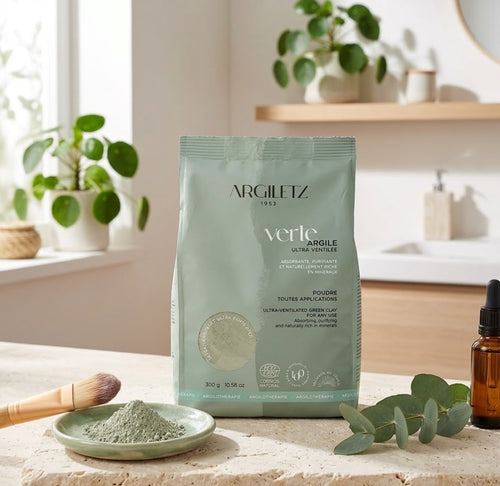
For your baths, choose pure clay, sun-dried and non-irradiated. Discover our Ultra-Ventilated Green Clay Powder, selected for its quality. See our clays
Tutorial: the anti-pesticide protocol (step by step)
Here is the practical guide to display on your fridge. Depending on the time you have and the origin of your vegetables, choose the most suitable method.
Method 1: the baking soda bath (the everyday go-to)
Ideal for thick-skinned vegetables (squash, citrus fruits, melons) or when you do not have clay on hand.
-
Fill a large bowl or clean sink with cold water.
-
Add 1 to 2 tablespoons of baking soda per liter of water and mix well.
-
Submerge your fruits and vegetables (they must be completely submerged).
-
Wait 12 to 15 minutes (this is the duration used in the study to degrade pesticides).
-
Rub gently with a small vegetable brush, then rinse thoroughly with clean water.
Method 2: the green clay bath (as a complement)
Ideal for leafy vegetables (spinach, lettuce), berries, grapes, and all highly porous produce where pesticides easily get embedded.
-
Prepare your cold water basin.
-
Pour 1 large tablespoon of our Green Clay Powder per liter of water.
-
Tip: tradition recommends a wooden, glass, or plastic spoon rather than metal. This is not scientifically proven, but it is harmless.
-
Submerge your produce and leave to work for 15 minutes. The water will be cloudy, which is normal.
-
Rinse with clean water.
The "Dirty Dozen"
Even with a good wash, some fruits and vegetables have skin so thin or absorb so many pesticides that it is impossible to purify them completely. The EWG (Environmental Working Group) publishes a list every year of the 12 most contaminated produce. If you cannot buy them organic, peel them when possible: Strawberries, Spinach, Kale, Nectarines, Apples, Grapes, Cherries, Peaches, Pears, Peppers, Celery, Tomatoes.
Comparative table of washing methods
To see more clearly on a daily basis, here is the summary of the different cleaning methods. This table will help you choose the right strategy depending on what you want to eliminate.
| Washing Method | Bacteria Removal | Pesticide Removal (Surface) | Heavy Metal Removal | Time Required | Naturopath's Verdict |
| Plain water | Low | Very low (Lipophilic) | None | Immediate | Insufficient (Just for dust) |
| White vinegar | Excellent | Low (Unsuitable pH) | None | 5 to 10 min | Ideal for bacteria, useless against chemicals |
| Baking soda | Medium | Very Good (Hydrolysis) | None | 12 to 15 min | The scientific basis against pesticides |
| Green clay | Good | Unmeasured | Possible (adsorption) | 15 min | Traditional complement, effectiveness not studied |
Common mistake to avoid: never mix baking soda and white vinegar in the same bath to "save time". One is alkaline, the other is acidic. They cancel each other out chemically, producing slightly salty water and foam, reducing their effectiveness to nothing.
Take action
Learning that our food contains pesticide residues can be worrying, or even create eco-anxiety. But remember one fundamental thing: eating conventional produce, even imperfectly washed, will always be infinitely better for your health than consuming ultra-processed products in a bag.
The goal is not perfection, but risk reduction. By incorporating the reflex of a clay or baking soda bath into your routine after grocery shopping, you reduce your exposure to pesticide residues.
To go further
-
Complete your routine: green clay can accompany the baking soda bath.
-
Check in on your health: do you suffer from chronic fatigue, digestive disorders, or hormonal imbalances? Toxic accumulation may have already left its mark.
Book your personalized naturopathic assessment to check in on your lifestyle.
Want daily support? Le Terrier's personalized follow-up, at €10 per month, allows you to ask us questions in writing and move at your own pace.
Frequently asked questions about anti-pesticide washing
Is plain water enough to wash vegetables?
No. Modern agricultural pesticides are formulated to resist rain (they are lipophilic). Plain water removes dust and soil, but glides over chemical residues without dislodging them.
Does white vinegar remove pesticides?
No. The acidic pH of vinegar is excellent for killing bacteria (antiseptic action), but it does not have the chemical capacity to degrade the complex molecules of pesticides. For that, you need an alkaline pH (baking soda).
Can you mix baking soda and vinegar?
It's a common biochemical mistake. Mixing a base (baking soda) and an acid (vinegar) causes a reaction that cancels out their respective properties, leaving only salt water and foam. Choose one or the other depending on your goal (bacteria or chemistry).
Should organic fruits and vegetables also be washed?
Yes. Even though they are grown without synthetic chemicals, organic products can carry soil bacteria, small insects, or residues related to handling and transport.
Does green clay change the taste of food?
Absolutely not. After the 15-minute adsorption bath, a simple rinse with clean water removes the clay. Your produce will retain its original taste.
Can I use soap or dish soap?
Absolutely avoid it. The skin of fruits is very porous. The surfactants and fragrances found in soaps risk penetrating directly into the flesh of the produce, creating a new source of exposure.
Should all non-organic vegetables be peeled?
For produce with very thin skin (apples, pears, peaches), it is highly recommended. The baking soda bath is particularly useful for produce that cannot be peeled (strawberries, grapes, lettuce, broccoli).
Do pesticides penetrate inside the fruit?
Some do. They are called "systemic" pesticides. They are absorbed by the roots and distributed through the sap. No surface washing can remove them, hence the importance of choosing organic for the most at-risk products.