The impact of high heels on the body: biomechanics, health, and solutions
Wearing heels isn't just a style choice: it's a complete biomechanical transformation that your body absorbs from the soles of your feet to the back of your neck. Let's say it right away: our goal is not to make you give up anything or to judge your choices. You're an adult; your shoes are your business. Our role is to explain exactly what happens in your body, what studies show (and what they don't), and then give you concrete steps to continue wearing heels while preserving your joints. Inform, not guilt-trip.
The postural compensation chain

It all starts with the tilt of the foot
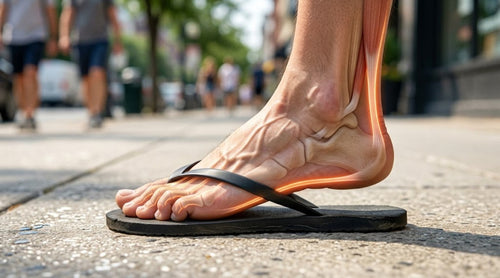
Putting on high heels means placing the foot in permanent plantar flexion: with an 8-centimeter heel, the tilt reaches about 40 degrees depending on the shoe size and shape. The center of gravity then shifts forward, and the body has no choice: it must reorganize itself level by level to keep from falling forward.
Pelvis, lumbar spine, cervical spine: the cascade
The pelvis tilts forward (anterior pelvic tilt), which accentuates the curve of the lower back: lumbar hyperlordosis. Further up, the shoulders and neck adjust in turn to bring the gaze back to the horizontal. Research has clearly shown these changes in lordosis angles and pelvic alignment in regular users (de Oliveira Pezzan et al., 2011). In practical terms, over a full day, a good part of your postural muscle chain works under continuous tension, which explains the sensations of a stiff back or a tight neck at the end of the day.
What science really says
The knee: increased stress, but let's nuance the conclusion
This is the most cited point, and also the most often distorted. The work of Kerrigan's team, published in The Lancet (1998, then 2001), measured in the lab a notable increase in stress at the knee during walking in high heels, on the order of 20 to 25% depending on the parameters studied (force couples and joint pressures). These stresses affect areas precisely involved in cartilage wear.
Let's be rigorous, it's important: these studies are biomechanical measurements carried out in the lab, on small groups of young and healthy women. They show a plausible and consistent mechanism, but they do not prove that wearing heels causes knee osteoarthritis. The causal link is not established, and epidemiological data on the subject remain inconsistent. In other words: there is a serious reason to be cautious, but no need to panic if you wear heels from time to time. For reading this type of studies, see our article on the reliability of scientific studies.
The Achilles tendon and the calf: the best-documented adaptation
This is where the evidence is strongest. In women who have worn heels daily for years, we observe shorter calf muscle fibers and a stiffer Achilles tendon (Csapo et al., 2010), as well as a lasting change in walking mechanics (Cronin et al., 2012). This is exactly what explains this sensation of discomfort, or even pulling, when walking barefoot or in flat shoes after years of daily heels. Good news: the body adapts in both directions, and regular stretching helps preserve this flexibility.
The forefoot: pressure, metatarsalgia, and hallux valgus
In a normal standing position, the load is distributed between the heel and the forefoot. In high heels, it shifts massively forward, up to about three-quarters of the weight depending on the height (Broch et al., 2004). This local overload promotes metatarsalgia (pain under the forefoot) and can irritate the interdigital nerves, causing Morton's neuroma.
On hallux valgus ("bunions"), let's be fair: we often hear that heels are the cause. That's too simple, and a bit unfair. Hallux valgus is first of all strongly hereditary: foot shape, ligament laxity, and family history play the leading role. Footwear is a contributing factor in predisposed people, and it's especially the width of the forefoot (pointed toe that compresses the toes) that matters, more than the height of the heel. If you have hallux valgus, it's therefore not "your fault": it's largely your anatomy.
| Heel height | Load on the forefoot | Overall impact |
|---|---|---|
| Barefoot or flat | Balanced distribution | Physiological |
| 2 to 4 cm (0.8 to 1.5 in) heel | Slightly increased | Moderate, well tolerated |
| 6 cm (2.5 in) heel | Significantly increased | Notable over the day |
| 8 cm (3 in) heel and more | Majority on the forefoot | Strong, to be reserved for occasional use |
The most immediate risk: sprains and falls We think about it less than osteoarthritis, and yet it is the most concrete and frequent danger. High heels reduce the support surface and ankle stability: sprains, falls down stairs, fractures. This risk increases on slippery or uneven ground (cobblestones, grates), in haste, and with alcohol consumption in the evening. Two simple reflexes: keep a pair of flat shoes in your bag for travel, and hold the handrail on the stairs. Finally, do not drive in high heels, because they hinder contact with the pedals.
Want an opinion on your situation? During a vitality assessment, we review together your diet, your sleep, your stress, and your goals, then we build a plan adapted to your pace.
The positive effects, without pretense
It would be dishonest to only present one side. Heels transform the silhouette and the look, by visually lengthening the leg and changing the gait: it is a real aesthetic effect, and it is often the primary reason for wearing them. Many women also report feeling more confident in heels, in certain professional or festive contexts. This feeling counts, and it does not have to be justified.
Two honest clarifications: first, the studies often cited on this subject (Guéguen, 2015; Morris et al., 2013) measure perception by others, not self-confidence: these are two different things, and these social psychology studies, carried out on small groups, belong to a field whose reproducibility is sometimes discussed. Second, the idea that heels "build muscle" in the calves deserves to be corrected: they change the appearance of the calf by the position of the foot, but in the long term, studies show rather shortened muscle fibers and a less efficient walk. It is therefore not a workout, it is a visual effect.
Your body, your choice This article is not a plea against heels, and especially not another injunction addressed to women about what they should wear. Heels are neither a sin nor an imminent danger: they are shoes that stress the body differently, like others. What matters is the dose and the manner. An evening in pumps will leave no trace; eight hours a day, five days a week, for twenty years, that is another story. You know your body, listen to its signals: pain remains the best indicator.
4 rules for wearing heels smartly
1. Alternate, again and again This is the most effective rule of all. Reserve high heels for special occasions or part of the day, and plan flat and flexible shoes for travel and the rest of the time. It is the duration and daily repetition that create lasting adaptations, not occasional wear.
2. Moderate the height daily In everyday use, staying below about 4 centimeters significantly limits the pelvic tilt and the forefoot overload. This benchmark is a practical order of magnitude, not a strict scientific threshold: the higher the heel, the more the stress increases, progressively.
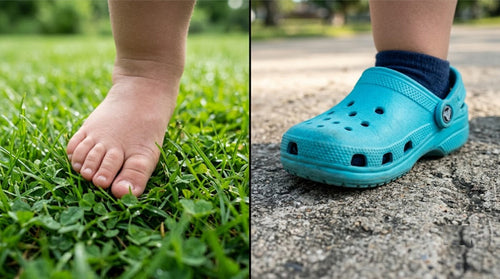
3. Favor the shape, not just the height A wide or wedge heel distributes the load better and stabilizes the ankle, compared to a stiletto heel. Above all, pay attention to the width of the front of the shoe: a rounded or square toe, which leaves the toes free, is much more important for your foot than a few centimeters less. It is the same principle as the one we detail for flexible shoes in children: a foot must be able to move.
4. Give freedom back to the foot Walk barefoot at home as often as possible, on varied textures: it is the best counterbalance to the confinement of the foot in a rigid shoe, and it maintains the intrinsic musculature and balance, as we explain in our article on the benefits of walking barefoot. Be careful, however, not to go abruptly from daily heels to completely flat: the transition must be progressive to spare the Achilles tendon.
The 4-move evening routine

A few minutes in the evening are enough to compensate for a good part of the accumulated tension. Go gently, never forcing or seeking pain: a stretch should be comfortable.
Calf stretch against a wall Hands on the wall, one leg straight behind you, heel firmly anchored to the ground, toes forward. Gently move the pelvis forward until you feel a comfortable stretch in the back of the calf. Hold calmly while breathing, then change legs. Repeat with the back knee slightly bent to target the lower part and the Achilles tendon.
Calf raises on tiptoes Standing, feet flat, slowly rise onto your tiptoes then come down even more slowly, in control. This simple movement strengthens the calf and tendon through its full range of motion, and improves ankle stability. Lean against a wall if necessary.
Plantar massage with a ball Sitting, roll a small ball under the plantar arch and the forefoot, varying the pressure according to your comfort. It is an excellent way to release the plantar fascia and relieve the tension of the day. One to two minutes per foot is enough.
Toe mobility and raised legs Spread and gather the toes, try to move them one by one: this gymnastics restores mobility to a foot that has remained compressed. Finish by lying down for a few minutes with your legs raised against a wall, which relieves the sensation of heavy legs. You can combine it with a natural lymphatic drainage to complete.
Want a mobility routine adapted to your morphology, your daily life, and your possible pain? Join Le Terrier's personalized follow-up at 10 euros per month: we build together realistic habits that protect your joints, without giving up what you love.
When to consult rather than self-manage Certain situations require professional advice rather than a home routine: persistent pain in the foot, knee, or back, already diagnosed osteoarthritis, painful hallux valgus, plantar fasciitis, Achilles tendinitis, or numbness and tingling in the toes. A podiatrist or doctor can assess your situation and, if necessary, offer adapted insoles. During pregnancy, the change in center of gravity and ligament laxity increase the risk of falls and lower back pain: it is better to favor stable shoes. Finally, in case of diabetes or foot sensitivity disorders, podiatric follow-up is essential.
FAQ on heels and health
Do high heels really cause knee osteoarthritis?
This is not proven, and we must be precise. Reference biomechanical studies have measured an increase in stress at the knee during walking in heels, which makes a link plausible with cartilage wear. But these studies, carried out in the lab on small groups, do not establish a cause-and-effect relationship, and epidemiological data remain inconsistent. Caution is justified on prolonged daily wear, without the need to panic about occasional use.
What heel height is reasonable daily?
In everyday use, staying below about 4 centimeters significantly limits the pelvic tilt and the forefoot overload. This figure is a practical benchmark, not a strict scientific threshold: stress increases progressively with height. Beyond 6 to 8 centimeters, it is better to reserve wear for occasional and time-limited occasions, alternating with flat shoes for travel.
Are heels responsible for hallux valgus (bunions)?
Not directly, and it is important to say it. Hallux valgus is first of all strongly hereditary: foot shape, ligament laxity, and family history play the leading role. Footwear is an aggravating factor in predisposed people, and it is especially a narrow and pointed forefoot, which compresses the toes, that poses a problem, more than the height of the heel. Therefore, favor wide, rounded, or square toes.
Why do my calves hurt when I walk barefoot?
This is a well-documented phenomenon in regular heel wearers. Daily and prolonged wear is accompanied by shorter calf muscle fibers and a stiffer Achilles tendon: the sudden switch to flat imposes an unusual stretch, hence the discomfort. Rest assured, it is reversible: the transition must simply be progressive, accompanied by gentle and regular calf stretches, without ever forcing.
Are wedge heels less harmful than stiletto heels?
They are generally more comfortable and safer, because a wide base distributes the load better and stabilizes the ankle, which reduces the risk of sprains. Be careful, however: at the same height, the tilt of the foot and the pelvic tilt remain comparable. A 10-centimeter wedge therefore changes your posture as much as a 10-centimeter stiletto. It is a progress in stability, not a miracle solution on the postural level.
Do heels really give more beautiful calves?
The effect is mostly visual: by placing the foot in extension, the heel highlights the curve of the calf. On the other hand, the idea that they "build muscle" in the calf is inaccurate. Studies on prolonged wear show rather shortened muscle fibers and a less efficient walk, which is not a functional gain. If you want to really strengthen your calves, calf raises on tiptoes are much more effective, and free.
Can you wear heels during pregnancy?
It is better to be cautious and opt for stable shoes. During pregnancy, the center of gravity shifts forward and hormones loosen the ligaments, which increases both the risk of falling and the frequency of lower back pain, already accentuated by hyperlordosis. A low, wide heel of 2 to 3 centimeters, with good grip, is often more comfortable than completely flat shoes. If you experience pain, talk to your midwife or doctor.
How to relieve your feet after a day in heels?
A few simple steps make a real difference: gently stretch your calves against a wall, first with the knee straight, then slightly bent; roll a small ball under the arch of your foot to release the plantar fascia; move your toes one by one; then lie down for a few minutes with your legs raised against a wall to relieve the feeling of heavy legs. A warm foot bath can be a pleasant addition. If the pain persists for several days, consult a podiatrist.
A matter of dosage, not morality
Let's recap without being alarmist. High heels require a complete postural reorganization: pelvic tilt, increased lumbar arch, cervical adjustment, and weight transfer to the forefoot. The best-documented adaptations concern the calf and Achilles tendon, which shorten and stiffen with prolonged daily wear. For the knee, studies show increased strain, but the link with osteoarthritis remains plausible and unproven: let's be cautious without being alarmist. The most concrete risk, which we often forget, is sprains and falls. And hallux valgus depends first and foremost on your genetics. The right approach is therefore not to give up, but to adjust: alternate, moderate the height on a daily basis, choose shoes with a wide toe box, let your feet breathe at home, and spend five minutes in the evening doing a few stretches. Your shoes remain your choice, and it is perfectly possible to love them while taking care of your joints. Let's remember: this content is educational and does not replace medical advice.