Flip-flops: effects on the feet and posture
As soon as the warm weather arrives, we swap our closed-toe shoes for flip-flops, the ultimate symbol of summer lightness. Practical, breathable, and affordable: it's hard to resist them. Yet, an American study that filmed walking in flip-flops frame by frame revealed surprising things about what they really do to our feet. Let's be clear and honest from the outset: it's all a matter of degree. Wearing flip-flops occasionally is not a problem. It's their daily use, as your main shoes for walking for hours, that warrants closer examination. Let's break down the biomechanics of flip-flops together, without being alarmist, and explore how to protect your foot health this summer.
The anatomy of a bad summer idea
Our foot is a marvel of engineering: 26 bones, a plantar arch that acts as a natural shock absorber, and an ankle that stabilizes every step. A well-designed shoe supports this mechanism. Flip-flops, on the other hand, consist of little more than a thin, flat sole and a strap between the toes, with no heel or ankle support. This means the foot has to "grip" the shoe with every step. This isn't a problem over a short distance, but when repeated all day, every day throughout the summer, this constant effort eventually takes its toll. This is exactly what science has been able to measure precisely.
What science says: the Auburn study

A shortened stride and altered heel strike
The landmark study came from Auburn University in Alabama (Shroyer & Weimar, Journal of the American Podiatric Medical Association, 2010). Researchers filmed participants walking in flip-flops and sneakers, respectively, and equipped them with sensors. The first observation: walking in flip-flops alters your gait. The stride becomes shorter, and the heel strike is less pronounced, as if the body reflexively adopts a more cautious walk. Subconsciously, we "know" that the shoe could slip or come off. This finding has been confirmed in children by other studies (Chard et al., 2013).
The "clawed toes" syndrome
The second, and most telling, observation: to prevent the flip-flop from falling off, the toes are constantly contracted, gripping the sole with every step. The toe flexor muscles work continuously, even though they are not designed for this prolonged isometric effort. This constant "gripping" creates unusual neuromuscular stress. We also know that shoes that are too flat and too flexible alter muscle activity and foot mechanics (Cranage et al., 2019). Repeated day after day, this pattern can fatigue the structures of the foot.
Would you like an assessment of your situation? During a vitality assessment, we review your diet, sleep, stress levels, and goals together, then create a plan tailored to your lifestyle.
Biomechanical consequences
| Criterion | Natural walking | Walking in flip-flops |
|---|---|---|
| Stride length | Normal, fluid | Shortened, cautious |
| Heel strike | Firm, cushioned | Muted |
| Toe muscles | Relaxed between steps | Constantly contracted |
| Plantar fascia | Supported | Overstressed |
| Knee-hip-back chain | Aligned | Stressed differently |
Plantar fasciitis: when the foot's "stay" becomes inflamed
The plantar fascia is a band of tissue stretched under the foot that supports the arch like a stay. Deprived of support and overstressed, it can become inflamed and develop micro-tears, leading to plantar fasciitis - the characteristic pain under the heel, often severe in the morning with the first step (Wearing et al., 2006). It is one of the complaints podiatrists see more of every summer.
Achilles tendinopathy
The altered gait and lack of rearfoot support also put unusual stress on the Achilles tendon. Repeated mechanical stress can promote tendinopathy, which is inflammation or damage to the tendon (Maffulli et al., 2003). Once again, it is prolonged, repeated use that is the problem, not an occasional trip to the beach.
The domino effect: knees, hips, and lower back
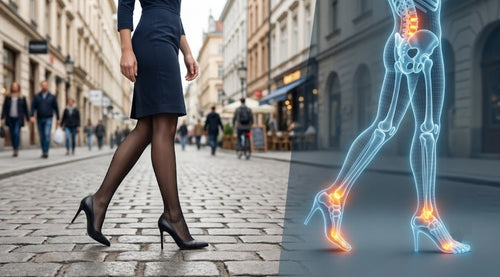
The foot is the foundation of the entire body. When its connection to the ground is altered, the gait changes, and this adaptation can affect the knees, hips, and lower back, one by one. This is known as a possible postural domino effect. Let's be nuanced: this link is biomechanically plausible and has been observed clinically, but everyone reacts differently. Far from everyone will develop pain.
Do you suffer from foot pain in summer or want to protect your posture on a daily basis? Join Le Terrier's personalized follow-up for 10 euros a month: natural health advice, postural hygiene, and tailored support to take care of yourself from head to toe.
The foot as a postural sensor
Beyond mechanics, the sole of the foot is a remarkable sensory receptor. Packed with receptors, it constantly informs the nervous system about our position, the nature of the ground, and our balance: this is proprioception. A flat, loose sole, such as that of a flip-flop, transmits impoverished and unstable signals, which can blur this information and require us to make more frequent balance adjustments. Conversely, feeling the ground accurately and stably supports good posture. This is precisely the point of direct contact with the ground, which we explore in our article on the benefits of walking barefoot.
Alternatives and best practices

When flip-flops are perfectly fine: don't feel guilty; flip-flops have their place. They are ideal for the beach, the pool, locker rooms, the bathroom, and very short distances, where they effectively protect against wet floors and fungal infections. The problem is not the flip-flop itself, but its intensive use as your main walking shoe.
When it's better to avoid them Avoid flip-flops for walking more than a few hundred meters, for long days of sightseeing in the city, for sports, and for driving (the strap can get caught under the pedals, posing a real safety risk). In these situations, a shoe that stays on your foot is much safer and more comfortable.
Physiological alternatives
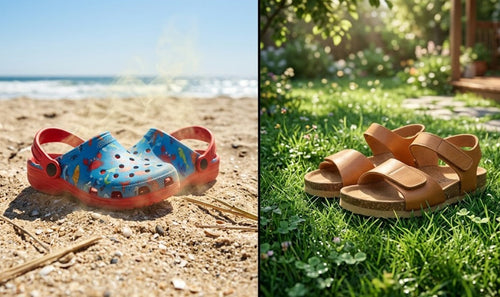
If you like the sandal style all summer, two options will protect your gait. First, anatomical sandals: a molded sole that follows the plantar arch and a support strap at the back of the foot, for real comfort without toe cramping. Next, quality walking shoes or minimalist sandals, which give the foot freedom of movement while providing a minimum of support. The common criterion: the foot should not have to "grip" to keep the shoe on. This attention to good shoes is important at any age, especially for growing children, as we explain regarding children's plastic shoes.
FAQ on flip-flops and foot health
Are flip-flops really dangerous for your feet?
It's important to be nuanced: flip-flops are not "dangerous" for occasional use (beach, pool, short distances). The problem comes from their daily and prolonged use as your main shoe. In this case, the lack of support and the continuous contraction of the toes can promote tension (plantar fasciitis, Achilles tendinitis) and alter your gait. Used sensibly, they are not a problem. The rule is moderation, not prohibition.
Can you drive in flip-flops?
This is not recommended for safety reasons. The strap or sole can get caught under a pedal, slip, or interfere with emergency braking. Even though the law does not explicitly prohibit driving in flip-flops in many countries, in the event of an accident due to a lack of control, you could be held liable. It's better to keep a pair of closed-toe shoes in the car and put on your flip-flops once you arrive.
How can you relieve foot pain in summer?
In the event of pain under the heel (typical of plantar fasciitis), a few simple steps help: give the foot relative rest, alternate with shoes that provide better support, apply cold after exertion, and gently stretch the calf and the sole of the foot. Rolling a ball under the plantar arch can provide relief. If the pain persists for more than a few days or returns every morning, consult a podiatrist or doctor: professional advice is important.
How long can you walk in flip-flops without risk?
There is no official time limit, but common sense suggests reserving them for short distances (a few hundred meters) and occasional use. For a long walk, a day of walking in the city, or a hike, it's better to wear a shoe that stays on your foot. If you feel your toes cramping or discomfort appearing, it's a sign that it's time to change your shoes. Listen to your feet: they are warning you.
What is the difference between a flip-flop and an anatomical sandal?
A flip-flop consists of a thin, flat sole and a strap between the toes, with no support: the foot has to grip to keep it on. An anatomical sandal, on the other hand, has a molded sole that follows the plantar arch and one or more support straps, including one at the back of the foot. The result: the foot is held in place without effort, the toes remain relaxed, and the gait is preserved. It is a much better choice for regular summer use.
Can flip-flops cause back or knee pain?
Indirectly, yes, it is possible. By altering the gait and the foot's connection to the ground, prolonged use of flip-flops can affect the knees, hips, and lower back (postural domino effect). This link is biomechanically plausible and observed in consultations, but it varies greatly from person to person: not everyone suffers from it. In the event of persistent joint pain in summer, make the connection with your shoes and consult if necessary.
Are flip-flops bad for children?
A child's foot is still developing; it needs to move freely but also have a minimum of support. As with adults, flip-flops are suitable for the beach or pool, but not as everyday walking shoes. For playing, running, and walking for long periods, choose shoes or sandals that hold the foot well. A study has also confirmed that flip-flops alter children's gait. Common sense: occasional flip-flops, real shoes for everything else.
How to choose good summer sandals?
Look for three things: a sole that provides a minimum of support for the plantar arch (ideally molded), a support strap at the back of the foot so the sandal stays on without the toes having to grip, and a sole that is neither too thin nor completely rigid, offering some cushioning. Try them on while walking: your toes should not have to "claw" to keep the shoe on. Immediate comfort and a natural gait are the best indicators of a good sandal.
Happy feet without giving up summer
Let's remember the essentials, with balance. Flip-flops are not an enemy to be banned: they remain ideal for the beach, the pool, and short distances, where they are very useful. But science, through the Auburn study, has shown that they alter the gait and cause the toes to cramp, which, with daily and prolonged use, can promote plantar fasciitis, Achilles tendinitis, and tension cascading up to the back. The solution is not to feel guilty, but to use each shoe wisely: flip-flops for their good moments, and anatomical sandals or appropriate shoes for real walking. Your feet, the foundation of your entire posture, deserve this little attention. Take care of them, and fully enjoy the summer. Let's remember: this content is educational and does not replace medical advice; in the event of persistent pain, a podiatrist or sports doctor remains your best ally.