

Shampoo and hair loss: the complete guide to saving your scalp
Reading time: 18 minutes
The invisible enemy in your bathroom
Every morning, you watch with concern as hair accumulates in your shower. You have tried "strengthening" shampoos, "anti-hair loss" ampoules, miracle supplements. Yet, the hair loss persists, or even worsens.
What if the culprit was precisely the product meant to take care of your hair?
Here is a fact that should catch your attention: many conventional shampoos contain sulfates, and one of them, SLS, is used as a reference irritant in dermatology labs. Sodium Lauryl Sulfate (SLS), found in many commercial formulas, is used to induce controlled skin irritation in clinical tests. In a shampoo, it is diluted and rinsed off quickly, which limits its effect for most people, but it can bother sensitive scalps.
The paradox is cruel: you invest in expensive hair care while daily stripping away the protective barrier of your scalp. This vicious cycle of aggressive washing creates a chronic inflammation of the hair follicle, weakens the root, and inexorably accelerates hair loss.
On the agenda:
- The real biochemistry of hair washing and why your hair "suffocates"
- The scientific link between sulfates, inflammation, and alopecia
- How to decipher INCI labels to no longer be fooled by greenwashing
- The ancestral alternative of clay: cleaning without stripping
- Practical recipes for a successful transition to natural products
Important note: This article is intended for informational and educational purposes. Hair loss can have multiple causes (hormonal, genetic, nutritional deficiencies, medication, autoimmune). If you notice abnormal or sudden hair loss, consult a dermatologist or trichologist to establish an accurate diagnosis. The advice presented here concerns the improvement of your washing routine and in no way replaces medical advice.
The biochemistry of washing: why your hair "suffocates"
The role of sebum: more than an oily film, an immune barrier
Before condemning sebum as the enemy to eliminate, let's understand its fundamental role.
Sebum is a complex lipid substance secreted by the sebaceous glands located at the base of each hair follicle. Far from being a simple unsightly "oily film", it fulfills vital functions:
The 5 essential functions of sebum:
| Function | Mechanism | Consequence of a deficiency |
|---|---|---|
| Antimicrobial protection | Maintains an acidic pH (4.5-5.5) hostile to pathogens | Bacterial and fungal proliferation (dandruff, dermatitis) |
| Hydration | Forms a hydrolipidic film preventing evaporation | Dry scalp, flaking, itching |
| Lubrication | Coats the hair shaft | Brittle, dull, split ends |
| UV protection | Contains squalene with photoprotective properties | Degradation of hair proteins |
| Thermoregulation | Participates in the thermal balance of the scalp | Increased sensitivity to temperature variations |
The fundamental problem with conventional shampoos? They do not distinguish between "fresh" sebum (protective) and "oxidized" sebum (to be eliminated). They strip everything, leaving your scalp bare and vulnerable.
The sulfate scandal: SLS and SLES under the microscope
Sodium Lauryl Sulfate (SLS) and its ethoxylated cousin Sodium Laureth Sulfate (SLES) are the most widespread surfactants in the cosmetic industry. Why? Because they are extremely effective at producing abundant foam and eliminating grease.
But this effectiveness comes at a price.
The disturbing scientific fact:
In 1990, researchers Agner and Serup published a foundational study in Contact Dermatitis. Their discovery: SLS became the standard reference irritant in dermatological testing protocols. In other words, when laboratories want to create controlled skin irritation to test the effectiveness of a soothing product, they use... the same ingredient as your daily shampoo.
The mechanism of hair destruction:
-
Protein denaturation: SLS penetrates the hair cuticle and alters keratin, the structural protein of the hair shaft. The hair becomes porous, brittle, unable to retain moisture.
-
Dissolution of the lipid barrier: Sulfates not only emulsify surface sebum, but also the intercellular lipids of the stratum corneum (the scalp's outer layer). Result: a compromised skin barrier.
-
pH modification: A shampoo's pH depends on its whole formula, not just the sulfates: most commercial shampoos are adjusted to between 5 and 7. However, a healthy scalp maintains an acidic pH (4.5-5.5). A more alkaline product, used often, could disrupt the skin microbiome of sensitive scalps.
-
Persistent residues: Unlike mild surfactants, sulfates leave residues that accumulate in the follicle, gradually blocking access to nutrients.
Comparison table: synthetic surfactants vs natural surfactants

| Criterion | Sulfates (SLS/SLES) | Glucosides (Coco/Decyl) | SCI (Sodium Cocoyl Isethionate) |
|---|---|---|---|
| Origin | Petrochemical or processed coconut oil | Sugars + coconut oil | Coconut oil + isethionic acid |
| Lathering power | 5/5 Very high | 3/5 Moderate | 4/5 Good |
| Degreasing power | 5/5 Very aggressive | 3/5 Mild | 3/5 Mild |
| Irritation potential | High (reference irritant) | Very low | Very low |
| Impact on the lipid barrier | Significant destruction | Preservation | Preservation |
| Biodegradability | Average | Excellent | Good |
| Typical pH | Varies with the formula (most often 5-7) | 5-6 (close to scalp) | 5-6 (close to scalp) |
| Production cost | Very low | Moderate | Moderate |
| Suitable for sensitive scalps | No | Yes | Yes |
Why do manufacturers persist? The answer is economic: SLS costs 5 to 10 times less than mild alternatives. And above all, it produces that abundant foam that consumers associate (falsely) with washing effectiveness.
Alopecia and sulfates: a closer link than we think
Silent inflammation: when the barrier falls, the bulb suffers
The American dermatologist Zoe Diana Draelos, a world reference in hair cosmetology, documented in her 2010 work the mechanism by which an altered skin barrier leads to the weakening of the hair bulb.
The cascade process:
Repeated aggressive washing
↓
Destruction of the lipid barrier
↓
Penetration of irritants and allergens
↓
Activation of the inflammatory response
↓
Release of pro-inflammatory cytokines
↓
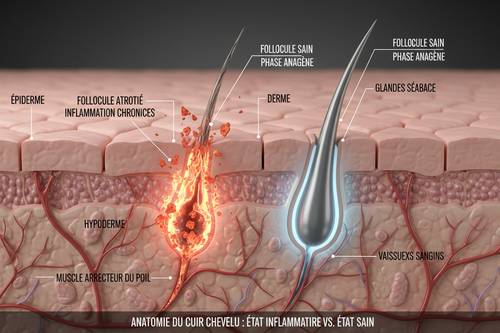
Chronic perifollicular inflammation
↓
Shortening of the hair cycle (anagen phase)
↓
Progressive miniaturization of the follicle
↓
Premature hair loss and thinning
This silent inflammation is all the more pernicious because it does not always produce visible symptoms. You may feel neither itching nor redness, while suffering from chronic micro-inflammation that slowly erodes the vitality of your follicles.
Subtle signs to watch for:
- Scalp that feels "tight" after washing
- Sensation of dryness despite using conditioner
- Hair that gets greasy abnormally fast (sebaceous compensation)
- Small recurring scabs or dandruff
- Increased sensitivity to temperature changes
- Hair that grows back increasingly fine
The vicious cycle of "re-greasing"
Here is the cruel irony of modern hair hygiene: the more aggressively you wash, the more you have to wash.
The mechanism of sebaceous compensation:
When you completely strip away the sebum with sulfates, your scalp detects an emergency situation. The sebaceous glands receive the signal of "critical dryness" and increase their production to restore the protective barrier.
Result: 24 to 48 hours after washing, your hair looks greasier than before. You interpret this as a need to wash again. And the cycle spirals out of control:
Daily washing → Stripping → Reactive hyperseborrhea → Daily washing → ...
This spiral has two disastrous consequences:
-
Exhaustion of the sebaceous glands: By overproducing, they can become permanently deregulated or atrophy.
-
Chronic follicle inflammation: Each wash renews the aggression, preventing any healing of the skin barrier.
The impact of chemical residues on follicle oxygenation
Beyond direct aggression, sulfates and their adjuvants (silicones, polymers, synthetic fragrances) leave residual deposits that accumulate over successive washes.
These residues form an occlusive film around the hair follicle, hindering:
-
Oxygen supply: The hair bulb is a highly metabolically active organ. Reduced oxygenation slows down cell multiplication and weakens the hair shaft.
-
Nutrient absorption: Even if your diet is optimal, micronutrients (iron, zinc, biotin) struggle to reach the hair matrix.
-
Elimination of metabolic waste: The accumulation of cellular toxins accelerates follicle aging.
Supporting studies: electron microscopy analyses revealed silicone deposits (dimethicone, cyclomethicone) persisting up to 15 shampoos after stopping the offending product. These "chemical ghosts" continue to affect hair health long after changing the routine.
Want an opinion on your situation? During a vitality assessment, we review together your diet, sleep, stress, and goals, then build a plan adapted to your pace.
Buying guide: how to choose your shampoo without being fooled?
Hair greenwashing: decipher the marketing traps
The cosmetic industry has perfectly integrated consumer concerns... into its advertising storytelling. Mentions of "Natural", "Sulfate-Free", "Clean Beauty" flourish on packaging, but the INCI reality (International Nomenclature of Cosmetic Ingredients) often tells a different story.
The 5 most frequent traps:
| Marketing claim | What you believe | The INCI reality |
|---|---|---|
| "Sulfate-Free" | Mild surfactants | Often replaced by Ammonium Lauryl Sulfate (ALS) or Sodium C14-16 Olefin Sulfonate, just as irritating |
| "Plant-Based" | Natural formula | 0.1% plant extract drowned in 15 synthetic ingredients |
| "Silicone-Free" | No occlusive residues | Replaced by quats (Polyquaternium-7, etc.) that form the same film |
| "Balanced pH" | Adapted to the scalp | pH "balanced"... at 7. A healthy scalp is at 5.5 |
| "Hypoallergenic" | No risk of irritation | Unregulated term, no legal guarantee |
The golden rule of reading INCI:
Ingredients are listed in descending order of concentration. The first 5 components generally represent 80% of the formula. This is where surfactants are hidden, and this is where you must focus your vigilance.
The "green" list: surfactants to favor
Not all surfactants are equal. Here are those that clean effectively without compromising your skin barrier:
Coco-Glucoside
- Origin: glucose (sugar) + coconut oil
- Properties: very mild, non-irritating, excellent biodegradability
- Lather: light and creamy
- Ideal for: sensitive, reactive scalps, children
Decyl Glucoside
- Origin: glucose + vegetable fatty alcohol
- Properties: extremely mild, compatible with all types of skin
- Lather: fine and airy
- Ideal for: atopic, eczematous skin, after aggressive treatments
Sodium Cocoyl Isethionate (SCI)
- Origin: coconut oil + isethionic acid
- Properties: mild but effective, good degreasing power
- Lather: dense and creamy (the closest to the "classic shampoo sensation")
- Ideal for: transition from sulfates, oily hair
Sodium Lauroyl Methyl Isethionate (SLMI)
- Origin: coconut oil derivative
- Properties: premium alternative to SCI, even milder
- Lather: creamy
- Ideal for: premium formulas, weakened scalps
Sodium Coco-Sulfate (with nuances)
- Warning: despite its "coco" name, it is technically a sulfate. Milder than SLS because it is less refined, but can still be irritating for very sensitive scalps.
The pH criterion: the neglected indicator
The pH of your shampoo is just as important as its ingredient list. Yet, few brands clearly display it.
Physiological reminder:
- pH of a healthy scalp: 4.5 to 5.5 (acidic)
- pH of the hair shaft: 3.5 (acidic)
- pH of most commercial shampoos: about 5 to 7 (some soaps and saponified shampoo bars can go above 8)
The consequences of an unsuitable pH:
| Shampoo pH | Effect on the cuticle | Effect on the scalp |
|---|---|---|
| < 4 (too acidic) | Very closed cuticles (straight but rigid hair) | Possible acidic irritation |
| 4.5-5.5 (optimal) | Naturally tightened cuticles | Microbiome balance preserved |
| 6-7 (neutral) | Cuticles slightly open | Start of microbial disruption |
| > 8 (alkaline) | Cuticles wide open (rough, porous hair) | Destruction of the acid barrier, pathogen proliferation |
How to check? Get pH strips (available at pharmacies) and test your products. A gentle shampoo should be between 5 and 6.
Clay: a natural "shampoo"
Why clay? The principle of adsorption
Clay represents a radically different approach to hair cleansing. Where chemical surfactants dissolve impurities (and destroy everything in their path), clay captures them through a physical mechanism called adsorption.
Absorption vs adsorption: understanding the difference
| Process | Mechanism | Image | Hair application |
|---|---|---|---|
| Absorption | Molecules penetrate inside the material | A sponge soaking up water | Not applicable to clay |
| Adsorption | Molecules attach to the surface of the material | A magnet attracting metal particles | Clay "magnetically" attracts impurities, toxins, and excess sebum |
The unique power of clay:
Clay particles are negatively charged. However, impurities (oxidized sebum, pollution, product residues, toxins) generally carry a positive charge. Through electrostatic attraction, clay captures these unwanted elements without touching fresh sebum or the structural lipids of the skin barrier.
Result: a selective cleansing that eliminates the "bad" and preserves the "good".

Rhassoul, green clay, or white clay? The guide to clays
Not all clays are suitable for all scalps. Here is how to choose:
Rhassoul (Ghassoul)
The ancestral Moroccan clay
| Characteristic | Detail |
|---|---|
| Origin | Atlas Mountains, Morocco (unique deposit in the world) |
| Composition | Magnesium and aluminum silicate, rich in silica |
| Absorbing power | 5/5 Exceptional |
| Texture | Fine, creamy, very easy to rinse |
| pH | ~7 (neutral) |
| Ideal for | Oily to very oily hair, scalps prone to dandruff |
| Frequency | 1-2 times/week |
Particularity: Rhassoul has been used in hammams for over 1000 years. Its layered structure gives it a superior adsorbing power compared to other clays, without drying out the hair.
Green clay (Illite or Montmorillonite)
The versatile European clay
| Characteristic | Detail |
|---|---|
| Origin | France, Europe (multiple deposits) |
| Composition | Aluminum, iron, magnesium, calcium silicates |
| Absorbing power | 4/5 Very good |
| Texture | Grainier, requires careful rinsing |
| pH | ~7.5-8 (slightly alkaline) |
| Ideal for | Normal to oily hair, scalps needing rebalancing |
| Frequency | 1 time/week |
Particularity: Green clay has superior remineralizing properties thanks to its richness in trace elements. It is slightly more "active" than rhassoul.
White clay (Kaolin) or red clay
The ultimate gentleness
| Characteristic | Detail |
|---|---|
| Origin | Multiple deposits worldwide |
| Composition | Hydrated aluminum silicate |
| Absorbing power | 3/5 Moderate |
| Texture | Extremely fine, silky |
| pH | ~5-6 (close to the scalp) |
| Ideal for | Sensitive, irritated scalps, children, dry hair |
| Frequency | 2 times/week possible |
Particularity: Kaolin is the gentlest clay, along with red clay. Perfect for people in transition or with skin sensitivities.
The remineralizing benefits: nourishing the bulb at the source
Beyond cleansing, clay directly provides the hair follicle with essential minerals for keratin synthesis:
Silica (SiO₂)
- Role: major structural component of hair, nails, and connective tissues
- Effect: strengthens the mechanical resistance of the hair shaft, improves elasticity
- Visible deficiency: brittle, dull hair, slowed growth
Magnesium (Mg)
- Role: cofactor for over 300 enzymatic reactions, including protein synthesis
- Effect: promotes growth, reduces inflammation
- Visible deficiency: accelerated hair loss, slow regrowth
Zinc (Zn)
- Role: essential for cell division and keratin production
- Effect: regulates sebum production, antifungal properties
- Visible deficiency: dandruff, seborrheic dermatitis, alopecia
Iron (Fe), mainly in green clay
- Role: transport of oxygen to the cells of the bulb
- Effect: improves the vitality and pigmentation of the hair
- Visible deficiency: fine, discolored hair, diffuse hair loss
Ready to switch to clay?
Discover our cosmetic-grade clays, sourced from ethical producers and packaged without additives. See the clays →
Practical guide: recipes and protocols
The quick recipe: clay shampoo and rosemary hydrosol
Preparation time: 2 minutes | Difficulty: 1/5 Beginner
Rosemary hydrosol with verbenone is known for its properties stimulating the microcirculation of the scalp. Combined with clay, it forms a remarkable anti-hair loss cleansing hair care blend.
Ingredients for 1 application:
| Ingredient | Quantity | Role |
|---|---|---|
| Clay (rhassoul or green) | 2 tablespoons | Adsorbing cleansing base |
| Rosemary hydrosol with verbenone | 4-5 tablespoons | Circulatory stimulant, anti-hair loss |
| Castor oil (optional) | 1/2 teaspoon | Strengthening, coating |
Preparation:
-
In a glass, ceramic, or wooden bowl (never metal, clay loses its properties on contact with metals), pour the clay.
-
Gradually add the rosemary hydrosol while mixing with a wooden spoon until you obtain a fluid paste (the consistency of liquid yogurt).
-
If you want an additional strengthening effect, incorporate the castor oil.
-
Let rest for 5 minutes so that the clay "activates".
Application:
-
On previously wet hair, apply the mixture while gently massaging the scalp with your fingertips (not your nails).
-
Leave on for 3 to 5 minutes, no more, the clay must not dry on your head.
-
Rinse abundantly with lukewarm water, making sure to remove all residue.
-
Finish with a rinse of diluted apple cider vinegar (1 tablespoon for 1 liter of water) to close the cuticles and rebalance the pH.
The "transition" recipe: homemade solid shampoo with gentle surfactants

Preparation time: 20 minutes | Difficulty: 2/5 Intermediate
For those who are not ready to completely give up foam, here is a solid shampoo formula using SCI (Sodium Cocoyl Isethionate), the ultimate gentle surfactant.
Ingredients for ~100g (about 40 washes):
| Ingredient | Quantity | % | Role |
|---|---|---|---|
| SCI (Sodium Cocoyl Isethionate) | 50g | 50% | Gentle cleansing base |
| White clay (kaolin) | 20g | 20% | Gentle adsorption, glide |
| Virgin coconut oil | 15g | 15% | Nutrition, facilitates unmolding |
| Nettle powder | 10g | 10% | Remineralizing, anti-hair loss |
| Rosemary hydrosol | 5g | 5% | Aqueous phase, natural fragrance |
| Atlas cedar essential oil | 10 drops | Hair stimulant (optional) |
Necessary equipment:
- Bain-marie
- Heat-resistant bowl
- Silicone mold
- Protection mask (SCI is volatile and irritating to the respiratory tract in powder form)
Preparation:
-
Wear a mask and work in a ventilated area.
-
In a gentle bain-marie (~50-60°C (122-140°F)), melt the SCI with the coconut oil. Mix until you obtain a homogeneous paste.
-
Off the heat, incorporate the white clay and nettle powder. Mix carefully.
-
Add the rosemary hydrosol (the mixture will "sizzle" slightly, this is normal).
-
Incorporate the essential oil if desired.
-
Transfer quickly into the mold and press firmly.
-
Let dry for 48 to 72 hours before unmolding.
-
Cure for 2 weeks before use (the time for the shampoo to harden completely).
Use: rub the bar on wet hair or lather between your hands before application.
The washing protocol: why 2 washes per week are enough
The transition to spaced washing is the most delicate step, and the most liberating. Here is how to succeed in this transition.
Understanding the "transition crisis":
For 2 to 6 weeks after stopping sulfates, your scalp will go through a rebalancing phase. The sebaceous glands, accustomed to overproducing to compensate for daily stripping, take time to regulate.
Normal symptoms during the transition:
- Hair oilier than usual
- Sensation of heaviness
- Waxy texture in places
- Sometimes temporary dandruff (detoxification)
These symptoms are temporary and correspond to an adaptation period of your scalp.
The progressive protocol over 8 weeks:
| Week | Washing frequency | Product type | Notes |
|---|---|---|---|
| 1-2 | Every other day | Gentle shampoo (SCI/Glucosides) | Sulfates withdrawal |
| 3-4 | Every 2-3 days | Alternate gentle shampoo and clay | Introduction of clay |
| 5-6 | 2 times/week | Mainly clay | The scalp regulates |
| 7-8 | 2 times/week | Clay or gentle shampoo | Balance achieved |
| Maintenance | 1-2 times/week | According to preference | Freedom regained |
Tips to "hold out" between washes:
-
Natural dry shampoo: Sprinkle white clay or cornstarch on the roots, massage, brush.
-
Daily brushing: 50 to 100 strokes with a natural bristle brush distribute the sebum over the lengths (the best conditioner that exists).
-
Strategic hairstyles: Braids, buns, textured ponytails mask the roots during the transition period.
-
Hydrosol spray: Spray rosemary or lavender hydrosol to refresh without washing.
Toward a conscious hair routine
At the end of this guide, one thing is clear: "unexplained" hair loss often has a very simple explanation, the daily chemical aggression we unconsciously inflict on our scalp.
Summary of your action plan
Step 1: audit your bathroom
- Turn your bottles around and analyze the first 5 INCI ingredients
- Eliminate any product containing SLS, SLES, ALS, Sodium C14-16 Olefin Sulfonate
Step 2: gentle transition
- Replace with formulas based on Coco-Glucoside, Decyl Glucoside, or SCI
- Check that the pH is below 6
Step 3: introduction of clay
- Choose your clay according to your scalp type
- Start with 1 clay wash per week, alternating with a gentle shampoo
Step 4: progressive spacing
- Gradually reduce washing frequency
- Goal: 2 washes per week maximum
Step 5: patience and observation
- Give your scalp 6 to 8 weeks to rebalance
- Document the evolution (monthly photos)

Final thoughts
Hair health, like any aspect of well-being, requires patience and consistency. After years, or even decades, of chemical aggression, your scalp will not regenerate in a week.
But many people who switch to a gentler routine report not only a significant reduction in hair loss, but also an overall transformation in the quality of their hair, making it thicker, shinier, and more vibrant.
The ancient clay of the Atlas Mountains, rosemary growing by the roadside... Before looking for complex and expensive solutions, let's not forget that nature has often already found the answer.
Your scalp is waiting for one thing: for you to stop assaulting it so it can regain its balance.
This article is provided for informational and educational purposes. It is not a substitute for professional medical advice. In case of significant or sudden hair loss, consult a dermatologist or trichologist.
Main sources:
- Agner, T., & Serup, J. (1990). "Sodium lauryl sulphate for irritant patch testing." Contact Dermatitis.
- Draelos, Z. D. (2010). "Essentials of Hair Care Often Neglected: Hair Cleansing." International Journal of Trichology.
- Gavazzoni Dias, M. F. (2015). "Hair Cosmetics: An Overview." International Journal of Trichology.
- Trüeb, R. M. (2007). "Shampoos: Ingredients, efficacy and adverse effects." Journal of the German Society of Dermatology.
Want daily support? Le Terrier's personalized follow-up, at €10 per month, allows you to ask us questions in writing and progress at your own pace.
Frequently Asked Questions
Everything you need to know about the link between shampoo and hair loss
Specific effects on fine hair:
- Increased porosity of the hair shaft
- Damaged cuticles that no longer close properly
- Loss of the natural protective lipid layer
- Hair breakage starting mid-shaft
- Dull and cottony appearance after drying
Lather comparison by surfactant:
- Sulfates (SLS/SLES): Abundant lather, large bubbles
- Sodium Cocoyl Isethionate (SCI): Dense and creamy lather, very close to the classic sensation
- Glucosides (Coco/Decyl): Light, fine lather, smaller bubbles
- Clay: No lather (cleaning by adsorption)
Immediate warning signs (after washing):
- Scalp that feels "tight" or a sensation of dryness
- Itching in the hours following washing
- Visible redness on the scalp
- Hair that feels "squeaky" to the touch
- Hair that gets greasy abnormally fast
- Recurring dandruff
- Hair that grows back increasingly fine
- Hair loss concentrated on the top of the head
Why clay works:
Unlike surfactants that dissolve impurities, clay uses adsorption: its negatively charged particles attract positively charged impurities like a magnet.
Benefits of clay:
- Selective cleaning (preserves protective sebum)
- No irritating surfactants
- Mineral replenishment (silica, magnesium, zinc)
- Zero chemical residue
- Preparation time (2-3 min)
- Longer rinsing
- Adaptation period of 2-6 weeks
Rhassoul, Recommended if:
- Oily to very oily scalp
- Hair loss related to excess sebum
- Tendency toward oily dandruff
- You are just starting with clay
Green clay, Recommended if:
- Normal to oily scalp
- Hair loss related to a mineral deficiency
- Need to detoxify after years of chemical products
White clay, Recommended if:
- Sensitive or irritated scalp
- Hair loss related to chronic inflammation
- Dry or damaged hair
What influences the duration:
- Duration of sulfate use: Longer = more difficult transition
- Previous washing frequency: Daily washing = longer transition
- Scalp type: Oily scalps take longer
- Use of silicones: Complete removal = 10-15 washes
- Weeks 1-2: greasier hair, sensation of heaviness
- Weeks 3-4: "waxy" texture, sometimes temporary dandruff
- Weeks 5-6: gradual improvement
- Weeks 7-8: balance achieved
Why an acid rinse is beneficial:
- pH rebalancing: Restores the protective acidity (pH 4.5-5.5)
- Cuticle closure: Smoother and shinier hair
- Removal of mineral residue: Dissolves hard water deposits
- Easier detangling
1 to 2 tablespoons of ORGANIC apple cider vinegar in 1 liter of warm water. Pour after rinsing. Do not rinse out.
Alternatives:
- Diluted lemon juice
- Rosemary or lavender hydrosol
- Cooled green tea as a rinse
The daily washing myth:
The idea that you need to wash your hair every day is a marketing construct from the 1970s-80s. Before that, people washed their hair once a week without any problems.
Recommended frequency:
- Dry/curly/coily hair: 1 time/week
- Normal hair: 2 times/week
- Oily hair (after transition): 2-3 times/week
- Athletes: Rinse with water after exercise, shampoo 2-3 times/week
- Preservation of the lipid barrier
- Natural sebum regulation
- Less exposure to surfactants
- Time and money savings

5 comments
Merci, une mine d’information avec des produits naturels simples et efficaces. J’adore
Très instructif mais de l’argile au Québec est très difficile à trouver.Merci pour vos explications et ça aide à comprendre le comportement de mes cheveux secs.Je viens de découvrir votre site et vous avez de très bons sujets qui m’intéresse beaucoup.Bonne journée
Très intéressant. Merci pour ces informations….
Merci ❤️
Très très instructif et intéressant merci 👌