Clay program: benefits, protocol and precautions for safe use
Share
Clay is one of the best-known home remedies. A purifying mask, a poultice on a painful joint, "clay water" first thing in the morning on an empty stomach: it has been used for centuries, both for the body and the skin.
But clay is not to be taken lightly, especially when ingested. Here is what it really does, what is based on tradition, and how to use it safely.
What clays and for what purpose?
| Clay | Characteristics | Common uses |
|---|---|---|
| Green clay (illite or montmorillonite) | The most widely used, highly absorbent | Masks for oily skin, poultices, internal use for some |
| White clay (kaolin) | Gentle, non-drying | Sensitive and dry skin |
| Red clay | Rich in iron oxide, gentle | Sensitive skin, dull complexion |
| Ghassoul (rhassoul) | Moroccan cleansing clay | Gentle shampoo and cleanser for skin and hair |
Not all clays are equal for internal use: only some are tested and intended for ingestion. Always check the label: if it says "for external use only", do not drink it.
What clay really does
Clays have a layered structure that allows them to retain water and bind certain molecules to their surface: this is adsorption. This explains their effect on excess sebum on the skin, or their ability to bind some gases and liquids in the intestine.
In fact, medicine uses a purified clay, diosmectite, to treat acute diarrhea. However, in 2019, the ANSM advised against its use in children under two years old due to naturally occurring traces of lead in the clay and recommended short courses for adults. This is a good reminder: even natural clay can contain metals.
What has not been proven: the idea that clay "absorbs toxins" or "heavy metals" from the body. In the laboratory, it does bind certain substances, but there is no evidence that a clay program detoxifies the body. It can also bind nutrients or medications.
Would you like an opinion on your situation? During a vitality assessment, we review your diet, sleep, stress, and goals together, then create a plan tailored to your pace.
Internal clay program
In naturopathy, clay water is traditionally used in a short course to support difficult digestion or rapid transit. Here is the gentlest method:
1. The evening beforePut one level teaspoon of superfine green clay intended for internal use in a glass of water. Mix and leave to rest overnight.
2. In the morningDrink only the water on top, without the clay settled at the bottom. This is the gentlest way to start.
3. For the following daysDepending on your tolerance, some people then mix the sediment before drinking. Stick to a short course of one to three weeks, then take a break.
Traditionally, metal utensils are avoided. There is no evidence that this is essential, but a wooden or glass spoon costs nothing.
Do not take clay internally: in children, during pregnancy and breastfeeding, in cases of constipation, intestinal obstruction, or a history of digestive surgery, or for long-term use. Space it at least two hours apart from any medication or supplement, including the pill, as it can reduce their absorption. In case of diarrhea with fever or blood, or that persists, consult a doctor.
External use of clay
The poultice
Mix green clay powder with water until you obtain a thick paste, or use ready-made clay. Spread a layer one to two centimeters thick on a compress or directly on the skin, leave on for one to two hours, then rinse. It is traditionally used on joints, minor bruises, and muscle tension. Never apply it to an open wound or burn.
The face mask
Mix one tablespoon of clay with a little water or hydrosol. Apply in a thin layer, avoiding the eye area, leave on for 5 to 10 minutes without letting it dry out completely, then rinse with lukewarm water. Once or twice a week is enough. For oily skin, green clay; for sensitive skin, red or white clay.
Ghassoul for hair and body
Diluted in lukewarm water, this clay cleanses gently without lathering. It is well suited for oily hair and combination skin.
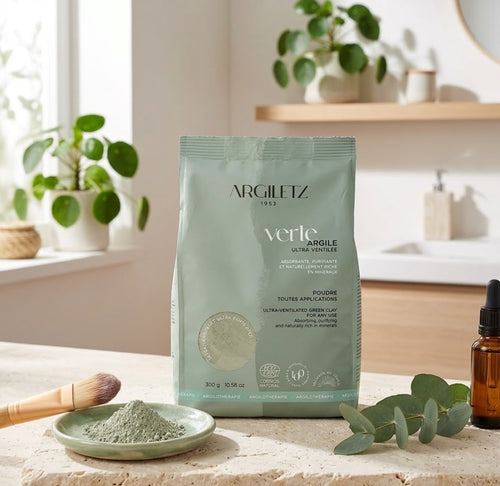
For your skincare, discover our ready-to-use green clay, ideal for masks and poultices, and the ultra-ventilated ghassoul for gentle cleansing.
Other practical uses
Clay is also useful around the house. Mixed with baking soda, it helps clean fruits and vegetables, as we explain in our article on cleaning fruits and vegetables. In powder form, it can also be used as a base for homemade toothpaste or deodorants, provided you choose a high-quality product.
Frequently asked questions
What are the benefits of green clay?
For external use, it absorbs excess sebum, purifies the skin, and can be used as a soothing poultice. For internal use, it is traditionally used in a short course for digestive comfort, especially in cases of rapid transit. However, its "detox" effect has not been proven.
How do you follow a clay program?
Put one level teaspoon of clay intended for internal use in a glass of water the evening before, and drink only the water on top in the morning. Limit the course to one to three weeks and space it at least two hours apart from your medications.
Can you drink clay every day?
Not for long. A short course is enough, followed by a break. Clay may contain traces of metals, bind nutrients, and reduce the absorption of medications. It is not recommended for children, during pregnancy, or in cases of constipation.
Does clay eliminate toxins and heavy metals?
This has not been proven in humans. Clay binds certain substances in the laboratory, but no study shows that a clay program detoxifies the body. It even naturally contains traces of metals, which is why it is important to choose a tested clay.
Which clay should you choose for your face?
Green clay is suitable for oily and acne-prone skin, white clay for dry and sensitive skin, and red clay for sensitive skin and a dull complexion. Ghassoul is ideal for gentle cleansing.
How long should you leave a clay mask on?
Between 5 and 10 minutes, without letting it dry out completely, because clay that cracks dries out the skin. Spray a little water or hydrosol if needed, then rinse with lukewarm water and apply a moisturizer.
Does a clay poultice relieve joint pain?
It is traditionally used for this, and many people find it soothing, especially thanks to the cooling or warming effect. Studies are rare. It can complement a treatment plan, but persistent pain or swelling should be examined by a doctor.
Can clay be stored?
In powder form, it can be stored for a long time in a dry, sealed container. Ready-made clay should be kept according to the indicated date. A paste prepared at home should be used quickly and not stored.
A simple ally, to be used sensibly
Clay is a simple, affordable, and versatile remedy, especially for the skin. For internal use, it can occasionally support digestive discomfort, provided you choose a clay intended for this purpose, stick to short courses, and follow the precautions. Keep in mind that it does not "cleanse" the body of toxins: its benefits lie elsewhere. Used sensibly, it has a place in your natural toolkit.
Looking for natural skincare or digestive support tailored to you? Le Terrier's personalized follow-up at 10 euros per month helps you choose the right steps safely.
This article is for informational purposes and does not replace medical advice.
Learn more
- The eliminative organs in naturopathy: understanding and supporting the organs of elimination
- Pesticides on fruits and vegetables: baking soda, clay, which method?
- Intestinal health: the complete guide to naturally balancing your microbiota
- Hydrating or nourishing your skin: the difference you need to know (and the routine that works)