Sun and skin cancer: the Nordic paradox and how to get sun exposure safely
Share
Sun and skin: a more nuanced topic than it seems
For decades, the public health message has been monotonous: the sun is an enemy, a mutagenic agent that must be avoided at all costs under layers of chemical filters. Yet, the link between the sun and melanoma is more subtle than we think: the way you expose yourself matters as much as the amount of sun you receive, and your skin color plays a major role.
The idea here is to look beyond the symptom to understand the biology of your constitution. Why does Norway have significantly higher rates of skin cancer than Greece or Italy? The answer lies mainly in two factors: lighter skin, which is therefore less protected, and sudden, intense exposure during vacations.
The sun is essential, and it is especially the alternation between a lack of light and sudden, intense exposure that damages the skin. Welcome to the era of thoughtful sun hygiene.
1. The Nordic paradox: when a lack of sun becomes a major risk
It is an epidemiological finding that seems to defy logic: Scandinavian countries (Denmark, Norway, Sweden), despite their low annual sunshine, have some of the highest rates of melanoma in Europe. In contrast, Mediterranean countries, bathed in light all year round, have significantly lower rates. This is sometimes referred to as the Nordic paradox. It is largely explained by the very fair skin of Northern populations and the way they expose themselves.
“Binge Tanning”: intermittent exposure under scrutiny
Research conducted by the Euromelanoma working group highlights a fundamental distinction between chronic exposure (regular and moderate) and intermittent exposure (sudden and intense).
The real danger does not lie in living under the sun, but in the “shut-in city dweller” syndrome:
-
The typical profile: an individual who spends 50 weeks a year in an office, under artificial light, chronically deficient in vitamin D.
-
The thermal shock: during summer vacation, this individual exposes “white” skin that is unprepared for a UV index of 9 for several hours.
-
The consequence: sunburn (erythema). It is this sudden aggression, and not the sun itself, that causes mutations in the DNA of melanocytes.
The mistake of total avoidance
By systematically avoiding the sun, we have created a generation of “under-exposed” populations whose skin has lost its natural ability to adapt. Melanin, the biological shield our body produces to protect us, is only synthesized through gradual exposure.
The scientific finding: outdoor workers (farmers, sailors, construction workers), although more exposed to total UV, statistically develop fewer malignant melanomas than office workers. One possible explanation: skin that is gradually accustomed to the sun burns less. On the other hand, they develop more other skin cancers (carcinomas), linked to cumulative exposure. Chronic exposure is therefore not without risk.
2. Vitamin D: your internal biological shield
If we had to designate a single molecule capable of protecting our body against the uncontrolled proliferation of cells, it would be Vitamin D. Yet, its name is misleading: it is not a simple dietary vitamin, but a prohormone synthesized by our skin under the action of UVB rays.
The anti-cancer protection mechanism
Major research, notably by the Harvard T.H. Chan School of Public Health, has highlighted the “oncoprotective” role of vitamin D. It acts at several levels:
-
Regulation of the cell cycle: it slows down the uncontrolled multiplication of cells (proliferation).
-
Induction of apoptosis: it helps the body “order” the suicide of cells whose DNA is damaged.
-
Anti-angiogenesis: it limits the formation of new blood vessels that would nourish a tumor.
A vitamin D deficiency, widespread in our modern societies, is associated with an increased risk of colon, breast, and prostate cancers and, paradoxically, more aggressive melanomas.
The trap of applying sunblock too early
The Journal of the American Osteopathic Association published alarming data: the systematic application of a sunscreen with an SPF of 15 or higher reduces the skin’s production of vitamin D by 99% in laboratory conditions. In real life, we apply less cream, and the effect is much more modest.
By slathering yourself in cream from the first minute of exposure, you certainly block the rays that could burn you, but you also reduce the production of vitamin D. The solution is not to eliminate cream, but to delay its application by 15 to 20 minutes to give the biochemical cascade time to kick in.
3. Understanding the enemy: sunburn (erythema) vs. the sun
To understand why the sun is not the culprit, we must stop confusing “radiation” and “burning.” In my naturopathic practice, I like to use the athlete analogy.
If you have never lifted weights and you try to lift 100 kg (220 lb) at your first weightlifting session, you will tear a muscle. Is it the weight’s fault? No, it is the fault of the load being unsuitable for your current level.
The “solar tan”: gradually acclimating your skin
Melanin is the pigment your body produces to absorb UV rays and protect the DNA of the cell nuclei. It offers real protection, but it is limited: a tan corresponds roughly to an SPF of 3 to 4, far from total protection. And this shield is not built in a day. It requires regular, moderate, and gradual exposure.
Sudden exposure (“Binge Tanning”) causes immediate damage: cyclobutane pyrimidine dimers (CPD), direct DNA lesions. It is the accumulation of these burns on “new” skin that creates the favorable conditions for melanoma.
Comparison table: therapeutic vs. toxic exposure
Here is how to distinguish therapeutic exposure from toxic exposure:
| Characteristic | Gradual Exposure (Health) | Sudden Exposure (Danger) |
| Frequency | Daily or regular (Spring/Summer) | Intermittent (Vacations, Weekends) |
| Duration | Short (15-30 min depending on phototype) | Prolonged (several hours at once) |
| Skin effect | Melanin synthesis (Solar tan) | Erythema (Sunburn/Burning) |
| Vitamin D Impact | Improved circulating levels | Blocked by protection or burns |
| Melanoma Risk | Lower than in sudden exposure | Significantly increased |
4. Naturopathic protocol: preparing your skin from within
In naturopathy, the skin is seen as a reflection of your internal metabolic balance. If your constitution is inflammatory or deficient, your ability to handle UV radiation will be poor. To avoid sunburn, the strategy begins on your plate, weeks before exposure.
Photoprotective micronutrition: your “internal sunglasses”
Certain nutrients have the ability to accumulate in the layers of the epidermis to neutralize free radicals generated by UV rays. This is what we call systemic photoprotection.
-
Astaxanthin: this red pigment from microalgae is one of the most powerful antioxidants in the world. Clinical studies suggest that it increases the time required for sunburn to appear (erythema threshold).
-
Lycopene: found in cooked tomatoes or watermelon, it helps reduce the oxidation of skin lipids.
-
Omega-3s (EPA/DHA): by modulating the inflammatory response, they reduce the skin’s sensitivity to burns. A study published in The American Journal of Clinical Nutrition shows that fish oil consumption reduces sun-induced immunosuppression.
The importance of your constitution: liver and lymphatic system
In naturopathy, a reactive skin is often linked to an overloaded liver, since the liver recycles hormones and manages toxins. This link is not scientifically proven, but taking care of your lifestyle in spring (diet, sleep, possibly plants like desmodium or artichoke, with the advice of a professional) can only support a healthy skin.
Expert advice: do not rely solely on classic “tanning preparation” capsules, which are often overdosed with synthetic beta-carotene. Prioritize a complete constitutional assessment.
5. Practical guide: how to “train” your melanin this summer?
Taming the sun requires method. Here is the step-by-step protocol to maximize your Vitamin D while minimizing the risk of DNA damage.
The 20-minute rule (the “naked” exposure)
The goal is to produce your Vitamin D supply without reaching the redness stage.
-
Time: expose yourself for 10 to 20 minutes depending on your skin type, with arms and legs uncovered, without sunscreen, always staying well below redness.
-
Frequency: regularity prevails over intensity. It is better to spend 15 minutes every day than one hour once a week.
-
Timing: around midday, vitamin D is produced the fastest, but the risk of burning is also the highest: a few minutes are then enough. To spend more time outdoors, prefer the morning or late afternoon.
-
Precautions: if you have very fair skin, many moles, or a history of skin cancer, ask for your dermatologist’s advice before any unprotected exposure.
Secondary protection: knowing when to stop
Once you have received your “dose” of light, protection becomes imperative if you stay outdoors.
-
Textiles: this is the safest and least toxic protection. A cotton t-shirt or a wide-brimmed hat beats any cream.
-
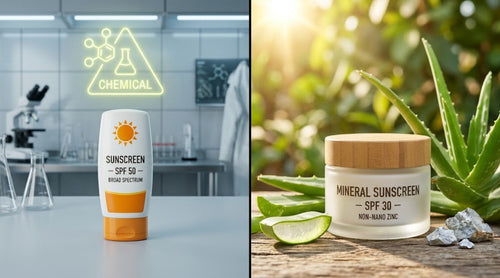
Mineral filters: if you must use a cream, favor mineral filters (Zinc Oxide or Titanium Dioxide without nanoparticles). Unlike several chemical filters, found in the blood during FDA studies, they practically do not cross the skin and act mainly as a screen on its surface.
-
Electrolyte hydration: the sun makes you sweat and consumes your minerals. Do not just drink plain water: add a pinch of sea salt or a little Quinton water to maintain the hydration of your skin cells.
Toward responsible sun hygiene
The sun is not to be avoided: it is essential, provided you expose yourself to it in moderation. By avoiding UV radiation for fear of cancer, we have paradoxically weakened our first line of defense: our innate immunity and our ability to regenerate cells via vitamin D.
The naturopathic approach does not consist in denying the dangers of radiation, but in giving you the keys to become resilient. Moving from a “victim” skin that burns to an “athlete” skin that adapts requires patience, targeted nutrition, and gradual exposure. The sun is the source of all life on Earth; learn to tame it, not fear it.
Go further
You have understood that your skin’s health is determined long before exposure. If you suffer from chronic skin problems, intense fatigue, or simply want to improve your constitution before summer, do not stay alone with your questions.
Take action
-
Personalized consultation: book your First Naturopathy Assessment to establish your custom micronutrition protocol (Vitamin D dosage, specific antioxidants, liver support).
-
Personalized follow-up: for 10 euros a month, discover Le Terrier's personalized follow-up and ask us your questions for real-time monitoring of your lifestyle.
Frequently asked questions about the sun and health
Can you synthesize vitamin D behind glass?
No. Glass blocks almost all UVB, which are the only rays capable of triggering the synthesis of vitamin D in your skin. UVA, on the other hand, pass through and can damage your cells.
Do vitamin D capsules completely replace the sun?
Not completely. While supplementation helps maintain your levels in winter, the sun brings other benefits that cannot be reproduced in capsules: regulation of the circadian rhythm, production of serotonin (mood) and nitric oxide (cardiovascular health).
Can you tan when it is cloudy?
Yes. Up to 80% of UV rays pass through thin clouds. Vigilance is required because the lack of heat sensation (due to the blocking of infrared rays) increases the risk of sunburn by inattention.
How long do you need to expose yourself for vitamin D?
On average, 15 to 20 minutes on 25% of the body surface (arms, legs) is enough during the zenith hours for a light phototype. The darker your skin, the longer the exposure must be.
Why does my skin never tan but always burn?
It is most often genetic: very fair skin (often with freckles, red or blonde hair) produces little protective melanin. It must protect itself particularly well and have its moles monitored. A diet rich in antioxidants helps the skin, but does not change this starting point.
Is tanning in a booth (artificial UV) protective?
Absolutely not. Tanning beds mainly emit UVA for a “surface” tan without creating the protective skin thickening that UVB triggers. It is a major risk factor for melanoma.
Should you shower immediately after exposure?
Nothing shows that a shower right after exposure “erases” vitamin D: it is made in the skin, not on its surface. You can therefore shower normally, then well hydrate your skin.
What is the best antioxidant for the skin?
Astaxanthin is often highlighted: in the laboratory, it neutralizes certain free radicals very effectively, and a few studies suggest that it reduces the skin's sensitivity to UV rays. The notable figures that circulate ("6,000 times more powerful than vitamin C") come from test tube tests and are not verified as such in the body. A colorful diet (cooked tomatoes, carrots, fatty fish, berries) remains the foundation.