Sunburn: How to Protect Your Skin Naturally This Summer
Share
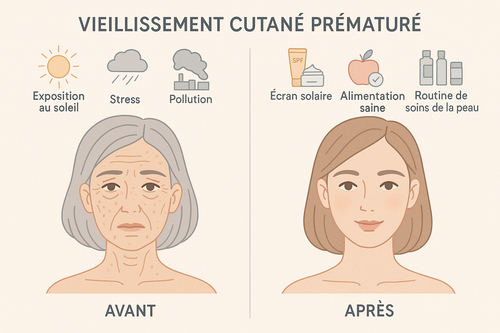
A sunburn is more than redness that fades in a few days. It is a burn caused by ultraviolet rays, and repeated sunburns, especially in childhood, increase the risk of skin cancer in adulthood. The good news: the habits that protect you best are also the simplest, and you can choose more natural sun protection without taking risks.
Here, in order, is what protects you most, what we think of conventional sunscreens, what to know before making your own, and how to soothe your skin once the sunburn is there.
The habits that protect you most
No sunscreen beats shade and clothing. Avoid the sun when UV rays are strongest, roughly between noon and 4 p.m. in summer in France. Wear a wide-brimmed hat, sunglasses, and clothes that cover you; tightly woven, dark fabrics filter better, and there are UV-protective clothes for the beach. Check the UV index in the weather forecast: from 3 up, protection is useful; from 8 up, it is better to stay in the shade in the middle of the day.
These habits matter twice as much for children, whose skin burns faster. Babies under one year old should not be exposed to direct sunlight.
Sunscreens: why we prefer mineral filters
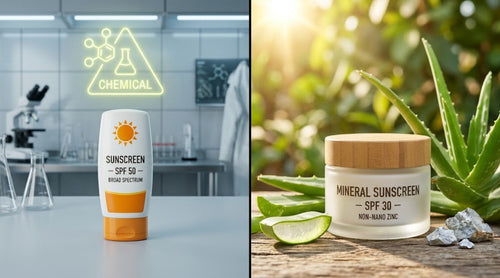
Conventional sunscreens often use so-called chemical filters, which absorb UV rays: avobenzone, oxybenzone, octocrylene, homosalate, octisalate, and octinoxate. In 2019 and 2020, two studies by the U.S. Food and Drug Administration (FDA) published in JAMA (Matta et al.) showed that these six filters pass into the bloodstream after a single application, above the level at which the FDA asks for additional safety studies.
The FDA itself states: "The fact that an ingredient is absorbed through the skin and into the body does not mean the ingredient is unsafe." To date, no study has shown a health risk at usual doses. But these filters do enter the blood and their long-term effects are still poorly understood: as a precaution, we prefer to avoid them and choose sunscreens with mineral filters, zinc oxide and titanium dioxide. These are, in fact, the only two filters the FDA currently considers safe and effective. Some chemical filters, such as oxybenzone and octinoxate, are also a problem for coral reefs, to the point of being banned in Hawaii.
That is no reason to give up sunscreen, though: a conventional sunscreen is better than no protection at all. To choose a good mineral sunscreen, look for:
- an SPF of 30 to 50, and the words "broad spectrum" or the circled UVA logo, which guarantees protection against UVA rays;
- preferably non-nano zinc oxide;
- a generous amount: the equivalent of six teaspoons for an adult's body, often much more than people actually apply;
- a fresh application every two hours and after each swim.
To learn more, we go over these filters in detail in our article on chemical and mineral sunscreens.
Want an opinion on your situation? During a vitality assessment, we review your diet, sleep, stress, and goals together, then build a plan tailored to your pace.
What about homemade sunscreen?
It is possible, but you need to know what to expect. No one can measure a sunscreen's protection factor at home: it depends on the amount of zinc oxide and above all on how evenly the powder is spread through the cream. A poorly mixed preparation leaves areas without protection. A study published in Health Communication in 2019 (Merten et al.) analyzed homemade sunscreen recipes shared on Pinterest: 68% of them offered insufficient protection. One of the authors concludes: "Homemade sunscreen products are risky because they are not regulated or tested for efficacy like commercial sunscreens."
If you still want to try, here is a recipe for guidance only, to be kept for short exposures, outside the hottest hours, and always with a hat and clothing:
- 50 g (about 1.8 oz) of shea butter;
- 30 ml (about 2 tablespoons) of vegetable oil (jojoba or sweet almond);
- 20 to 25 g (about 0.7 to 0.9 oz) of non-nano zinc oxide, or about one fifth of the mixture.
Melt the shea butter in a double boiler, add the oil, let it cool until lukewarm, then work in the zinc oxide little by little, stirring for a long time until you get a smooth, even cream. Wear a mask while handling the powder so you don't breathe it in. Store it in a cool place away from light, and use it within two months.
This cream does not replace a tested sunscreen for children, the beach, the mountains, or long exposures. And be wary of oils presented as "natural sunscreens": the figure often quoted for raspberry seed oil (SPF 28 to 50) comes from a lab measurement of how much UV the oil absorbs (Oomah et al., 2000), not from a protection test on skin. No vegetable oil protects enough on its own.
Soothing your skin after a sunburn
Cool your skin under a lukewarm to cool shower, then apply pure aloe vera gel or a simple moisturizer. Aloe vera soothes the burning sensation, even though the evidence on how fast it helps healing remains limited. Drink more, because a sunburn dehydrates you, and stay out of the sun as long as your skin is red. Don't pop the blisters.
See a doctor if the sunburn covers a large area with blisters, if it comes with fever, chills, headache, or nausea, or if it affects a baby or a young child.
To prepare your skin gently before summer, also read our tips for preparing your skin for the sun naturally and our article on the sun, vitamin D, and skin cancer.
Want day-to-day support? Le Terrier's personalized follow-up, at €10 per month, lets you ask us your questions in writing and move forward at your own pace.
Frequently asked questions
Are chemical sunscreens dangerous?
No danger has been proven at usual doses. But FDA studies have shown that several chemical filters enter the bloodstream, and their long-term effects are still poorly understood. As a precaution, we prefer mineral filters: zinc oxide and titanium dioxide.
Does homemade sunscreen really protect you?
Its protection factor is impossible to measure at home and often too low. It may be fine for short exposures, outside the hottest hours and with covering clothes, but not for children or for a day at the beach.
Does coconut oil or raspberry seed oil protect you from the sun?
No, not enough. No vegetable oil replaces a tested sunscreen. The high SPF figures sometimes quoted come from lab measurements, not from tests on skin.
What should you put on a sunburn?
A cool shower, then aloe vera gel or a simple moisturizer. Drink plenty and stay out of the sun until the redness goes away. See a doctor if the blisters are widespread or if you have a fever.
When should you see a doctor?
If you have blisters over a large area, fever, chills, headache, or nausea, and always if the sunburn affects a baby or a young child.
This article is for informational purposes and does not replace medical advice.