Calcium: why it is poorly absorbed and how to use it effectively
The paradox of a vital mineral
This mineral makes up 40% of your bone mass, triggers every muscle contraction, including your heart's, and accounts for 1.2 kilograms of your body weight.
Yet, despite often high consumption, it is the most wasted and misused mineral.
The scandal? You can swallow tons of it without absorbing a single useful crumb. Worse: poorly managed supplementation can be dangerous for your heart.
Discover why Calcium is an essential ally… provided you follow the right strategy.
1. The bone builder that collapses after 30
Calcium is your "mineral savings account." 99% of your total supply is wisely stored in your bones and teeth, giving them strength and structure.
However, this account goes into overdraft after 30:
- The decline: From age 30-35, the body begins to lose more calcium than it absorbs. This is the start of a slow demineralization.
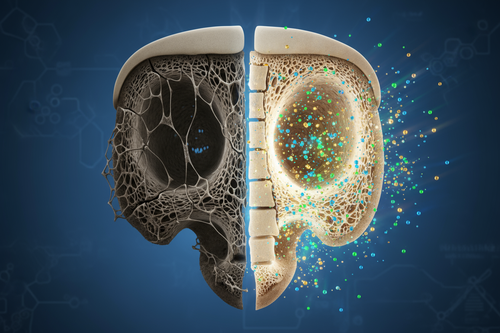
- The consequence: this progressive loss leads to osteoporosis, turning dense bone into a "Swiss cheese" structure prone to fracture. One in three women, and one in five men, will break a bone after age 50 because of this fragility.
2. The conductor of muscles (and the heart)
Contrary to popular belief, calcium is not only used by the bones. Its most notable role takes place at the muscular and nervous level.
It is what triggers every muscle contraction.
- Cramps and spasms: without an adequate blood level, nerve signals go haywire, causing cramps, spasms, or even tetany.
- The heart: since your heart is a muscle, a calcium imbalance can lead to potentially fatal heart arrhythmias. The balance between calcium and its cofactor, magnesium, is the key to heart stability.
3. The absorption paradox: 90% waste
This is where the real problem lies: we naturally absorb only 10 to 30% of the calcium we ingest.
The rest is simply eliminated. For some cheap supplements, this absorption rate can drop to just 2%.
The calcium thieves on your plate and in your life:
Several factors in our modern lifestyle act as calcium thieves:
- Antacids and medications: they reduce stomach acidity, which is essential for solubilizing and absorbing calcium.
- Soda: every can of soda can "steal" up to 50 mg of calcium from your bones to neutralize its acidity.
- Retardants: oxalates (in spinach, rhubarb), phytates (in unsoaked grains), and excess fiber bind calcium, preventing it from entering the bloodstream.
- Salt and animal proteins: excessive consumption increases body acidity, forcing the body to use bone calcium reserves to restore balance (massive urinary loss).
- Chronic stress: elevated cortisol (the stress hormone) can double urinary calcium loss.
4. The fatal mistake: why taking it alone is dangerous
This is the most critical point:
Taking calcium alone, without its cofactors, is useless and can even be dangerous for cardiovascular health.
Without its partners, calcium circulating in the blood does not know where to go. Instead of being directed to the bones (where it is needed), it can deposit where it should not: in soft tissues and artery walls.
This is the process of arterial calcification, a major risk factor for heart attacks and strokes. You are building "stones" in your arteries.
The synergy formula: the 4 absolute cofactors
For calcium to be absorbed and, above all, directed to the bones, it must be accompanied by this synergy:
- Vitamin D3: essential. It increases calcium absorption in the intestine by 30% to 80%.
- Vitamin K2: the "conductor." It activates the proteins that capture calcium from the blood and incorporate it into the bone matrix, while preventing it from depositing in the arteries.
- Magnesium: essential. It is necessary for the activation of Vitamin D and for muscle and heart stability.
- Citrate form: if you are over 50, calcium citrate is often better absorbed than carbonate, because it does not require as much stomach acidity.
5. The real sources of calcium (it's not just milk)
The myth of dairy products as the sole source of calcium is outdated. Sterilization (UHT processing) and the addition of sugar in many modern dairy products reduce their bioavailability.
For maximum absorption, prioritize:

The strategy to protect your skeleton
Calcium is the mineral of your bones and the muscle trigger. But without the right strategy, it becomes your enemy.
The golden rule: never take a calcium supplement alone. Prioritize high-quality food sources and ensure you have sufficient and synergistic intakes of D3, K2, and Magnesium.
As always with mineral supplementation, consult your doctor or naturopath to determine your specific needs and avoid any cardiovascular danger.
Want daily support? Le Terrier's personalized follow-up, at €10 per month, allows you to ask us questions in writing and move at your own pace.