

The 5 essential oils you must have in your kit
There's no need for a cabinet filled with thirty bottles. With five well-chosen essential oils, you already cover most of the little everyday troubles: a runny nose in winter, a headache, difficulty sleeping, or a bruise after a bump. The rest is often superfluous.
Essential oils are highly active concentrates of plant molecules. A few drops are enough, and that is precisely why they require caution. They support, but never replace, a doctor or treatment. In case of fever, symptoms that persist, or any doubt, a medical consultation takes precedence.
Here is our selection of five oils for a simple and versatile kit, what they are known for, and above all, how to use them without making mistakes.
Why five oils are enough
The idea of a compact kit is to cover a lot with very little. Rather than an ultra-specialized oil for every situation, we choose versatile, well-tolerated oils whose uses overlap. Two for the respiratory system and winter immunity, one for everyday emergencies, one soothing, and one for bumps. With these five, you cover the essentials. If you are just starting out, our essential oils guide for beginners lays the foundations before you get started.
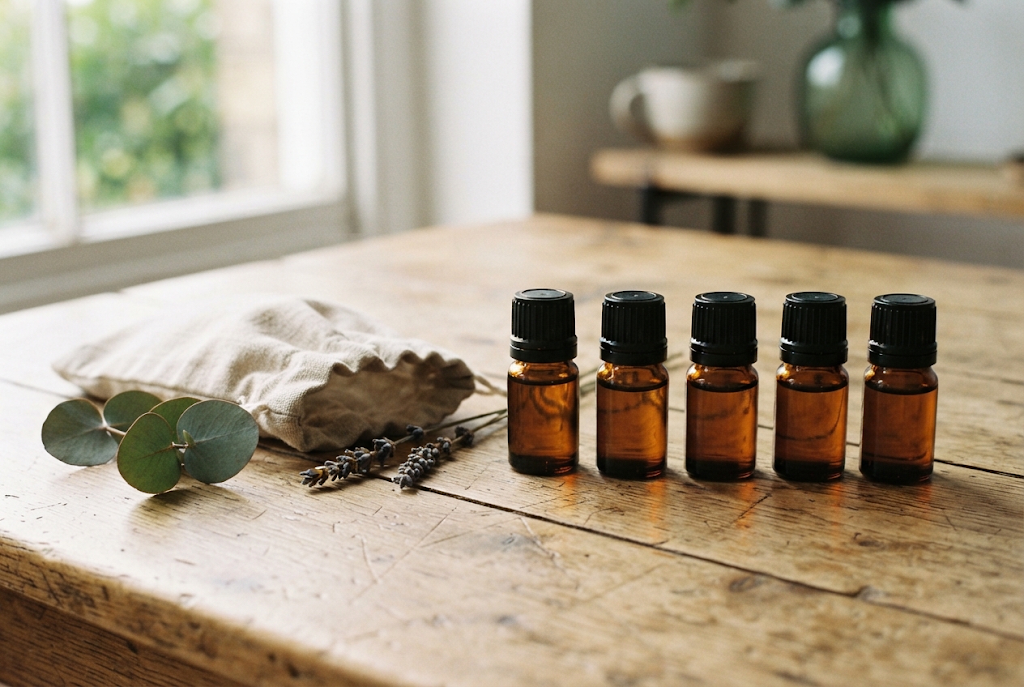
The five essential oils to have
Saro, the versatile one
Saro, or mandravasarotra, is a plant from Madagascar. We prefer it to tea tree for a compact kit because it is more versatile. While tea tree is primarily a topical antibacterial, saro is studied for its antibacterial, antiviral, and decongestant properties for the respiratory tract. These properties are based mainly on its composition (rich in 1,8-cineole) and laboratory research, rather than large-scale clinical trials, so we remain modest about its promises. In practice, when winter arrives, at the first sign of a runny nose, two drops diluted in a little carrier oil massaged onto the upper back and chest. Its scent is mild and it is well tolerated. For a single bottle that covers the most situations, this is it: you will find it in our range under the name mandravasarotra (saro).
Ravintsara, the winter essential
Ravintsara (Cinnamomum camphora, cineole chemotype) is the traditional reference for supporting immunity during the virus season. It is very well tolerated. We use it diluted in a massage on the chest and along the spine, or diffused to purify the air in a room. Here again, the data are mainly laboratory and ethnobotanical, so we see it as support, not as a treatment. Together with saro, it forms the respiratory duo of the kit. It is available under the name ravintsara.
Peppermint, for emergencies
Peppermint is the most spectacular. One drop on the temples, away from the eyes, in case of a headache: it is one of the few external uses supported by clinical studies (Göbel et al., Schmerz, 2016). It also helps with difficult digestion and nausea, and its effect on irritable bowel syndrome has been the subject of a meta-analysis (Alammar et al., BMC Complementary and Alternative Medicine, 2019), but in the form of gastro-resistant capsules, not through topical application. It is very strong: never use it on young children, pregnant or breastfeeding women, or people with epilepsy. One drop is enough. For digestion, also see our natural solutions for digestive issues. You will find it under the name peppermint.
True lavender, the gentlest
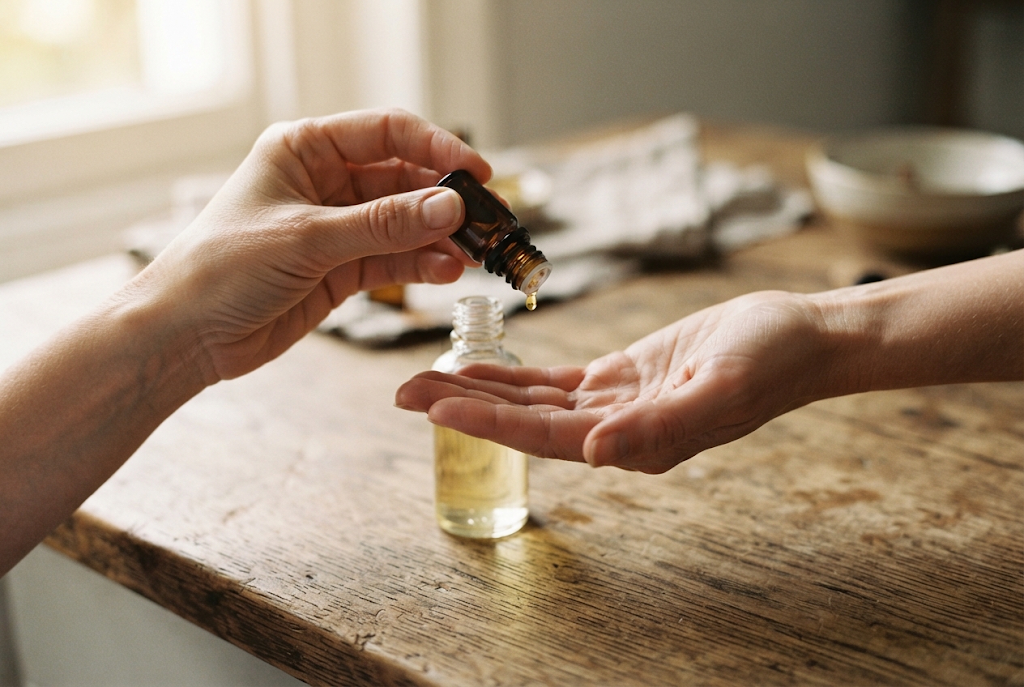
True lavender, or fine lavender (Lavandula angustifolia), is the most versatile and gentlest. For a small burn, superficial cut, or insect bite, it soothes. For stress and sleep, its action on the nervous system is one of the best documented among oils (Koulivand et al., Evidence-Based Complementary and Alternative Medicine, 2013): a few drops diffused in the evening, or on a tissue near the pillow. We often read that it can be applied pure: it is the only one that sometimes tolerates it, on a very small area, but when in doubt, and always with children, dilute. To make it an evening ritual, draw from our tips for sleeping better and our relaxation ritual.
Helichrysum, for bumps and bruises
Italian helichrysum, also called immortelle, is the specialist that few people know. It is traditionally used for bumps, bruises, and minor impacts, with scientific data that is still limited but promising (Antunes Viegas et al., Journal of Ethnopharmacology, 2014). A child who bumps themselves, a bruise that appears: apply immediately, diluted, to the area (never on an open wound), and the bruise often fades faster. In a family with children, it quickly finds its place. It is the rarest and most expensive of the five, but it is truly useful.
The summary table
| Essential oil | Main uses | Key precaution |
|---|---|---|
| Saro (mandravasarotra) | Respiratory, immune support | Dilute, avoid in young children |
| Ravintsara | Winter immunity, diffusion | Dilute for the skin |
| Peppermint | Headache, digestion, nausea | Forbidden for children, pregnancy, epilepsy |
| True lavender | Stress, sleep, small burns | Dilute when in doubt |
| Helichrysum (immortelle) | Bumps, bruises, hematomas | Never on an open wound |
Want an opinion on your situation? During a vitality assessment, we review together your diet, sleep, stress, and goals, then we build a plan adapted to your pace.
The safety rules you should never forget
Essential oils are active, and active does not mean without risk. A few simple rules prevent the vast majority of accidents.
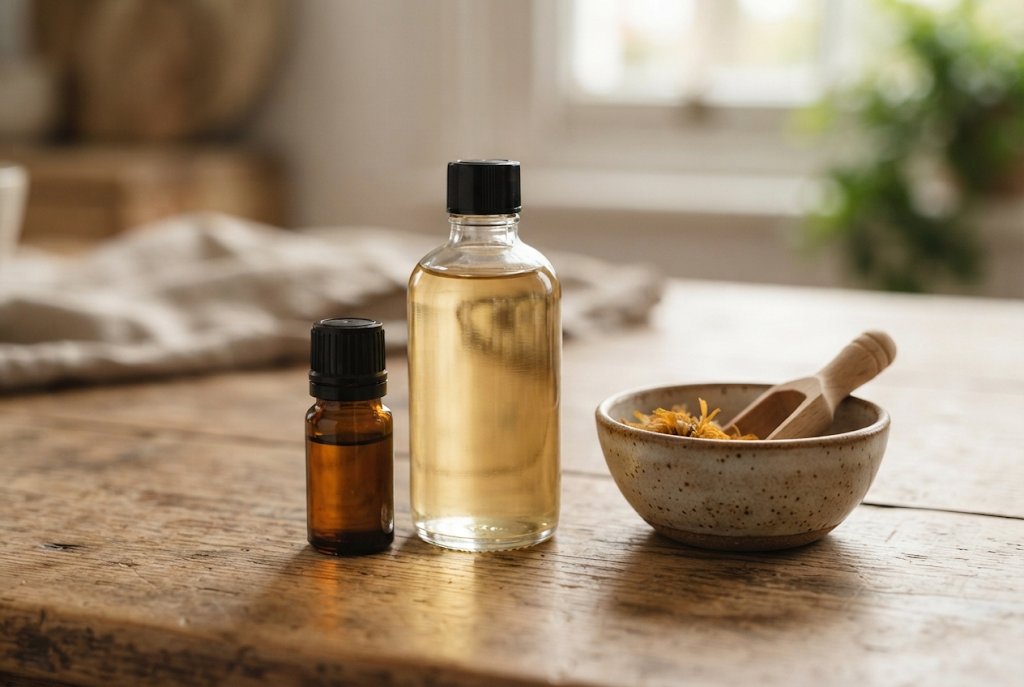
First, we almost always dilute in a carrier oil for application on the skin, and we do a test in the crook of the elbow before the first use. Then, we never put essential oil in the eyes, nose, or ears. In case of contact with the eye, rinse abundantly with a carrier oil, not with water.
Caution is paramount for babies and young children: we generally wait until age six before any common use, and some oils like peppermint remain discouraged for much longer. Same rule of caution for pregnant or breastfeeding women, people with epilepsy, and people with asthma: for them, professional advice before any use. Citrus essential oils, on the other hand, are photosensitizing: avoid the sun on skin that has just received them.
Finally, we do not swallow essential oil without the advice of an aromatherapist or a doctor, we keep them out of reach of children, and in case of accidental ingestion, we contact a poison control center (1-800-222-1222 in the US). These oils remain a complement, never a replacement for a treatment.
Want daily support? Le Terrier's personalized follow-up, at €10 per month, allows you to ask us questions in writing and move at your own pace.
Frequently asked questions
What are the five basic essential oils to have at home?
For a simple and versatile kit, saro and ravintsara for the respiratory system and immunity, peppermint for headaches and digestion, true lavender for stress, sleep, and small burns, and helichrysum for bumps and bruises. With these five, you cover most of the little everyday troubles.
Can you apply an essential oil pure to the skin?
Generally, no: we almost always dilute in a carrier oil to avoid irritation. True lavender is one of the few that sometimes tolerates a pure application on a very small area, but when in doubt, and always with children, dilute. A test in the crook of the elbow before the first use is still recommended.
Are essential oils safe for children?
No, they require a lot of caution. We generally wait until age six before any common use, and some oils like peppermint remain discouraged for much longer. Before using an essential oil on a child, ask the advice of a professional trained in aromatherapy or a doctor.
Which essential oil for stress and sleep?
True lavender is the most indicated. Its soothing action on the nervous system is one of the best documented among essential oils. A few drops diffused in the early evening, or on a tissue near the pillow, are enough. It does not replace the management of an established sleep disorder.
Can you swallow essential oils?
Not without the advice of an aromatherapist or a doctor. The oral route is the riskiest, because these substances are highly concentrated. In case of accidental ingestion, contact a poison control center (1-800-222-1222 in the US). For family use, we favor diluted application on the skin and diffusion.
Saro or tea tree, which one to choose?
For a compact kit, saro is more versatile. Tea tree is primarily a topical antibacterial, while saro is also studied for its antiviral and decongestant properties for the respiratory tract, with a milder scent. If you had to keep only one of the two, saro covers more situations.
This article is for informational purposes and does not replace medical advice.