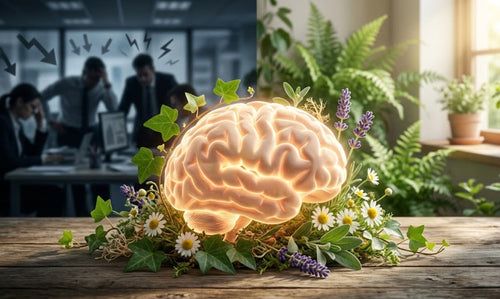
How to Quickly Calm Anxiety: The Power of Self-Distancing
Anxiety has become one of the most widespread ailments of our time. In France, it is estimated that one in five adults experiences an anxiety disorder in their lifetime. Yet, the vast majority of people who suffer from it have no practical tool to overcome it in the moment, during a stressful meeting, at 3 a.m. with insomnia, or during a panic surge before an important event.
Naturopathy and neuroscience are now converging on a technique of astonishing simplicity: self-distancing. It's free, immediate, has no side effects, and its effects on the brain have been measured in milliseconds. A complete breakdown.
Anxiety explained by neuroscience (and why it's not your fault)
Before learning how to calm anxiety quickly, you need to understand what really happens in your brain when it strikes. Too often, anxious people blame themselves for "not controlling their emotions." Yet biology teaches us that this reaction is deeply rooted in our neural architecture and has long served a survival purpose.
The infernal duo: amygdala and cortisol
At the center of your brain is a small almond-shaped structure: the amygdala. It's your primitive alarm system, inherited from millions of years of evolution. Its role? To detect threats, real or perceived, and trigger a survival response in a fraction of a second, long before your conscious brain can analyze the situation.
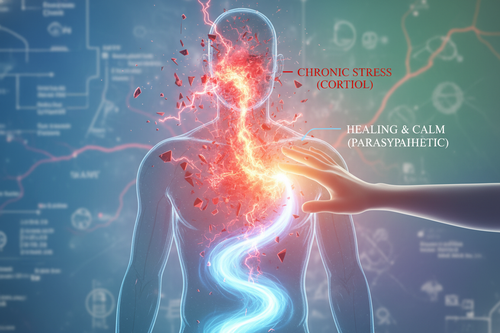
As soon as the amygdala activates, it sends an emergency signal to the hypothalamus, which instructs the adrenal glands to release cortisol and adrenaline into the bloodstream. The immediate physical result: a racing heart, tense muscles, shallow breathing, and racing thoughts. This is the fight or flight response, to fight or flee. Perfectly suited for a prehistoric predator. Far less useful during a presentation in a meeting.
Reference: LeDoux, J.E. (2000). "Emotion circuits in the brain." Annual Review of Neuroscience, 23, 155-184. LeDoux's work established that the amygdala processes emotional information in parallel with the cortex, and often faster, which explains why fear always precedes rational thought.
The role of the prefrontal cortex: the conductor knocked out of the game
Normally, it is the prefrontal cortex, the seat of logic, reasoning, and emotional regulation, that tempers the amygdala. It evaluates: "Is this threat real? Do I have the resources to deal with it?" and sends a signal to deactivate the alarm.
The problem: under intense stress, the overactive amygdala inhibits the prefrontal cortex. This is what neuroscientist Daniel Siegel calls "flipping the lid": the emotional brain takes control and the rational brain disconnects. You lose access to your judgment, your perspective, and your ability to put things in context. The anxiety spiral can then spin out of control.

The "I" trap: what your inner dialogue does to your nervous system
Now that you understand what happens in your brain, ask yourself this question: how do you talk to yourself when you are anxious?
In the vast majority of cases, this inner dialogue is saturated with a single pronoun: "I." "I am stressed." "I will fail." "I won't make it." "I haven't slept in three days." This is no coincidence, and it is not insignificant.
In cognitive psychology, this phenomenon is called cognitive fusion: by saying "I," you fuse with the emotion. You no longer observe your anxiety, you are your anxiety. You no longer look at the wave, you are overwhelmed by it. And neurobiologically, this omnipresent "I" maintains and amplifies the activation of the amygdala, keeping the body in a state of chronic stress.
Self-distancing: the science-backed "hack"
This is where one of the most interesting discoveries in cognitive neuroscience of the last ten years comes in. And its simplicity is baffling: you just need to change the pronoun.
The Kross et al. (2014) study: the pronoun that changes everything
Ethan Kross, a psychologist at the University of Michigan, conducted a series of experiments on what he calls "self-talk", the inner dialogue. In his 2014 study, he asked participants who were anxious about speaking in public to talk to themselves in two different ways before their speech:
- Group 1 (fusion): "Why am I stressed?"
- Group 2 (distancing): "Why are You stressed?" or "[Name], why are you stressed?"
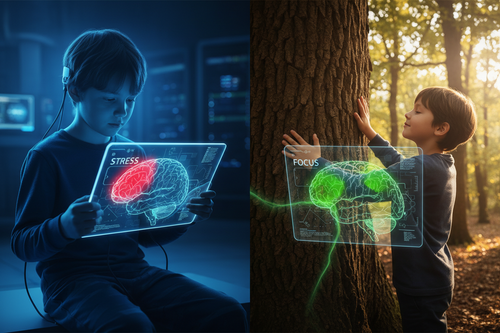
Results: Group 2, by simply adopting the second or third person, showed significantly lower anxiety, better performance, and far less intense post-speech rumination. The simple change of pronoun had created enough psychological distance to reactivate the prefrontal cortex.
Reference: Kross, E., et al. (2014). "Self-talk as a regulatory mechanism: How you do it matters." Journal of Personality and Social Psychology, 106(2), 304-324.
The Moser et al. (2017) study: proof by EEG
While Kross's study measured behaviors, Jason Moser's (Michigan State University) study wanted to see what happens inside the brain, in real time, using an electroencephalogram (EEG).
Participants were exposed to emotionally disturbing images and asked to regulate their emotions either in the first person ("I feel...") or by using their name or "you". The EEG measured brain activity with millisecond precision.
The discovery is remarkable: pronoun distancing produced emotional regulation as effective as usual cognitive techniques, but without overloading the prefrontal cortex. In other words: the brain calmed down quickly, without costly conscious effort, as if the simple linguistic distance was enough to automatically cut off the amygdala alarm.
Reference: Moser, J.S., et al. (2017). "Third-person self-talk facilitates emotion regulation without engaging cognitive control." Scientific Reports, 7, 4519.
The effect on heart rate variability (HRV)
An additional bridge between psychology and naturopathy: complementary research has explored the impact of self-distancing on heart rate variability (HRV), a physiological marker of the balance between the sympathetic nervous system (stress) and the parasympathetic (rest). High HRV reflects good stress resilience; low HRV is associated with chronic anxiety and cardiovascular disorders.
The results suggest that cognitive distancing practices improve HRV, indicating an activation of the parasympathetic nervous system, the "rest and digest" branch of your autonomic nervous system. This is precisely what naturopathic practices like heart coherence, diaphragmatic breathing, or meditation aim for.
Comparison table: rumination vs. self-distancing
| Criterion | Classic rumination ("I" mode) | Self-distancing ("you / Name" mode) |
|---|---|---|
| Brain activity | Overactive amygdala, inhibited prefrontal cortex | Deactivated amygdala, re-engaged prefrontal cortex |
| Psychological posture | "Victim" mode: overwhelmed by emotion | "Coach" mode: benevolent observer of oneself |
| Effect on cortisol | Maintenance or amplification of the cortisol spike | Drop in cortisol levels and stress response |
| Cognitive effort required | None, automatic and exhausting reaction | Minimal, only one word to change |
| Time to effect | Spiral that builds over time | Regulation visible in a few seconds to a few minutes |
| Effect on post-event rumination | Strong, the mind replays the scene on loop | Weak, perspective stops the loop faster |
| Accessibility | Always present, unfortunately automatic | Free, discreet, usable in all circumstances |
Instructions: how to practice self-distancing in 3 steps
The technique is disarmingly simple. Its difficulty lies solely in remembering to use it at the right time, when anxiety begins to rise. Here is how to integrate it concretely:
- Step 1, notice: as soon as you feel anxiety rising (tension in the chest, racing thoughts, knotted stomach), identify the anxious thought. For example: "I am unable to handle this situation."
- Step 2, distance: immediately rephrase this thought by replacing "I" with your name or "you". "Marie, why are you anxious? You have handled much more difficult situations before." Or more simply: "You will get through this, Marie. You always have."
- Step 3, amplify with breathing: combine self-distancing with 3 cycles of slow breathing (inhale 5 seconds, exhale 5 seconds). The parasympathetic activation is amplified. It is the perfect synergy between cognitive neuro-hacking and physiological regulation.
Concrete use cases:
- Before a presentation or stressful meeting
- In case of insomnia related to nighttime rumination
- During an interpersonal conflict that is escalating
- Facing a difficult decision or an anxiety-inducing medical result
- During a budding panic attack
Self-distancing is an effective tool, but lasting neuroplasticity must be nurtured. My personalized follow-up program combines neuro-hacks, naturopathy, and support of the biological terrain for in-depth results.
Start my personalized follow-up3 mistakes that block the natural management of your stress
Self-distancing is remarkably effective, but it cannot compensate for everything if the underlying biological terrain constantly sabotages your nervous system. Here are the three most common pitfalls:
1. Emotional resistance ("I must not stress")
One of the best-documented paradoxes in psychology: wanting to eliminate an emotion amplifies it. This is the principle of Daniel Wegner's ironic process theory (try not to think about a white bear for thirty seconds...). Self-distancing does not seek to erase anxiety, it creates a space between you and it, allowing you to observe it without being its captive. Accepting the emotion as information, not as an identity, is the first skill to develop.
2. Chronic lack of sleep
A brain deprived of sleep is a brain with a hyperreactive amygdala and an underperforming prefrontal cortex. Imaging studies (Walker, M.D., 2017, Why We Sleep) show that a single night of insufficient sleep increases amygdala reactivity by 60%. Without quality restorative sleep, no cognitive tool, however effective, can work at full efficiency.
3. Neglect of the biological terrain
Anxiety is not just psychological. An unbalanced gut microbiota (gut-brain axis), a magnesium deficiency (a co-factor in more than 300 enzymatic reactions involving the nervous system), a congested liver, or low-grade systemic inflammation can all considerably exacerbate anxious reactivity. Naturopathy addresses the terrain of anxiety, working on both biological balance and cognitive tools, alongside medical or psychological care when needed.
Reference: Jacka, F.N. et al. (2017). "A randomised controlled trial of dietary improvement for adults with major depression." BMC Medicine, 15, 23. Although focused on depression, this study suggests that diet can influence mental health and supports the value of an integrative approach (nutrition + psychology) for emotional regulation.
Going further: support and natural synergy
Self-distancing is a first-line tool, fast, accessible, and whose neurobiological effects are undeniable. But it is part of a broader vision of mental health and nervous balance that naturopathy calls the terrain.
Neuroplasticity, the ability of your brain to reconfigure itself and create new neural circuits, is real and documented. But it requires regular practice, sufficient sleep, a diet that nourishes the nervous system (magnesium, omega-3, B vitamins, probiotics), and sometimes support to break out of deeply rooted patterns.
To remember: the self-distancing technique gives you access to your prefrontal cortex in a few seconds. Naturopathic lifestyle builds, over the long term, a more resilient nervous system, which panics less often and regulates faster.
In the personalized support program, you benefit from a tailor-made follow-up combining scientific neuro-hacks, naturopathy, analysis of assessments, and protocols adapted to your unique terrain. No dogma. With results.
Join the programWant daily support? Le Terrier's personalized follow-up, at €10 per month, allows you to ask us questions in writing and move at your own pace.
Frequently Asked Questions: managing anxiety and self-distancing
What is psychological self-distancing?
Self-distancing is a cognitive technique consisting of observing yourself with perspective, as if you were looking at the situation from the outside. In practice, it is activated by replacing the pronoun "I" with "You" or with your own name in your inner dialogue. This simple linguistic change creates a psychological distance between yourself and the emotion, allowing you to deactivate the amygdala and re-engage the prefrontal cortex, the area of the brain responsible for judgment, calm, and emotional regulation.
How can you quickly calm an anxiety attack?
To quickly calm anxiety, you need to deactivate the amygdala and reactivate the prefrontal cortex. Self-distancing is the fastest scientifically documented tool to achieve this. Combine it with 3 to 5 cycles of heart rate variability breathing (inhale for 5 seconds / exhale for 5 seconds) to amplify the activation of the parasympathetic nervous system. Avoid trying to "not stress" at all costs, accept the emotion as information, then take a step back using your first name: "[Name], what is really going on here? You have the resources to handle it."
Why does talking to yourself in the third person reduce stress?
Talking to yourself in the 2nd or 3rd person ("You can do it, [Name]") creates what neuroscientists call psychological distancing. The brain then processes the information as if it were advising a friend, which removes the personal threat dimension and naturally triggers a less emotional, more rational response. The EEG study by Moser et al. (2017) shows that this effect occurs neurologically in a few milliseconds, without additional cognitive effort.
What role does the amygdala play in anxiety?
The amygdala is the primitive alarm center of your brain. When it perceives danger, whether real or simply imagined (such as anticipating failure), it immediately triggers the fight or flight response: an increase in adrenaline and cortisol, a racing heart, muscle tension, and racing thoughts. At the same time, it inhibits the prefrontal cortex, cutting off access to logic and perspective. Self-distancing is one of the tools that can help calm this mechanism in the moment, without medication.
Does self-distancing replace therapy?
No. Self-distancing is an excellent tool for managing acute daily stress, scientifically validated. But it does not replace therapeutic follow-up in cases of generalized anxiety disorder (GAD), panic disorder, debilitating phobias, or chronic anxiety. In these situations, a doctor, psychiatrist, or clinical psychologist is the first professional to consult. Naturopathy and cognitive tools like self-distancing act as a complement, to support the terrain and improve stress resilience.
How long does it take to see the effects of this technique?
According to the electroencephalogram study by Moser et al. (2017), the neurological effect of pronoun distancing is observable on a millisecond scale. The subjective calming effect (lower heart rate, release of tension) generally occurs within the minute following practice, especially when combined with a few slow breaths. In the long term, regular practice strengthens the prefrontal emotional regulation circuits through neuroplasticity.
Does diet have an impact on anxiety?
Absolutely. The gut-brain axis is currently one of the most active areas of neuroscience research. An unbalanced gut microbiota may promote low-grade inflammation that, according to recent research, could affect the nervous system and amygdala reactivity. Deficiencies in magnesium (a key regulator of the nervous system), omega-3 (neuronal membranes), and B vitamins (neurotransmitter synthesis) are frequently found in anxious people. Naturopathy works on this biological foundation alongside cognitive tools, without replacing medical care.
Can self-distancing be used to fall asleep?
Yes, it is one of its most effective applications. Nighttime rumination is almost systematically built around the "I": "I won't be able to sleep," "I'm going to be exhausted tomorrow," "I can't stop thinking." Switching to "You" breaks this hyper-arousal loop and allows the brain to gradually exit the sympathetic mode (alert) to switch to the parasympathetic mode (rest). Combine with slow 5-5 breathing and soothing visualization to maximize the effect.