Gut Microbiota: What Your Bacteria Say About Your Health
Reading time: 11 minutes
The microbiota is a kind of invisible organ: it weighs about 200 g, houses 38 trillion microorganisms, produces 90% of your serotonin, drives 70 to 80% of your immune system, influences your mood, weight, energy, and mental clarity, and has been ignored by conventional medicine for decades.
It's your gut microbiota. And the scientific revolution surrounding it is only just beginning.
In less than 20 years, research has transformed our understanding of these bacteria that inhabit us. We used to treat them as harmless parasites. Today we know that they are indispensable partners, co-evolved with the human species for millions of years, whose balance directly determines our overall health.
This guide gives you a complete overview of what your microbiota does for you, how to read it, and how to take care of it.
- Gut microbiota: what your bacteria say about your health
- Gut microbiota: what your bacteria say about your health
- Gut microbiota: what your bacteria say about your health
- Gut microbiota: what your bacteria say about your health
- Gut microbiota: what your bacteria say about your health
- Gut microbiota: what your bacteria say about your health
- Gut microbiota: what your bacteria say about your health
- Gut microbiota: what your bacteria say about your health
1. Portrait of the microbiota: figures and reality
The term "gut microbiota" refers to the collection of microorganisms that inhabit your digestive tract, mainly bacteria, but also viruses, fungi, archaea, and yeasts. We sometimes talk about the "microbiome" to refer to the collection of genes of these microorganisms.
Figures that change your perspective
- 38 trillion microorganisms, as many as or more than the total number of human cells in the body
- More than 1,000 different bacterial species identified
- About 200 g, that's the estimated weight of your microbiota (Sender et al., 2016)
- About 150 times more genes in your microbiota than in your human DNA
- A unique microbiota, as personal as a fingerprint, conditioned by genetics, mode of birth, breastfeeding, diet, and environment
Distribution in the digestive tract
The microbiota is not uniformly distributed. The stomach and proximal small intestine are almost sterile (acidic pH). The bacterial concentration gradually increases toward the colon, where most of the microbiota is located, with a density reaching 10 billion bacteria per milliliter of colonic content.
The major bacterial families
The adult human microbiota is dominated by two major phyla:
- Firmicutes (60-65%), including Lactobacillus, Clostridium, Ruminococcus. Involved in fiber fermentation and the production of short-chain fatty acids
- Bacteroidetes (20-30%), including Bacteroides. Also fiber fermenters, propionate producers
- Actinobacteria (3-10%), including Bifidobacterium, particularly important for immunity
- Proteobacteria (1-5%), some species of which can become pathogenic in case of imbalance
The Firmicutes/Bacteroidetes ratio is one of the markers monitored in research: an excess of Firmicutes is associated with obesity and insulin resistance, while a balanced ratio characterizes individuals with a healthy weight and metabolism.
2. What your microbiota does for you every day
The list of functions of the gut microbiota is so long that it surprises even the researchers who compile it. Here are the best documented.
Digestion and nutrient absorption
Your microbiota digests what your own enzymes cannot, especially dietary fibers, certain polyphenols, and resistant starches. This fermentation produces short-chain fatty acids (SCFAs), acetate, propionate, and butyrate, which are the preferred fuel of colonocytes (colon cells), regulate appetite via intestinal hormones (GLP-1, PYY), and influence carbohydrate metabolism.
Butyrate deserves special attention: it is the main nutrient of the colonic mucosa, it strengthens the tight junctions of the intestinal wall (anti-permeability), has documented anti-inflammatory and anti-cancer properties, and modulates the expression of genes involved in inflammation.
Immune regulation
70 to 80% of the immune cells of the body reside in the gut-associated lymphoid tissue (GALT). The microbiota constantly interacts with this intestinal immune system:
- It "educates" the immune system from birth, which is why children born by cesarean section or not breastfed, less exposed to maternal bacteria, have a higher risk of allergies and autoimmune diseases
- It maintains immune tolerance, the balance between reaction to pathogens and tolerance to food and self
- It stimulates the production of secretory IgA, the first-line antibodies of the intestinal mucosa
- It regulates the production of pro- and anti-inflammatory cytokines
Synthesis of vitamins and active molecules
- Vitamin K2, synthesized by Bacteroides and Lactobacillus, essential for coagulation and bone health
- B vitamins (B12, B9, B6, B2), intestinal bacteria contribute significantly to the intake of B group vitamins
- Tryptophan, precursor of serotonin, whose conversion is regulated by the microbiota
- GABA, inhibitory neurotransmitter produced notably by Lactobacillus rhamnosus
3. The gut-brain axis: the most concrete mind-body link there is

The gut-brain axis is one of the most striking discoveries of neuroscience in the last 20 years. It designates the bidirectional communication network linking the gut microbiota to the brain via several channels:
The vagus nerve
The vagus nerve is the main highway of this axis. It connects the brainstem to almost all internal organs, including the intestine. What is interesting: 80% of the fibers of the vagus nerve are afferent, they go from the intestine to the brain, and not the reverse. The intestine talks to the brain as much as the brain to the intestine.
Neurotransmitters produced in the intestine
- 90% of the serotonin of the body is produced in the intestine by enterochromaffin cells, under the direct influence of the microbiota
- GABA, produced by Lactobacillus and Bifidobacterium, it inhibits anxiety and promotes relaxation
- Acetylcholine, involved in memory and learning
Practical implications
These connections explain clinical phenomena long misunderstood:
- Why stress worsens irritable bowel syndrome
- Why we often observe differences in microbiota in depressed people
- Why some probiotics ("psychobiotics") reduce anxiety scores in clinical trials
- Why stress management is a non-negotiable component of any intestinal protocol
For a complete exploration of these connections and their practical implications, see our complete guide to intestinal health.
4. What your microbiota reveals about your health
The composition of the microbiota is a faithful mirror of the overall state of health. Some bacterial patterns are now associated with specific conditions with increasing scientific robustness.
Markers of a healthy microbiota
- High diversity, a healthy microbiota contains many different species. Microbial diversity is inversely correlated with the risk of chronic diseases. Hunter-gatherers have a microbial diversity 2 to 3 times higher than the Western average
- Abundance of Bifidobacterium and Lactobacillus, markers of good immune and digestive health
- Sufficient production of SCFAs (notably butyrate), reflection of a diet rich in fermentable fibers
- Low abundance of opportunistic pathogenic bacteria (Clostridium difficile, certain Proteobacteria)
Signals of an unbalanced microbiota
A disturbed microbiota, we talk about intestinal dysbiosis, sends signals that we can learn to read:
- Bloating and excessive gas after meals
- Irregular transit (constipation, diarrhea or alternation)
- Unexplained fatigue despite sufficient sleep
- Chronic sugar cravings
- Skin problems (acne, eczema, psoriasis)
- Recurrent infections (frequent colds, candidiasis)
- Mood disorders, underlying anxiety, brain fog
- Food intolerances that develop gradually
Do you recognize several of these signals? Our nutrition and deficiency self-tests allow you to assess your nutritional profile and guide your microbiota restoration protocol.
5. The major disruptors of the modern microbiota

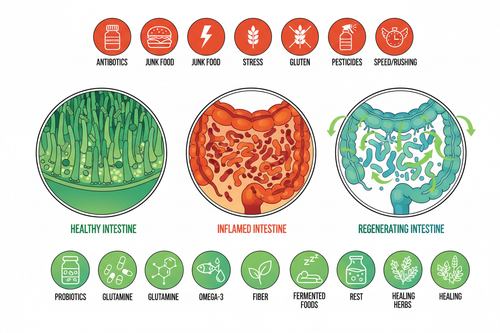
Antibiotics
Antibiotics are the most brutal disruptors of the microbiota. A course of antibiotics strongly reduces the diversity of the flora. In a healthy adult, it reconstitutes largely in a few weeks, but some species can be missing for several more months (Palleja et al., Nature Microbiology, 2018).
This does not mean that we should refuse antibiotics when they are medically necessary, but that their intake must systematically be accompanied by a microbiota restoration protocol: multi-strain probiotics (spaced by 2h), fermented foods, prebiotic fibers.
Ultra-processed food
It is the most insidious disruptor because it is daily. Emulsifiers (carrageenans, polysorbates), artificial sweeteners (aspartame, sucralose), preservatives, colorings, residual pesticides (notably glyphosate), all directly alter the intestinal mucosa and impoverish the microbial diversity. A study published in Nature showed that the composition of the microbiota changes in just a few days when the diet changes (David et al., 2014).
Chronic stress
The cortisol released during chronic stress directly changes the composition of the microbiota, reduces the production of protective mucus, increases intestinal permeability and slows down transit. And the vicious circle accelerates: a microbiota impoverished by stress produces less serotonin and GABA, which amplifies anxiety and reactivity to stress.
Lack of sleep
Recent studies show that a sleep restriction of just 2 nights significantly changes the composition of the microbiota, with a reduction of Bifidobacterium (anti-inflammatory bacteria) and an increase in pro-inflammatory bacteria. The microbiota itself has a circadian rhythm: it changes cyclically over 24h in synchronization with the biological clock.
Long-term medications
- Proton pump inhibitors (PPIs), reduce protective gastric acidity and allow the colonization of the small intestine by bacteria usually eliminated
- Non-steroidal anti-inflammatory drugs (NSAIDs), increase intestinal permeability and impoverish the colonic microbiota
- Birth control pill, alters microbial diversity and promotes candidiasis
- Metformin, paradoxically, part of its anti-diabetic effects is thought to work through changes in the microbiota
Sedentary lifestyle
Physically active people systematically present a greater microbial diversity than sedentary people, regardless of diet. Physical exercise increases the production of butyrate and promotes anti-inflammatory species. Even 30 minutes of walking per day has a measurable effect on the composition of the microbiota after 6 weeks.
6. How to feed and diversify your microbiota

The rule of 30 plants per week
It is the best supported recommendation by research to improve microbial diversity. The American Gut Project study, covering more than 10,000 participants, showed that those consuming 30 different plants per week had a significantly more diversified microbiota than those consuming only 10.

Each type of plant fiber feeds different bacterial species. Dietary diversity creates microbial diversity. Count broadly: herbs, spices, teas and coffees also count.
Fermented foods, live probiotics
| Food | Main strains | Microbiota benefit |
|---|---|---|
| Milk kefir | Lactobacillus, Bifidobacterium, yeasts | Very great diversity of live strains |
| Raw sauerkraut (unpasteurized) | Leuconostoc, Lactobacillus | Rich in Lactobacillus resistant to gastric acidity |
| Kimchi | Lactobacillus kimchii and others | Anti-inflammatory, rich in natural prebiotics |
| Kombucha (unpasteurized) | Acetobacter, Gluconobacter, yeasts | Organic acids beneficial for the mucosa |
| Miso | Aspergillus oryzae, Lactobacillus | Digestive enzymes + probiotics |
| Tempeh | Rhizopus oligosporus | Fermentation that improves mineral absorption |
Prebiotic fibers, the fuel for good bacteria
Prebiotics are fibers that selectively feed beneficial bacteria. The best sources:
- Inulin and FOS (fructo-oligosaccharides), Jerusalem artichoke, artichoke, chicory, garlic, onion, leek. They primarily feed Bifidobacterium.
- Resistant starch, slightly green banana, legumes, cooled rice and potatoes. The preferred fuel for butyrate producers.
- Beta-glucan, rolled oats, barley, rye. Stimulates immunity and promotes SCFA production.
- Pectin, apple, pear, citrus fruits (especially in the skin and white pulp). Feeds Akkermansia muciniphila (mucosal guardians).
Probiotic supplementation
When diet is not enough, after a course of antibiotics, in cases of proven dysbiosis, or during a period of intense stress, targeted probiotic supplementation is useful. Choose multi-strain formulas containing at least:
- Lactobacillus acidophilus, protects the intestinal mucosa
- Bifidobacterium longum and Bifidobacterium bifidum, anti-inflammatory, immuno-modulators
- Lactobacillus rhamnosus, the best studied for anti-anxiety and anti-diarrhea effects
- Lactobacillus plantarum, particularly resistant to transit, colonizes the intestine well
Minimum 10 billion CFU per dose, in a course of at least 4 to 8 weeks to observe a lasting effect.
Our natural dietary supplements include multi-strain probiotic formulas selected according to naturopathy criteria.
7. Microbiota and diseases: what research says
The list of pathologies associated with microbiota alterations grows every year. Here are the best-documented connections.
Metabolic diseases
Obesity, type 2 diabetes and insulin resistance are systematically associated with an impoverished microbiota with an excess of Firmicutes and a deficiency of Akkermansia muciniphila. Microbiota transplants from lean donors to obese subjects temporarily improve insulin sensitivity, suggesting a direct role of the microbiota in metabolism.
Autoimmune and allergic diseases
The "hygiene theory" suggests that a less diverse microbiota from childhood (Cesarean section, lack of breastfeeding, early antibiotic use, overly sanitized environment) disrupts the education of the immune system and promotes autoimmune diseases (rheumatoid arthritis, multiple sclerosis, Crohn's disease) and allergic diseases (asthma, eczema, food allergies).
Mental health
Microbiota alterations are documented in depression, anxiety, autism spectrum disorder, and Parkinson's disease (whose earliest lesions seem to appear in the enteric nervous system before the brain). Clinical trials on "psychobiotics" show significant reductions in anxiety and depression scores after 4 to 8 weeks of taking targeted probiotics.
Inflammatory bowel diseases
Crohn's disease and ulcerative colitis are accompanied by severe dysbiosis with an impoverishment of butyrate-producing Firmicutes and an expansion of pro-inflammatory bacteria. Microbiota restoration is now integrated into the complementary management protocols of these diseases.
To understand in detail how to detect and correct a microbiota imbalance, consult our article on intestinal dysbiosis.
Want daily support? Le Terrier's personalized follow-up, at €10 per month, allows you to ask us questions in writing and move at your own pace.
8. Frequently asked questions
What is the intestinal microbiota?
The intestinal microbiota refers to the set of microorganisms (bacteria, viruses, fungi, yeasts) that inhabit your digestive tract. It counts about 38 trillion microorganisms belonging to more than 1,000 different species, for an estimated weight of about 200 g. Each individual has a unique microbiota, as personal as a fingerprint.
What is the link between the intestinal microbiota and the brain?
The gut-brain axis is a bidirectional neural highway connecting the microbiota to the brain via the vagus nerve. About 90% of the body's serotonin is made in the intestine, under the influence of the microbiota. This serotonin does not pass into the brain, but it acts on digestion and communicates with it via the vagus nerve. An unbalanced microbiota is associated with an increase in anxiety and depression, while a diverse microbiota supports mental health and cognitive clarity.
How to improve your intestinal microbiota naturally?
The most effective strategies: eat 30 different plant foods per week, consume fermented foods daily (kefir, raw sauerkraut, kimchi), reduce ultra-processed foods, manage stress, sleep well, limit antibiotics to the strict necessity, and practice regular physical activity.
How long does it take to improve your microbiota?
Significant changes can be observed in 2 to 4 weeks of targeted dietary changes. A deep restoration of diversity requires 3 to 6 months of continuous effort. Fermented foods and prebiotic fibers produce the fastest changes.
Do antibiotics destroy the intestinal microbiota?
Yes, a course of antibiotics greatly reduces the diversity of the flora. In a healthy adult, it largely reconstitutes itself in a few weeks, but some species may be missing for several more months (Palleja et al., Nature Microbiology, 2018). Taking multi-strain probiotics during and after the course (spaced 2 hours apart) significantly reduces the damage.
What to remember
The intestinal microbiota is the forgotten organ of modern medicine, and its rediscovery is transforming our understanding of health and disease. Behind each bacterium, a mechanism. Behind each mechanism, a concrete lever of action.
The good news: feeding your microbiota requires neither restrictive diets nor expensive supplements. 30 plants per week, regular fermented foods, less stress, and sufficient sleep: that's what matters most. The rest follows.
To go further, our complete guide to intestinal health details the complete 4-step naturopathic protocol to restore your microbiota sustainably.
This article is for informational purposes and does not replace medical advice.
- Related articles:
- Intestinal health: the complete guide to naturally balancing your microbiota
- Intestinal dysbiosis: signs, causes, and natural solutions to rebalance your flora
- Natural probiotics: the best food sources
- Leaky gut: symptoms and natural protocol
- Symptoms of insulin resistance: 4 clinical signs not to ignore
- Our recommended products: