Gut Health: The Complete Guide to Naturally Balancing Your Microbiome
Estimated reading time: 15 minutes
Your gut is not just a simple digestive tube. It is a living ecosystem, populated by 38 trillion bacteria, which behind the scenes drives your immunity, your mood, your energy, and your weight. Research today links an unbalanced microbiota to many chronic conditions, from anxiety to autoimmune diseases, as well as skin problems and joint pain.
Yet, most of us have never learned to take care of this organ. Nor to read its signals. Nor to rebalance it when it falters.
This is exactly the purpose of this guide. You will find here a complete overview of gut health, what it is, how to detect it when it goes off track, and above all, how to restore it through natural methods and naturopathy.

Table of Contents
- Gut health: the complete guide to naturally balancing your microbiota
- Gut health: the complete guide to naturally balancing your microbiota
- Gut health: the complete guide to naturally balancing your microbiota
- Gut health: the complete guide to naturally balancing your microbiota
- Gut health: the complete guide to naturally balancing your microbiota
- Gut health: the complete guide to naturally balancing your microbiota
- Gut health: the complete guide to naturally balancing your microbiota
- Gut health: the complete guide to naturally balancing your microbiota
- Gut health: the complete guide to naturally balancing your microbiota
- Gut health: the complete guide to naturally balancing your microbiota
1. What is gut health, really?
Gut health refers to the overall state of balance of your digestive system: the quality of the intestinal wall, the diversity of your bacterial flora, and the ability of your digestive tract to fulfill its three essential functions: digest, absorb nutrients, and serve as a shield against pathogens.
A healthy gut is one that:
- Digests efficiently without bloating, pain, or disrupted transit
- Properly absorbs vitamins, minerals, and amino acids
- Protects the body thanks to an intact intestinal mucosa
- Communicates harmoniously with the brain via the gut-brain axis
- Regulates immunity (70 to 80% of your immune cells reside in the gut)
Naturopathy considers the gut as the cornerstone of overall health. Hippocrates is often credited with the formula "every disease begins in the gut". The quote is probably apocryphal, but current research confirms that the gut plays a central role in immunity, metabolism, and the dialogue with the brain.
2. The gut microbiota: your second brain
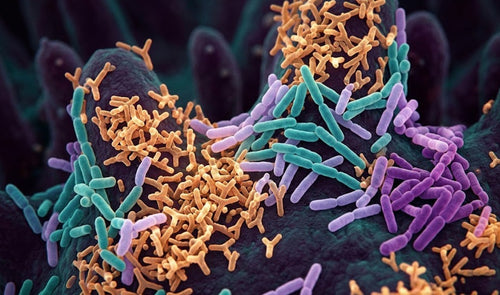
The gut microbiota, formerly called "intestinal flora", refers to the set of microorganisms (bacteria, viruses, fungi, yeasts) that populate your digestive tract, with a maximum concentration in the colon.
Dizzying numbers
- 38 trillion microorganisms in an adult gut
- More than 1,000 different bacterial species identified
- About 200 g: this is the estimated weight of your microbiota (Sender et al., 2016)
- About 150 times more genes in your microbiota than in your human DNA
Why do we talk about a "second brain"

The gut is connected to the brain by the vagus nerve, a bidirectional nerve highway. It also houses its own enteric nervous system, composed of 500 million neurons, as many as in the spinal cord.
But above all, your gut bacteria produce neurotransmitters directly involved in your mood and cognition:
- 90% of serotonin (the well-being hormone) is produced in the gut
- Dozens of other signaling molecules directly influence your brain
So it is not a metaphor: your gut thinks, feels, and communicates. And when it suffers, the whole body suffers.
Did you know? Studies often observe microbiota differences in people suffering from depression, without yet knowing what is cause and what is consequence. Recent studies are even testing "psychobiotics" (probiotics targeting mental health) as a complementary treatment for anxiety disorders.
3. The 10 signs of an unbalanced gut
An unbalanced microbiota, we call it intestinal dysbiosis, does not always manifest itself in an obvious way. Here are the signals not to ignore:
Digestive signs (the most obvious)
1. Chronic bloating, especially after meals, often accompanied by gas. Sign that some bacteria are fermenting excessively.
2. Irregular transit, alternating constipation and diarrhea, or one of the two persistently. Irritable bowel syndrome (IBS) is very often of dysbiotic origin.
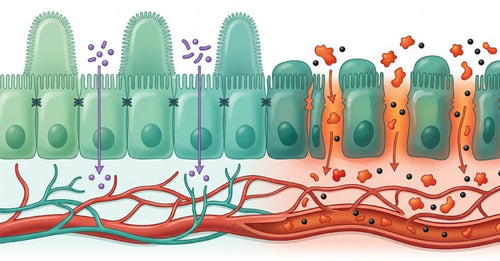
3. Reflux and heartburn, often linked to an imbalance of the flora and increased intestinal permeability.
4. Abdominal pain, cramps, spasms, sensations of heaviness after meals.

Systemic signs (less obvious but just as revealing)
5. Unexplained fatigue, poor absorption of nutrients (iron, magnesium, B vitamins) exhausts the body.
6. Skin problems, acne, eczema, psoriasis, hives. The gut-skin axis is now well documented.
7. Mood disorders, anxiety, irritability, brain fog. Let's remember that 90% of serotonin is produced in the gut.
8. Repeated infections, frequent colds, urinary tract infections, recurrent herpes. 70-80% of immunity resides in the gut.
9. Food intolerances, progressive development of intolerances to gluten, lactose, or other foods, often linked to increased intestinal permeability.
10. Weight gain difficult to explain, certain families of bacteria (especially excess Firmicutes) are directly involved in the excessive extraction of calories from food.
Not sure about the state of your microbiota? Our nutrition and deficiency self-tests help you identify nutritional imbalances often linked to poor intestinal absorption.
4. The root causes of intestinal imbalance
A microbiota does not become unbalanced overnight. It is the result of an accumulation of factors, some occasional, others chronic. In naturopathy, we always go back to these root causes rather than treating the symptoms.
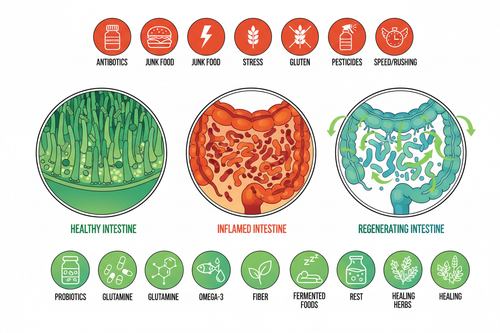
The 6 major microbiota disruptors
Ultra-processed food is probably the first cause of dysbiosis in Western countries. Additives, emulsifiers, artificial sweeteners, and pesticides radically impoverish bacterial diversity. A study published in Nature showed that the composition of the microbiota changes in just a few days when the diet changes (David et al., 2014).
Antibiotics are necessary when they are required, but their impact on the microbiota is devastating. A course of antibiotics greatly reduces the diversity of the flora. In a healthy adult, it reconstitutes largely in a few weeks, but some species can be missing for several months after (Palleja et al., Nature Microbiology, 2018).
Chronic stress activates the hypothalamic-pituitary-adrenal axis (HPA), releases cortisol continuously, and directly changes the composition of the intestinal flora. Stress also slows down transit, promotes intestinal permeability, and reduces the production of protective mucus.
Lack of sleep is a factor often underestimated. Recent studies show that sleep restriction changes the composition of the microbiota in just 2 days, with a significant reduction in bifidobacteria.
Sedentary lifestyle: physically active people systematically show greater microbial diversity than sedentary people, regardless of diet.
Long-term medications, anti-inflammatory drugs (NSAIDs), proton pump inhibitors (PPIs), birth control pills, significantly alter the flora and intestinal permeability.
5. How to restore your gut health naturally
Good news: the microbiota is one of the body's systems that are the most plastic and reactive to changes. Studies show significant changes in the composition of the microbiota in just 2 to 4 weeks of targeted intervention.
Naturopathy offers an approach in 4 concentric circles:
- Remove what attacks the flora
- Feed the good bacteria
- Reinoculate with targeted probiotic strains
- Regenerate the intestinal mucosa
We detail each of these steps in the protocol below.
6. The 4-step naturopathy protocol

This protocol is inspired by naturopathic approaches validated by research. It can be followed independently for moderate imbalances, or supervised by a naturopath for more complex cases.
Important: this protocol does not replace medical advice. In case of severe symptoms (intense pain, blood in the stool, unexplained weight loss), consult a doctor first.
Step 1, elimination (weeks 1-2)
Temporarily remove the main flora disruptors:
- Refined sugars and ultra-processed products (→ see our article on the symptoms of excess sugar)
- Alcohol
- Gluten (if sensitivity is suspected)
- Pasteurized dairy products
- Excess coffee (more than 2 cups/day)
Step 2, Microbiota feeding (weeks 2-6)
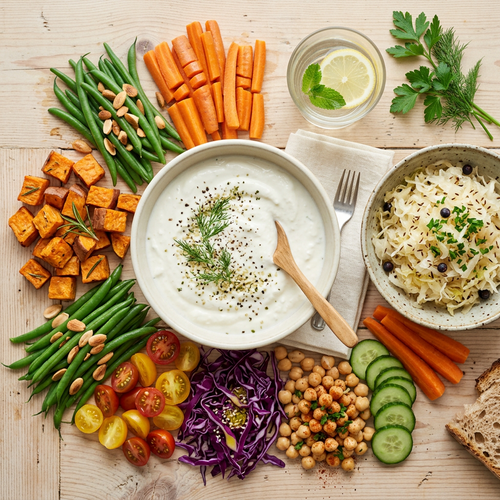
Introduce massively prebiotic fibers, the fuel of your good bacteria:
- Legumes (lentils, chickpeas, beans)
- Root vegetables (sunchoke, artichoke, chicory, garlic, onion, leek)
- Whole grains (oats, barley, rye)
- Slightly green banana (rich in resistant starch)
- Chia and flax seeds
Goal: 30 different plant foods per week, a key figure from studies on microbiota diversity.
Step 3, reinoculation (weeks 3-8)
Provide probiotics in sufficient quantity and diversity:
Food sources (to be prioritized):
- Milk or water kefir
- Kombucha (unpasteurized)
- Raw sauerkraut (uncooked)
- Kimchi
- Miso, tempeh
- Artisanal lacto-fermented yogurts
Probiotic supplements: choose multi-strain formulas containing Lactobacillus acidophilus, Bifidobacterium longum, Lactobacillus rhamnosus, minimum 10 billion CFU per dose. (→ Discover our selection of dietary supplements)
Step 4, mucosa regeneration (weeks 4-12)
Repair the weakened intestinal wall:
- L-Glutamine: amino acid fuel for enterocytes (intestinal wall cells)
- Zinc carnosine: protects and regenerates the gastrointestinal mucosa
- Curcumin: effective intestinal anti-inflammatory
- Aloe vera (pure gel, unprocessed): mucosa healing
- Bone broth: rich in collagen and glycine, essential nutrients for the wall
7. Diet: what helps and what damages
The foods that take care of the gut
| Category | Foods | Action |
|---|---|---|
| Fermented | Kefir, kombucha, miso, kimchi | Provide live probiotics |
| Prebiotics | Artichoke, sunchoke, garlic, onion | Feed the good bacteria |
| Anti-inflammatory | Turmeric, ginger, fatty fish | Reduce intestinal inflammation |
| Regenerating | Bone broth, aloe vera, L-glutamine | Repair the mucosa |
| Rich in polyphenols | Red fruits, green tea, olive oil | Stimulate microbial diversity |

The foods that damage the gut
- Refined sugars, feed pathogenic bacteria and yeasts like Candida (→ our complete article on the signs of excess sugar)
- Refined vegetable oils (sunflower, corn, soy), pro-inflammatory, unbalance the omega-3/omega-6 ratio
- Food additives, emulsifiers (modified soy lecithin, carrageenan) and artificial sweeteners (aspartame, sucralose) directly damage the mucous membrane
- Alcohol increases intestinal permeability and drastically reduces microbial diversity
- Gluten and dairy in cases of sensitivity trigger a local inflammatory response in predisposed individuals
8. Supplements and plants for the gut
Phytotherapy and micronutrition offer remarkable tools to support and accelerate intestinal restoration.

Essential plants
Chamomile (Matricaria chamomilla): antispasmodic, anti-inflammatory, relieves abdominal pain and cramps.
Licorice (Glycyrrhiza glabra): protects and regenerates the gastrointestinal mucous membrane, particularly effective in cases of leaky gut. A word of caution: licorice can raise blood pressure and lower potassium. Avoid it if you have high blood pressure or are pregnant, check with your doctor if you take any medication, and do not use it long term.
Turmeric (Curcuma longa): one of the most powerful intestinal anti-inflammatories identified by science. Combine with piperine (black pepper) for optimal absorption.
Psyllium (Plantago ovata): exceptional soluble fiber, forms a gel that soothes the mucous membrane, regulates transit and feeds bifidobacteria.
Activated charcoal: absorbs toxins and intestinal gases. Useful for short courses, not long-term use.
Ginger (Zingiber officinale): prokinetic (speeds up gastric emptying), anti-inflammatory, anti-nausea.
Key micronutrients
- Zinc: essential for the integrity of the tight junction (intestinal barrier)
- Vitamin D: regulates intestinal immunity and reduces mucous membrane inflammation
- Magnesium: regulates transit, often deficient in cases of chronic stress
- Vitamin A: maintains the integrity of the wall's epithelial cells
How to know if you have a deficiency? Our nutrition and deficiency self-tests allow you to precisely identify your deficiencies before supplementing.
9. When should you consult a naturopath?
Self-management is possible for moderate imbalances. But certain situations require personalized support.
Signs that warrant a naturopathic consultation
- Symptoms persisting for more than 3 months despite dietary changes
- Irritable bowel syndrome (IBS) diagnosed or suspected
- Suspected leaky gut (increased intestinal permeability)
- History of repeated antibiotic courses
- Chronic intestinal candidiasis
- Chronic inflammatory bowel diseases (Crohn's, UC), in addition to medical follow-up
- Desire for a personalized protocol and long-term follow-up
What our naturopathic support includes
During a first naturopathic consultation, we establish a complete vitality assessment which includes the evaluation of your digestive sphere, the identification of your specific disruptors, and the development of an individualized protocol.
We also offer 3 or 6-month support programs for people who want a profound and lasting transformation of their intestinal health.
Want daily support? Le Terrier's personalized follow-up, at €10 per month, allows you to ask us questions in writing and move at your own pace.
10. Frequently asked questions
How long does it take to rebalance your microbiota? The first improvements are often noticeable in 2 to 4 weeks. A deep restoration of the microbiota requires 3 to 6 months of continuous effort.
Can you take probiotics and antibiotics at the same time? Yes, but with a minimum spacing of 2 hours. Probiotics during an antibiotic course significantly reduce digestive side effects.
Is fasting beneficial for the gut? Intermittent fasting (16:8) has shown positive effects on microbial diversity by allowing the mucous membrane to regenerate. Prolonged fasting is more complex and must be supervised.
Are the microbiota tests sold on the Internet reliable? Stool DNA sequencing tests provide a picture of microbial diversity, but their interpretation remains complex and standardization is insufficient. They can be a starting point but do not replace clinical evaluation.
Can stress really damage my gut? Absolutely. Chronic stress changes the composition of the microbiota, increases intestinal permeability and slows down transit in just a few days. Stress management is a non-negotiable component of any intestinal protocol.
What to remember
Intestinal health is not a niche topic reserved for naturopathy enthusiasts. It is the foundation of your overall health, immunity, energy, mood, weight, mental clarity, all of which depend on it, directly or indirectly.
The microbiota is plastic. It responds quickly to the right interventions. And the tools to restore it are within reach: living food, stress management, plants, probiotics, and when necessary, personalized naturopathic support.
Where to start? Choose one action from this guide and put it into practice today. Add a serving of fermented vegetables to your next meal. Cut out refined sugar for 14 days. Order a self-test to identify your deficiencies.
Every step counts. And your gut will reward you.
This article is for informational purposes and does not replace medical advice.
→ Related articles:
- Symptoms of excess sugar: 5 signs your body is saying stop
- Intestinal dysbiosis: signs, causes and natural solutions to rebalance your flora
- Magnesium deficiency: how to detect it and remedy it
- Nutritional deficiencies: the most common in France and the signs to know
→ Our recommended products: