

Waxed fruit and pesticides: why water is no longer enough and how to protect yourself?
Share
Reading time: 11 minutes
Try it now.
Take an apple from the supermarket, one of those shiny, perfectly smooth apples that look like they came out of a commercial. Run your fingernail firmly across the surface. Do you see that whitish residue accumulating under your nail?
It's not dirt. It's industrial wax.
And beneath this wax, potentially trapped like under a layer of plastic wrap, are the pesticide residues and post-harvest treatments you think you wash away by rinsing your fruit under tap water.
Bad news: water alone is not enough.
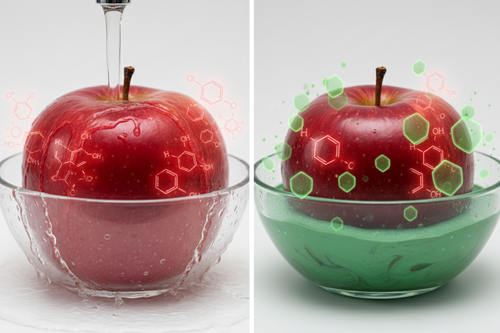
Good news: science has identified a simple, inexpensive, and remarkably effective method for thoroughly cleaning your fruit. This is what we see here.
Behind the scenes: why is your fruit waxed?
The natural mechanism: the sacrificed bloom
Fruit naturally produces its own protection: the bloom. This thin layer of natural wax, visible on freshly picked plums, grapes, or blueberries, protects the fruit from dehydration, microbial attacks, and UV rays.
The problem: during industrial processing, fruit undergoes intensive washing that removes this natural wax. Without it, the fruit quickly dehydrates, loses its firmness, and becomes vulnerable to mold.
The industry's solution: apply a replacement wax to artificially restore this protective barrier. So far, nothing scandalous in itself.
“Long-life” storage: 12 months on the shelf
What becomes problematic is the scale of the phenomenon. Did you know that an apple you buy in March may have been harvested in September of the previous year?
How is this possible?
Apples are stored in a controlled atmosphere:
- Temperature maintained between 0 and 4°C (32-39°F)
- Oxygen level reduced to 1-3% (vs. 21% in normal air)
- CO₂ level increased to 1-5%
- Humidity controlled at 90-95%
Under these conditions, the fruit's metabolism slows down drastically. Combined with the coating wax that limits water loss and gas exchange, this technique allows certain apple varieties to be stored for up to 12 months without visible deterioration.
The economic aspect: shine = sales
Beyond preservation, the coating serves an effective marketing function:
- Reduction in weight loss: an unwaxed fruit loses up to 5-10% of its weight through evaporation during transport and storage. For the industry, that's money evaporating.
- The “perfect” aesthetic: a shiny, flawless apple catches the consumer's eye. The wax hides micro-imperfections and gives it that “plastic-coated” look that we unconsciously associate with freshness.
The paradox? The shinier a fruit is, the more likely it is to be old and treated.
Decoding labels: petroleum in your applesauce?
Not all coating agents are created equal. European regulations authorize several types of waxes, identified by their E code. Here is what you need to know:
Comparative table of coating agents
| Code | Name | Origin | Characteristics | Assessment |
|---|---|---|---|---|
| E901 | Beeswax | Animal (bees) | Natural, used since antiquity | Natural option |
| E903 | Carnauba wax | Plant-based (Brazilian palm tree) | Natural, highly resistant, “queen of waxes” | Natural option |
| E904 | Shellac (confectioner's glaze) | Animal (secretion of the Kerria lacca insect) | Natural but surprising origin | Acceptable |
| E905 | Microcrystalline wax | Mineral (petroleum derivative) | By-product of petroleum refining | Controversial |
| E912 | Montanic acid esters | Mineral (lignite/petroleum) | Synthetic | Controversial |
| E914 | Oxidized polyethylene wax | Synthetic (plastic) | Plastic derivative | Avoid if possible |
What the EFSA says (and what the naturopathic expert thinks about it)
The European Food Safety Authority (EFSA) has assessed these additives and considers them “safe at the levels used.” This is technically true: the amounts of wax ingested are low, and these substances are considered inert.
But here is the key point that the EFSA does not directly address:
The problem is not so much the intrinsic toxicity of the wax itself, but its “sealing” effect on pesticide residues and post-harvest treatments. The wax creates a hydrophobic layer (which repels water) that:
- Traps surface pesticides beneath it
- Resists simple rinsing with water
- Prevents the natural removal of residues
This is the mechanism we will now decode.
The invisible danger: when wax becomes a pesticide trap
The “sealing” effect: pesticides sealed in
Before the wax is applied, fruit generally receives post-harvest treatments to prevent storage diseases. Among the most common:
- Thiabendazole (fungicide)
- Imazalil (fungicide)
- Orthophenylphenol (fungicide)
- Pyrimethanil (fungicide)
These substances are applied by spraying, dipping, or fumigation before waxing. The wax applied afterward acts as a protective film that:
- Fixes the fungicides to the surface
- Protects them from evaporation
- Makes them harder to remove
It's a bit like putting a clear varnish over fresh paint: the varnish protects, but it also seals in what is underneath.
Hydrophobicity: why water slides off without cleaning
Tap water is ineffective against this waxy barrier for a simple physical reason: surface tension.
Waxes are hydrophobic, meaning they repel water. When you put your apple under the tap:
- Water beads on the surface
- It slides off without penetrating the waxy layer
- It does not reach the residues trapped underneath
You feel like you have cleaned your fruit. In reality, you have just wetted the wax.
The skin dilemma: nutrients vs. residues
The skin of fruit concentrates a large part of its nutrients:
- Fiber: an apple skin contains twice as much fiber as the flesh
- Antioxidants: quercetin, anthocyanins, and catechins are concentrated in and just under the skin
- Vitamins: especially vitamin C
But the skin is also where pesticide residues concentrate. According to the EFSA, residues are 3 to 10 times more concentrated in the skin than in the flesh for most fruits.
Hence the dilemma: peel to remove the residues (and lose the nutrients) or keep the skin and risk ingesting undesirable substances?
The solution: clean effectively to enjoy the best of both worlds.
Your body is exposed daily to unavoidable residues. To support your body's natural detoxification functions, especially the liver, discover our liver drainage solutions in the Le Terrier du Bien-Être store.
Science has spoken: the University of Massachusetts study (2017)
The scientific protocol
In 2017, a team of researchers from the University of Massachusetts Amherst published a rigorous study in the Journal of Agricultural and Food Chemistry (Yang et al., 2017), comparing the effectiveness of different washing methods on Gala apples treated with thiabendazole and phosmet.
The three methods tested:
- Tap water (control), 2-minute rinse
- Clorox solution (diluted bleach), common commercial method
- Baking soda solution (10 g/L), household method
The results: a landslide victory for baking soda
| Method | Thiabendazole removal | Phosmet removal |
|---|---|---|
| Water alone (2 min) | ~10% | ~15% |
| Diluted Clorox (2 min) | ~30% | ~35% |
| Baking soda (12-15 min) | ~80% | ~96% |
Conclusion of the study: “The baking soda solution is the most effective for removing surface pesticide residues from apples.”
Why does baking soda work so well?
The mechanism of action is twofold:
1. Alkaline pH:
Baking soda (NaHCO₃) creates a slightly alkaline solution (pH ~8.5). This pH promotes the hydrolysis of pesticide molecules, meaning their chemical degradation through reaction with water.
2. Action on the wax:
Alkalinity also helps to soften and partially dissolve the waxy layer, allowing the solution to reach the residues trapped underneath.
Limitations of the method: systemic vs. surface pesticides
Important nuance: this method is effective against surface pesticides and post-harvest treatments. It can do nothing against systemic pesticides, those that were absorbed by the plant during its growth and are found in the very flesh of the fruit.
In the study, after 12-15 minutes of soaking in baking soda:
- 80-96% of surface pesticides were removed
- Pesticides that had penetrated more than 80 microns deep into the skin remained present
This is why, even with optimal cleaning, choosing organic or low-treatment fruit remains relevant.
Practical protocol: the “health bath” for your fruits and vegetables
Here is the research-validated method, adapted for your kitchen:
Step 1: Prepare the solution
Precise dosage:
- 10 grams of food-grade baking soda (about 2 level teaspoons)
- 1 liter of cold or lukewarm water
Mix until completely dissolved. The solution should be slightly cloudy.
Step 2: Immersion
Duration:
- Minimum 12 minutes for thin-skinned fruit (apples, pears, peaches)
- 15 minutes for fruit with thicker skin or that is heavily waxed (citrus, treated lemons)
Completely immerse the fruit in the solution. You can treat several pieces of fruit at once in a large bowl.
Step 3: Mechanical action
After soaking, gently rub each piece of fruit with:
- A soft vegetable brush
- Or simply your hands
This mechanical action helps loosen the softened wax and residues.
Step 4: Final rinse
Rinse thoroughly with clean water to remove any residual baking soda and loosened particles.
Dry with a clean towel before consuming or storing.
Variation: white vinegar
White vinegar (acetic acid) is sometimes recommended as an alternative. Its effectiveness is documented but lower than that of baking soda according to the reference study.
When to use vinegar:
- When baking soda is unavailable
- For leafy greens (lettuce, spinach) where baking soda may leave a taste
- As a supplement after baking soda for a “double cleaning”
Vinegar dosage: 1 part white vinegar to 3 parts water, soak for 5-10 minutes.
Alternatives and sustainable solutions
Organic and local: prioritize “unwaxed”
The most radical solution remains avoiding waxed fruit at the source:
Organic fruit:
- Coating with synthetic waxes (E905, E914) is prohibited in organic farming
- Only natural waxes (E901, E903) are authorized, and their use is limited
- Synthetic post-harvest treatments are prohibited
Short supply chains and local producers:
- Fruit sold through short supply chains (markets, AMAPs, farms) is rarely waxed
- Long-term storage is not necessary
- You can ask the producer directly about their practices
The “unwaxed” label:
On some citrus fruits, the mention “untreated after harvest” or “untreated peel” indicates the absence of wax and post-harvest fungicides. Choose these products if you use the zest.
Peeling: a radical solution with compromises
Peeling your fruit effectively removes almost all surface residues. But it comes at the cost of a significant nutritional loss:
| Nutrient | Estimated loss if peeled |
|---|---|
| Fiber | 30-50% |
| Vitamin C | 10-30% |
| Polyphenols (antioxidants) | 30-50% |
| Flavonoids | up to 80% |
Recommendation: reserve peeling for heavily treated fruit when you are not confident about cleaning it (fruit imported from countries with less strict regulations) or for preparations where the skin is not desired (applesauce).
Would you like to improve your food choices without spending hours researching? Our naturopathic support helps you with personalized shopping lists and practical advice for a healthy, toxin-free diet.
Proactive hygiene, not paralyzing fear
The purpose of this article is not to make you look at your fruit bowl with dread. Fruits and vegetables remain essential foods in a healthy diet, and the benefits of consuming them far outweigh the risks associated with residues.
But ignorance is never a protection.
Understanding what the industry applies to your food, and knowing how to protect yourself simply, gives you back the power over your plate.
The 4 habits to adopt right now:
-
Prioritize organic and local when possible, especially for fruit you eat with the skin
-
Adopt the “baking soda bath” for all your conventional fruits and vegetables: 10g/L, 12-15 minutes, rinse
-
Do not skip the mechanical action: a vegetable brush or manual rubbing after soaking significantly improves effectiveness
-
Keep the skin of organic or properly washed fruit to benefit from all its nutrients
A simple 15-minute step can make a real difference in the long term.
Scientific References
Yang T, Doherty J, Zhao B, Kinchla AJ, Clark JM, He L. (2017). "Effectiveness of Commercial and Homemade Washing Agents in Removing Pesticide Residues on and in Apples." Journal of Agricultural and Food Chemistry, 65(44), 9744-9752. DOI: 10.1021/acs.jafc.7b03118
Keikotlhaile BM, Spanoghe P, Steurbaut W. (2010). "Effects of food processing on pesticide residues in fruits and vegetables: A meta-analysis approach." Food and Chemical Toxicology, 48(1), 1-6. DOI: 10.1016/j.fct.2009.10.031
Bajwa U, Sandhu KS. (2014). "Effect of handling and processing on pesticide residues in food, A review." Journal of Food Science and Technology, 51(2), 201-220. DOI: 10.1007/s13197-011-0499-5
Orecchio S, Paradiso Ferraro R. (2014). "Polycyclic aromatic hydrocarbons (PAHs) in candles and indoor environment." Atmospheric Environment, 90, 82-93. DOI: 10.1016/j.atmosenv.2014.03.024
EFSA (European Food Safety Authority). (2023). "The 2021 European Union Report on Pesticide Residues in Food." EFSA Journal, 21(4), e07939. DOI: 10.2903/j.efsa.2023.7939
Lozowicka B, Jankowska M, Hrynko I, Kaczynski P. (2016). "Removal of 16 pesticide residues from strawberries by washing with tap and ozone water, ultrasonic cleaning and boiling." Environmental Monitoring and Assessment, 188(1), 51. DOI: 10.1007/s10661-015-5001-5
Krol WJ, Arsenault TL, Pylypiw HM, Mattina MJI. (2000). "Reduction of pesticide residues on produce by rinsing." Journal of Agricultural and Food Chemistry, 48(10), 4666-4670. DOI: 10.1021/jf0002894
Bonnechère A, Hanot V, Jolie R, Hendrickx M, Bragard C, Bedoret T, Van Loco J. (2012). "Effect of household and industrial processing on the levels of pesticide residues and degradation products in melons." Food Additives & Contaminants: Part A, 29(7), 1058-1066. DOI: 10.1080/19440049.2012.672339
Holland PT, Hamilton D, Ohlin B, Skidmore MW. (1994). "Effects of storage and processing on pesticide residues in plant products." Pure and Applied Chemistry, 66(2), 335-356. DOI: 10.1351/pac199466020335
Rasolonjatovo ma, Cemek M, Cengiz MF, Ortaç D, Konuk HB, Karaman E, Kocaman AT. (2017). "Reduction of methomyl and acetamiprid residues from tomatoes after various household washing solutions." International Journal of Food Properties, 20(11), 2748-2759. DOI: 10.1080/10942912.2016.1250099
González-Rodríguez RM, Rial-Otero R, Cancho-Grande B, Simal-Gándara J. (2008). "Occurrence of fungicide and insecticide residues in trade samples of leafy vegetables." Food Chemistry, 107(3), 1342-1347. DOI: 10.1016/j.foodchem.2007.09.035
European Commission. (2008). "Regulation (EC) No 1333/2008 of the European Parliament and of the Council on food additives." Official Journal of the European Union, L354, 16-33.
Does baking soda really remove pesticides?
For the most part, at least for residues on the surface. A study by the University of Massachusetts (2017) published in the Journal of Agricultural and Food Chemistry showed that soaking for 12-15 minutes in a baking soda solution (10 g/L) removes 80 to 96% of surface pesticides, far more than a two-minute rinse with tap water. The alkaline pH of baking soda promotes the hydrolysis (chemical degradation) of pesticide molecules and helps dissolve the waxy layer. Residues that have penetrated the fruit's skin, however, do not wash off: peeling remains more effective.
Why isn't water alone enough to wash fruit?
Water alone is ineffective mainly because of the hydrophobic wax layer (which repels water) applied to most commercially available fruit. This wax causes water to bead on the surface without being able to reach the pesticide residues trapped underneath. Furthermore, pesticides themselves are often lipophilic (fat-soluble) rather than water-soluble, making them resistant to simple water rinsing.
What is the difference between E901, E903, E904, and E905 waxes?
These codes refer to different coating agents authorized in Europe. E901 (beeswax) and E903 (carnauba wax) are of natural origin (animal and plant). E904 (shellac or confectioner's glaze) comes from an insect secretion. E905 (microcrystalline wax) is a petroleum derivative, produced during oil refining. Natural waxes E901 and E903 are generally preferred from a naturopathic standpoint and are the only ones authorized in organic farming.
How long should fruit be soaked in baking soda?
According to the landmark study (Yang et al., 2017), the optimal soaking time is 12 to 15 minutes in a solution of 10 grams of baking soda per liter of water. A shorter soak (2-5 minutes) is significantly less effective. Beyond 15 minutes, the gains are marginal. After soaking, it is important to mechanically scrub the fruit (with a brush or by hand) and rinse it under clean water.
Is white vinegar as effective as baking soda?
White vinegar has documented cleaning and antibacterial properties, but according to comparative studies, it is less effective than baking soda at removing pesticide residues. Its acidity (pH ~2.5) is not as effective as the alkalinity of baking soda (pH ~8.5) for the hydrolysis of pesticide molecules. Vinegar remains useful for leafy greens (where baking soda can leave a taste) or as a supplement to baking soda for a "double cleaning."
Do organic fruits need to be washed with baking soda?
Organic fruits are subject to strict regulations prohibiting synthetic pesticides and limiting the use of waxes to natural options only (E901, E903). They therefore contain significantly fewer problematic residues. However, washing is still recommended for reasons of general hygiene (handling, transport, dust) and to eliminate potential cross-contamination. A simple water rinse is generally sufficient for organic fruit.
Does baking soda also remove systemic pesticides?
No. Baking soda is effective against surface pesticides and post-harvest treatments, but not against systemic pesticides that have been absorbed by the plant during its growth and are found in the very flesh of the fruit. The 2017 study showed that pesticides that had penetrated more than 80 microns deep into the skin remained present despite cleaning. This is why choosing organic or low-treatment fruit remains complementary to cleaning.
Should fruit be peeled to remove pesticides?
Peeling effectively removes almost all surface residues, but at the cost of significant nutritional loss. The skin of fruit contains up to 50% of the fiber, 30-50% of the polyphenols (antioxidants), and a large portion of vitamin C. Recommendation: prioritize cleaning with baking soda to keep the skin of organic or properly washed fruit. Reserve peeling for highly treated fruit or fruit imported from countries with less strict regulations.
How can you tell if a fruit is waxed?
Several clues can help detect waxed fruit: 1) A shiny and "perfect" appearance, almost plastic-like. 2) The nail test: scratch the surface; if a whitish or waxy residue accumulates under the nail, the fruit is waxed. 3) The water test: water beads and slides over waxed fruit instead of soaking in. 4) The label may sometimes mention "waxed" or the codes E901, E903, E904, E905. Note: the absence of a label does not guarantee the absence of wax.
Does this method work for all fruits and vegetables?
The baking soda method is effective for most smooth-skinned fruits and vegetables: apples, pears, peaches, nectarines, plums, tomatoes, cucumbers, peppers, zucchini. It is less practical for small fruit (strawberries, raspberries, blueberries) that gets damaged by rubbing, or leafy greens (lettuce, spinach) where baking soda can leave a taste; in these cases, prefer diluted vinegar or a simple prolonged rinse.
Want daily support? Le Terrier's personalized follow-up, at €10 per month, allows you to ask us questions in writing and progress at your own pace.


2 comments
Bonjour et un grand merci pour cette lecture attentive.
Votre commentaire soulève précisément les enjeux de fond que nous devons aborder lorsque l’on croise toxicologie moderne et santé naturelle. Vous posez d’excellentes questions, auxquelles la science apporte aujourd’hui des réponses claires, bien que parfois ignorées par les instances de régulation.
Voici des éléments de réponse précis sur les différents points que vous soulevez :
1. L’impact sur les populations vulnérables et l’« effet cocktail »
Le vieillissement s’accompagne d’une diminution naturelle de la capacité de nos émonctoires (notamment le foie et les reins) à filtrer et neutraliser les toxiques. L’activité des enzymes hépatiques (comme le cytochrome P450), responsables de la détoxication de phase 1, ralentit.
Face aux résidus de pesticides, le danger majeur pour ces populations n’est pas l’intoxication aiguë, mais l’accumulation chronique et le fameux effet cocktail. La toxicologie classique évalue les molécules une par une. Or, dans notre organisme, ces substances interagissent. Certains fongicides (comme le prochloraze) ont la capacité d’inhiber nos enzymes de détoxication, rendant d’autres pesticides ingérés simultanément beaucoup plus toxiques qu’ils ne le seraient isolément.
Les effets les plus marquants documentés chez les seniors incluent :
- La neurotoxicité : Des familles de pesticides comme les organophosphorés inhibent l’acétylcholinestérase, un neurotransmetteur clé, favorisant le déclin cognitif et augmentant les risques de maladies neurodégénératives (le lien entre l’exposition aux pesticides et la maladie de Parkinson est aujourd’hui officiellement reconnu comme maladie professionnelle chez les agriculteurs).
- La perturbation endocrinienne : De nombreux résidus agissent comme des leurres hormonaux, perturbant la thyroïde ou le métabolisme glucidique, aggravant les risques de diabète de type 2.
2. Effets carcinogènes et reconnaissance institutionnelle
Oui, les institutions scientifiques alertent, bien que les décisions politiques tardent souvent à suivre. Le CIRC (Centre International de Recherche sur le Cancer, dépendant de l’OMS) classe régulièrement des pesticides en fonction de leur cancérogénicité :
- Le glyphosate, le malathion ou le diazinon sont classés dans le groupe 2A (“cancérogènes probables pour l’homme”).
- Le lindane (un insecticide massivement utilisé par le passé et très persistant) est classé dans le groupe 1 (“cancérogène avéré”).
- Concernant les traitements post-récolte mentionnés dans l’article, l’EPA (l’agence environnementale américaine) classe par exemple l’imazalil (très utilisé sur les agrumes) comme “cancérogène humain probable”.
Les cancers les plus directement corrélés à l’exposition chronique aux pesticides sont les lymphomes non hodgkiniens, le cancer de la prostate, les myélomes multiples et certaines leucémies.
3. Le Bicarbonate : y a-t-il un risque à long terme ?
Vous évoquez le carbonate de sodium (les cristaux de soude, très irritants), mais la méthode validée par l’étude utilise le bicarbonate de soude (hydrogénocarbonate de sodium, de formule NaHCO3 ), qui est de qualité alimentaire.
Il n’y a absolument aucun risque lié à son utilisation à long terme pour laver les fruits, pour deux raisons :
- Il est rincé à l’eau claire après le bain.
- Même en cas d’ingestion de micro-traces, le bicarbonate de soude est naturellement neutralisé par l’acide chlorhydrique (HCl) de notre estomac selon une réaction chimique spécifique.
Le corps le décompose simplement en sel de table (NaCl), en eau et en dioxyde de carbone (ce qui peut d’ailleurs faciliter la digestion en neutralisant un excès d’acidité gastrique).
4. L’industrie chimique et le biomimétisme
C’est une observation très pertinente. Pour clarifier, les cires E901 (cire d’abeille) et E903 (carnauba) mentionnées dans l’article ne sont pas des pesticides, mais de simples agents d’enrobage naturels.
Cependant, l’industrie agrochimique utilise bel et bien le biomimétisme pour créer ses pesticides. Elle s’inspire des molécules de défense naturelles des plantes ou des insectes, puis les modifie chimiquement pour les rendre plus persistantes (et donc plus mortelles).
- Exemple des Pyréthrinoïdes : L’industrie s’est inspirée des pyréthrines naturelles (sécrétées par les fleurs de chrysanthème pour repousser les insectes) pour créer des molécules de synthèse similaires, mais qui ne se dégradent pas rapidement à la lumière du soleil, les rendant massivement neurotoxiques.
- Exemple des Néonicotinoïdes : Ils sont calqués sur la structure de la nicotine (un insecticide naturel puissant produit par la plante de tabac).
Le problème de ces “copies synthétiques” est que la nature ne possède pas toujours les enzymes bactériennes pour les dégrader rapidement dans les sols, contrairement à leurs versions naturelles.
En naturopathie, notre rôle n’est pas de combattre l’industrie de front, mais d’éduquer. Soutenir nos capacités de détoxication (notamment par le drainage hépatique) tout en réduisant la charge toxique à l’entrée par des méthodes simples comme le bain au bicarbonate, c’est reprendre concrètement le pouvoir sur notre santé.
Merci encore pour cet échange stimulant !
Vraiment impressionnant votre article; presque tous les aspects néfastes de l’industrialisation de l’agriculture sont énoncés de manière honnête, franche et scientifique, dépourvus d’intérêts économiques liés directement à l’utilisation de ces additifs chimiques nécessaires à la viabilité de cette industrie.
L’important serait de continuer à lutter contre ces pratiques industrielles avec d’autres articles du même genre soulignant les aspects directement liés aux conséquences des effets négatifs sur la santé des consommateurs. Quels sont donc les effets les plus marquants liés à la santé des consommateurs, en particulier des consommateurs vulnérables en vue de leur âge avancé et de leur système immunitaire dégradant au fil des années?
Effets carcinogènes reconnus par les institutions scientifiques liées à la santé? Quels types de pesticides seraient directement responsables de la santé dégradante d’une population vulnérable? Quels pourraient être les conséquences de l’utilisation à long-terme du Carbonate de Sodium?
Est-ce qu’il y a eut des atteintes par l’industrie chimique de développement de pesticides ou fongicides ayant des formules chimiques analogues à ceux utilisés naturellement par certains insectes (E901 et E903)? Enfin…