Premature gray hair: causes and natural solutions
Share
Twenty-five years old and already silver strands are piercing through your hair. Far from being anecdotal, this phenomenon is experiencing an unprecedented explosion. Premature graying seems to be increasingly common, and many young people discover their first white hairs well before thirty. This trend is probably not explained by genetics alone. Your body uses these white hairs as a language, a metabolic alarm signal that most ignore until it is too late.
When melanocytes stop their production
The color of your hair depends entirely on specialized cells nestled in your hair follicles: melanocytes. These microscopic factories produce melanin, the pigment that colors every hair from deep black to golden blonde. When these cells stop their activity or die prematurely, the hair grows without pigment, appearing white or gray.
Natural aging does indeed lead to a progressive decrease in melanocyte activity, generally after 35 years. But when this process begins in your twenties, it reveals cellular distress of metabolic or environmental origin. A study published in Nature demonstrates that melanocytes are particularly vulnerable to oxidative stress, much more than other cell types. This fragility explains why they are often the first visible indicators of a systemic imbalance.
The six modern aggressors of melanocytes
Oxidative stress sits at the top of the destructive factors. Free radicals, unstable molecules generated by our metabolism and amplified by our environment, directly attack the DNA of melanocytes. Research from the International Journal of Trichology establishes that uncompensated oxidative stress can accelerate graying by ten to fifteen years.
Nutritional deficiencies affect 60% of young adults according to current epidemiological data. Vitamin B12, essential for melanin production, is particularly lacking in people following strict vegetarian diets without supplementation. Iron and copper, indispensable enzymatic cofactors for pigment synthesis, also show insufficient levels in a large part of the population.
Air pollution and heavy metals gradually accumulate in the hair follicles. Hair analyses reveal worrying concentrations of lead, mercury, and cadmium in urban dwellers, these toxins directly inhibiting melanocyte activity. Hydrogen peroxide, naturally produced by our cells, accumulates in the follicles when the catalase enzyme, supposed to neutralize it, becomes deficient with age or under the effect of stress.
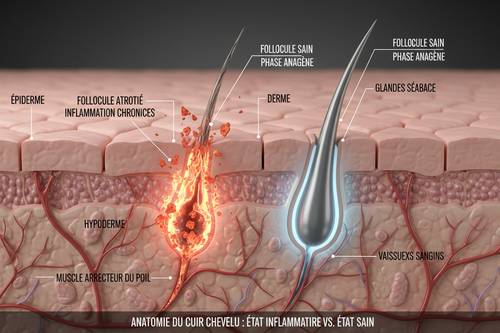
Chronic inflammation of the scalp, often asymptomatic or confused with dandruff, creates an environment hostile to the survival of melanocytes. Finally, thyroid dysfunctions, affecting one in eight women according to the American Thyroid Association, deeply disrupt follicular metabolism and accelerate graying.
The five alerts before massive whitening
Your hair sends precursor signals before whitening massively. The progressive thinning of the hair diameter often precedes depigmentation, reflecting overall follicular distress. The appearance by areas, particularly at the temples then on the sides, follows a classic pattern related to the vascular distribution of the scalp.
The change in texture, where the hair becomes rougher or drier before whitening, reflects a change in the keratin structure associated with the loss of melanin. The slowing of hair growth indicates a failing follicular metabolism. Finally, persistent scalp itching signals an underlying inflammation that compromises the survival of melanocytes.
The seven strategies for melanocyte protection
Supplementation in catalase, this enzyme that neutralizes the hydrogen peroxide accumulated in the follicles, constitutes the most innovative approach. Preliminary trials show a reduction in follicular oxidative stress after three months of treatment. The copper-vitamin B12 combination restores the enzymatic cofactors necessary for melanin synthesis. An Indian study demonstrates partial repigmentation in 23% of deficient subjects after six months of nutritional correction.
Para-aminobenzoic acid (PABA), sometimes wrongly called "vitamin B10" (it is not a true vitamin), has been studied for its protective effect on melanocytes. A few old studies suggested it might slow graying, but recent research is limited. At high doses it can cause side effects (digestive upset, skin reactions, liver damage), and it interferes with certain antibiotics (sulfonamides): do not take it without medical advice, and avoid it during pregnancy and breastfeeding. Ashwagandha, an effective adaptogen, reduces cortisol by 30% according to research published in the Journal of Evidence-Based Complementary Medicine, thus mitigating chronic oxidative stress.
A daily five-minute scalp massage stimulates follicular microcirculation and promotes the supply of nutrients and oxygen to melanocytes. Rosemary essential oil, applied diluted, activates local circulation and has documented antioxidant properties. Finally, intermittent fasting triggers cellular autophagy, the mechanism by which cells eliminate their damaged components and regenerate, potentially benefiting melanocytes.
The scientific hope of reversibility
A recent discovery from Columbia University, published in eLife in 2021, has overturned certainties. By analyzing hairs one by one from 14 volunteers, the researchers observed, in some of them, a few white hairs that had regained their color, with repigmented segments matching periods of lower stress. This phenomenon remains limited and does not apply to most white hairs.
This revelation indicates that melanocytes do not necessarily die, but sometimes enter a reversible dormancy. When metabolic conditions become favorable again, these cells can resume their melanin-producing activity. This plasticity offers a therapeutic window previously untapped.
The 90-day protocol seems to be the minimum time to observe significant changes. It is the time necessary for a new hair to grow from the follicle to become visible, incorporating the metabolic and nutritional changes made. Consistency in the application of protective strategies largely determines success.
For those who wish to improve this approach with specific supplements (catalase, complete B complex, chelated copper, standardized ashwagandha), it is extremely important to use dosages based on scientific data. And if you desire personalized guidance to identify your specific deficiencies and develop a protocol adapted to your hair situation, remote consultations are available on our site, including a review of your lab results and the development of a targeted nutritional plan.
A three-month plan
Hair grows about one centimeter per month: so allow at least three months before judging any change at the root. The first month, we focus on inputs (proteins, copper, zinc, iron, vitamin B12) and on cutting back on smoking and reducing oxidative stress. The second month, we add scalp massage for microcirculation. The third month, we observe the regrowth. If white hairs appear very early, in large numbers or with fatigue, a blood test (B12, ferritin, thyroid) with a doctor is a good idea.
Want daily guidance? The personalized follow-up from Terrier, at €10 per month, allows you to ask us questions in writing and move at your own pace.