Alopecia areata or androgenetic alopecia: the types and treatments that work
Share
Hair loss that goes beyond aesthetics
Alopecia affects 147 million people worldwide, with forms ranging from simple diffuse shedding to total hair loss. Alopecia areata affects about 2% of the population during their lifetime, while androgenetic alopecia affects about half of men and a significant proportion of women after 50. Hair loss often has a major psychological impact, with an increased risk of anxiety and depression.
Recent research is transforming our understanding of this condition, which was long considered purely cosmetic. Alopecia is now emerging as the visible symptom of deep-seated immune, metabolic, or inflammatory dysfunctions. This new perspective opens up new therapeutic possibilities that go beyond the simple topical solutions of the past.
Alopecia areata: when the immune system attacks
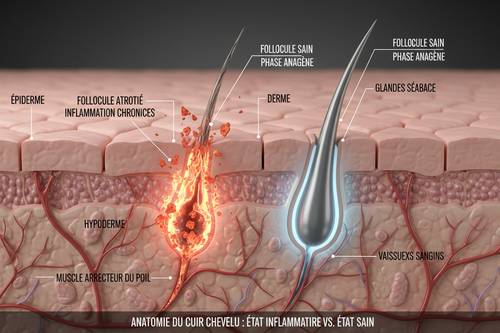
Alopecia areata is one of the most notable forms, with round patches of baldness appearing suddenly. Immunological discoveries reveal that CD8+ T lymphocytes specifically attack hair follicles in the anagen phase, forcing them prematurely into the telogen phase. This autoimmune attack results from a loss of follicular "immune privilege," a unique protective mechanism normally present.
Genomic research has identified more than 20 susceptibility genes, including ULBP3 and ULBP6, which encode ligands that activate NK cells. This genetic component explains why some people with the condition have a family history. The discovery of these mechanisms guides the development of targeted therapies rather than traditional empirical approaches.
Inflammation plays a central role, with an overexpression of IFN-γ and IL-15 creating an environment hostile to the normal hair cycle. JAK inhibitors, originally developed for rheumatoid arthritis, have transformed the treatment of severe alopecia areata, with significant regrowth in some patients. This serendipitous discovery is transforming the treatment of once-desperate forms.
Androgenetic alopecia: beyond hormones
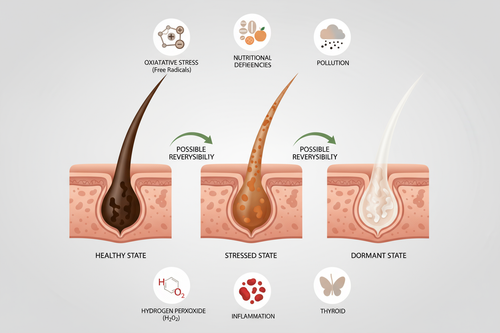
Androgenetic alopecia gradually affects the majority of the population, but the mechanisms go beyond simple sensitivity to androgens. Research shows that follicular miniaturization results from a complex cascade involving perifollicular inflammation, oxidative stress, and changes in the dermal microenvironment. Prostaglandin D2 is elevated in bald areas and slows hair growth.
The role of follicular stem cells is emerging as a key factor. These cells do not disappear in baldness but become dysfunctional, unable to differentiate into mature follicles. Studies in mouse models show that reactivating these dormant cells with specific growth factors allows for complete follicular regeneration, opening up new therapeutic possibilities.
The genetics of androgenetic alopecia are proving to be more complex than anticipated. Beyond the AR gene encoding the androgen receptor, more than 200 genetic variants influence risk and severity. Genetic scores already allow for an estimation of the risk of baldness, although they are not yet used in routine practice.
Nutritional deficiencies: a major modifiable factor
Nutritional deficiencies play an essential but underestimated role in alopecia. Iron deficiency, common in menstruating women, is associated with hair loss. Low ferritin increases the risk of diffuse shedding, even without anemia. Correcting the deficiency often improves hair density within a few months.
Vitamin D profoundly influences the hair cycle through its follicular receptors. A vitamin D deficiency is common in people with alopecia areata. Its correction, under medical supervision, is being studied for its possible role in immunity and regrowth.
Sulfur amino acids, particularly cysteine and methionine, are the essential building blocks of keratin. Restrictive or unbalanced diets compromise follicular protein synthesis. Insufficient protein intake can also slow growth and can be corrected through diet.
Want an opinion on your situation? During a vitality assessment, we review your diet, sleep, stress, and goals together, then build a plan tailored to your pace.
Stress and alopecia: the mechanisms finally elucidated
The link between stress and alopecia is finally finding a solid scientific explanation. Chronic stress keeps follicles in a prolonged telogen phase through the release of corticotropin-releasing hormone (CRH), which directly inhibits follicular stem cells. Studies in mouse models show that blocking CRH allows for complete regrowth even under continuous stress.
Traction alopecia, common with certain hairstyles, reveals the mechanical sensitivity of the follicles. Chronic tension activates follicular mechanoreceptors, triggering an inflammatory cascade that leads to perifollicular fibrosis. Histological studies show irreversible damage after 5 years of continuous traction, highlighting the importance of prevention.
Sleep profoundly influences hair health through the regulation of growth hormone and melatonin. Night work, which disrupts the internal clock, could also affect hair health. Improved sleep significantly improves hair quality within 6-8 weeks.
Therapeutic innovations: hope is reborn
Regenerative therapies are transforming the treatment of alopecia. Platelet-rich plasma (PRP) releases growth factors that directly stimulate follicular stem cells. Several studies show an improvement in density after a few sessions, with effects lasting several months. Combining it with microneedling seems to enhance the results.
Low-level light therapy (LLLT) is gaining increasing scientific validation. Red light (655-660 nm) stimulates follicular mitochondrial ATP production and prolongs the anagen phase. Controlled studies show an increase in the number of hairs after a few months of daily use.
Biomimetic peptides represent the new therapeutic frontier. These short chains of amino acids mimic the action of natural growth factors, stimulating follicular proliferation without oncogenic risk. Early trials are promising but need to be confirmed.
Toward a personalized approach
Alopecia is no longer inevitable but a condition that is increasingly understood and treatable. Scientific advances now allow for the identification of the specific mechanisms for each patient and the adaptation of interventions accordingly. From nutritional rebalancing to cutting-edge regenerative therapies, the range of treatments is constantly expanding.
There is hope for the millions of people affected. Research is progressing rapidly, promising increasingly effective and personalized solutions. The key lies in a comprehensive approach combining the identification of root causes, targeted nutritional corrections, and the judicious use of therapeutic innovations.
The essential message is that each type of alopecia requires a specific strategy. Self-diagnosis and self-medication often lead to discouraging failures, while a professional assessment allows for the identification of the unique contributing factors in each case and the proposal of a tailored protocol.
The future looks promising with the emergence of gene therapies, specific immunomodulators, and follicular bioengineering techniques. In the meantime, current approaches, when correctly applied, already allow for remarkable results in the majority of cases.
Take action to regain healthy hair
No longer let alopecia dictate your self-confidence. If you suffer from hair loss, personalized solutions exist for your specific situation.
Discover our selection of natural products specially formulated to support hair health in our dedicated shop, accessible via the shop tab on our website. Each product has been rigorously selected for its quality and the available data about it.
For a truly personalized approach, book an appointment for a consultation that can be carried out entirely remotely from the comfort of your home. During this consultation, we will analyze your situation in detail, identify the root causes of your alopecia, and develop a custom protocol tailored to your specific needs.
Book your consultation online now directly on our website. Your journey toward healthy, abundant hair begins with this decisive first step.
Want daily support? Le Terrier's personalized follow-up, at €10 per month, allows you to ask us questions in writing and move at your own pace.