

Liver and acne: understanding the link and taking natural action
Share
In functional naturopathy, the skin is considered the truest reflection of internal balance. It is the fifth excretory organ of the human body, an elimination organ that comes into action when the main pathways (liver, kidneys, intestines, lungs) are saturated or underperforming. A pimple is therefore not a surface flaw, it is a signal. And creams, however effective they may be locally, cannot solve a biochemical problem that is playing out several organs higher up.
Here is what connects the plate, the liver, hormones, and the skin, and what you can do concretely.
Why anti-acne creams are not enough: the functional approach
The skin: an emergency exit
The human body has a sophisticated elimination system that naturopathy refers to as excretory organs: the liver (chemical filtration of the blood), the kidneys (water filtration), the intestine (elimination of digestive waste), the lungs (elimination of CO₂ and volatile compounds), and the skin (sweat, sebum).
Under normal conditions, the liver takes care of the vast majority of the detoxification work: it filters the blood, conjugates and eliminates used hormones, medications, environmental pollutants, and metabolic waste. But when its processing capacity is overwhelmed, by a pro-inflammatory diet, an excess of toxins, chronic stress, or a structurally underperforming liver, it "overflows". And when the liver overflows, the body calls upon its secondary excretory organs. The skin is one of them.
This is why applying a purifying cream to acne of hepatic or hormonal origin is like turning off a warning light on a car's dashboard without looking at what is happening under the hood. The signal disappears momentarily, but the problem persists and worsens.
Sweating and the skin microbiome: the "sudoriparous" myth
The idea that "sweating purifies the skin" is a persistent myth that needs to be clarified precisely, because the reality is more nuanced, and more important for understanding exercise-induced acne.
Two distinct systems coexist in the skin: the sweat glands (which produce sweat) and the sebaceous glands (which produce sebum). These are two separate elimination channels that do not mix. Sweat does not carry away sebum, and sweating does not open clogged pores in the literal sense.
On the other hand, here is what sweating actually does: it changes the skin pH (which rises from 4.5-5.5 to more neutral values) and creates surface moisture which, if not removed quickly, constitutes an ideal environment for the proliferation of Cutibacterium acnes, the anaerobic bacterium responsible for the inflammation of the pilosebaceous follicles. The maceration of sweat on the face is therefore a direct aggravating factor of acne, particularly during physical exertion.
Reference: Langan, E.A. et al. (2018). "Exercise-induced acne." Journal of the European Academy of Dermatology and Venereology, 32(6), 957-963. And: International Journal of Cosmetic Science. Sweat left on the skin changes the skin pH and promotes the proliferation of Cutibacterium acnes in the pilosebaceous follicles. A gentle facial cleansing within 10 to 15 minutes after exertion significantly reduces this risk factor.
The rule of sports and skin: exercise, it is excellent for skin microcirculation and hormonal regulation. But clean your face immediately after exertion with a gentle cleanser, without waiting. Do not touch your face with your hands during exertion. And never "pop" a pimple, you spread the infection deep and create a risk of scarring.
The plate and the liver: the biochemical cascade of acne
Sugar and insulin spike: the overproduction of sebum
Every time you consume carbohydrates with a high glycemic index, refined sugars, white bread, sugary drinks, industrial cereals, your pancreas secretes insulin to manage the blood sugar spike. This insulin, in high quantities, triggers the production of endogenous IGF-1 (insulin-like growth factor) in the liver.
IGF-1 directly stimulates two critical mechanisms for acne:
- The proliferation of sebocytes (sebum-producing cells), more sebum, more risk of follicular obstruction
- The hyperkeratinization of the follicles, the dead cells that clog the pores renew too quickly, creating comedones
In parallel, high insulin stimulates the production of androgens (testosterone and DHEA-S) by the adrenal glands, hormones that further amplify sebum secretion. The cascade is complete: a sugary meal triggers a chain reaction that ends in your pores.
Dairy and the IGF-1 trap
Dairy products, particularly skim milk, paradoxically more problematic for the skin than whole milk, are today one of the best-documented dietary factors in acne. The reason is biochemical and distinct from sugar.
Cow's milk naturally contains bovine IGF-1 and precursors of this molecule, because it is designed to make a calf grow quickly. Ingested by humans, this exogenous IGF-1 adds to the endogenous production and amplifies the same mechanisms described above. Milk also contains androgen precursors (DHEA-S, androstenedione) and growth hormones that stimulate the sebaceous glands.
Hard cheese, cream, butter, and fermented products seem less problematic than liquid milk, but for people with acne, the entire range of dairy products deserves a trial elimination period.
Reference: Melnik, B.C. & Schmitz, G. (2009). "Role of insulin, insulin-like growth factor-1, hyperglycaemic food and milk consumption in the pathogenesis of acne vulgaris." Experimental Dermatology, 18(10), 833-841. And: Adebamowo, C.A. et al. (2008). "Milk consumption and acne in teenaged boys." Journal of the American Academy of Dermatology, 58(5), 787-793. These studies document the statistically significant association between milk consumption and acne severity, regardless of the fat content of the dairy product.
The overview of diet and skin
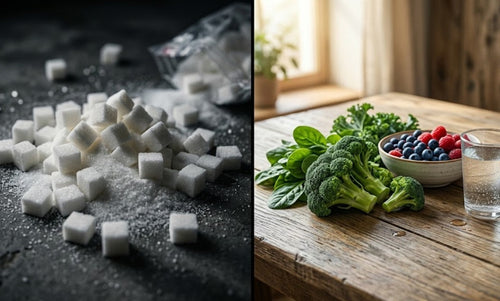
| Pro-inflammatory foods (saturate the liver) | Acne-causing mechanism | Pro-hepatic foods (support the liver) |
|---|---|---|
| Refined sugars, sodas, pastries | Insulin spike, overproduction of sebum and androgens | Bitter green vegetables (arugula, endive, black radish) |
| Milk, cottage cheese, skim milk | Bovine IGF-1, hyperactivation of sebaceous glands | Cruciferous (broccoli, cabbage, cress), Phase II hepatic detoxification |
| Fried foods, oxidized vegetable oils | Liver overload, overflow through the skin | Artichokes, dandelion, choleretic and biliary support |
| Frequent alcohol | Saturation of hepatic detoxification pathways | Lemon (citric acid), stimulation of bile secretion |
| Ultra-processed foods rich in omega-6 | Systemic inflammation, activation of skin inflammasomes | Omega-3 (sardines, mackerel), inflammation modulation |
| Whey protein (dairy) in excess | Excessive stimulation of the mTORC1 pathway, hyperseborrhea | Zinc (pumpkin seeds, oysters), hepatic hormonal modulation |
To go further: our "Liver Disorders" guide details the habits, meals, and plants that support the liver, with the precautions to know.
The hormonal trap: stress, cycle, and hepatic congestion
Peri-menstrual acne, those characteristic breakouts that invariably appear in the 5 to 7 days preceding menstruation, is probably the most eloquent manifestation of the liver-hormone-skin link. Understanding this mechanism radically changes the therapeutic approach.
Here is the simplified physiology:
- In the second half of the cycle, progesterone drops and estrogen also decreases, while androgens become proportionally more dominant
- The liver is responsible for hormonal clearance, the elimination of used hormones via conjugation (glucuronidation, sulfoconjugation) and biliary excretion
- If the liver is slowed down, by a pro-inflammatory diet, an excess of hepatic work, intestinal dysbiosis (the intestinal flora can "deconjugate" estrogens via beta-glucuronidase), the used hormones stagnate in circulation
- This excess of circulating androgens stimulates the sebaceous glands and triggers the pre-menstrual acne breakout
The same cascade occurs during chronic stress: cortisol directly stimulates the adrenal glands to produce more DHEA-S (androgenic precursor), and at the same time monopolizes the hepatic detoxification resources, reducing the liver's ability to eliminate sex hormones. Double penalty: more androgens produced, fewer androgens eliminated.
Reference: Zouboulis, C.C. (2004). "Acne and sebaceous gland function." Clinics in Dermatology, 22(5), 360-366. The sebaceous gland expresses specific androgen receptors (particularly for dihydrotestosterone, DHT, the active form of testosterone converted by 5-alpha-reductase). An excess of circulating androgens, whatever the cause, directly increases sebum secretion and the probability of inflammatory comedone formation.
The naturopathic protocol: cleanse from within
Timing and anticipation: D-5 before menstruation
If you observe a regular acne breakout in the days preceding your menstruation, you have a very valuable predictive intervention window. The 5 to 7 days before menstruation are the critical time when the liver is under the most demand to eliminate the end-of-cycle hormones.
The D-5 protocol:
- Remove refined sugars and dairy from D-5 (5 days before the estimated date of menstruation), reducing the hepatic workload at the time when it needs it most
- Increase cruciferous vegetables (broccoli, cabbage, cress), their glucosinolates activate Phase II hepatic detoxification enzymes (glutathione-S-transferases) which conjugate estrogens for their elimination
- Soluble fibers (psyllium, ground flax seeds, legumes), they capture the deconjugated estrogens in the intestine and eliminate them before they are reabsorbed (enterohepatic circulation)
- Reinforced hydration, 1.5 to 2L of water to support renal filtration and dilute metabolic waste
- Stress reduction the days preceding menstruation, heart coherence, yoga, exposure to natural light in the morning to regulate cortisol
Hepatic support: plants and zinc
Milk thistle (silymarin): it is the best-documented hepatoprotector in European phytotherapy. Silymarin (flavonolignan complex from Silybum marianum) protects hepatocytes against oxidative stress, stimulates their regeneration, and improves the liver's Phase I and II detoxification capacity. For hormonal acne, a better protected and more efficient liver metabolizes and eliminates androgens with greater efficiency.
Reference: Polachi, N. et al. (2016). "Modulatory effects of silibinin in various cell signaling pathways." European Journal of Medicinal Chemistry, 116, 382-394. Silymarin acts as a modulator of multiple hepatic signaling pathways involved in detoxification, cell proliferation, and inflammation. Clinical studies document its effectiveness in improving liver function markers in patients with non-alcoholic steatosis.
Zinc: the most documented trace element in functional dermatology for acne. Its mechanism of action is multiple and particularly adapted to the acne-liver-hormone problem:
- Inhibition of 5-alpha-reductase: the enzyme that converts testosterone into dihydrotestosterone (DHT, the 5 times more androgenic form), reducing the activity of this enzyme, is directly reducing the androgenic stimulus on the sebaceous glands
- Local anti-inflammatory action: modulation of the inflammatory response of sebocytes and keratinocytes to Cutibacterium acnes
- Hepatic support: co-factor of hepatic detoxification enzymes
Reference: Dreno, B. et al. (2018). "Zinc and cutaneous biology." Dermatologic Therapy. And: Sharquie, K.E. et al. (2006). "Oral zinc sulfate in the treatment of acne vulgaris." Saudi Medical Journal. Several clinical trials show that zinc supplementation (sulfate or bisglycinate, 15 to 30 mg/day of elemental zinc, 30 mg being the dose used in the main trials) can reduce the number of inflammatory acne lesions. In the largest head-to-head trial, however, its effect was smaller than that of a tetracycline antibiotic (minocycline), with the advantage of carrying no risk of bacterial resistance.
Choleretic plants (which stimulate bile secretion):
- Arugula and endive: natural bitterness that reflexively stimulates bile secretion, integrating them raw at the beginning of a meal is the simplest and most daily intervention
- Black radish (Raphanus sativus niger): effective biliary stimulant, particularly effective in juice form or as a supplement (rafanol)
- Artichoke: the cynarin it contains stimulates choleresis and protects hepatocytes
- Citric acid (fresh lemon): half a lemon in a large glass of warm water in the morning on an empty stomach, a naturopathic classic to activate bile secretion upon waking
Post-exertion hygiene and adapted skin routine
Exercise is a valuable ally against hormonal acne, it reduces chronic cortisol, improves insulin sensitivity (fewer blood sugar spikes, less IGF-1) and stimulates skin microcirculation. But it must be accompanied by a rigorous post-exertion hygiene.
- Cleansing within 10 to 15 minutes after exertion: a gentle cleanser (pH 5 to 5.5, without alkaline soap) to remove sweat and restore the acidic skin pH before C. acnes proliferates
- No touching, no popping: hands carry bacteria, nails deepen the infection, touching your pimples multiplies the risk of scarring by 4
- Green or white clay mask: 1 to 2 times a week, for 10 minutes, to absorb excess sebum without disrupting the pH; clay is a relevant local aid provided that an internal approach is also in place
- Avoid comedogenic cosmetics: coconut oil, shea butter, lanolin, and excessive oleic acid; opt for cosmetics tested as "non-comedogenic" for acne-prone skin
Identifying your exact acne profile (hormonal acne, digestive acne, stress acne, or nutritional acne) is essential for a truly effective protocol. My personalized naturopathic follow-up analyzes your individual health profile and creates a tailored approach.
Start my personalized follow-up, €10/monthYour skin is talking to you - listen to it
Acne is not an enemy to be fought with topical acids and antibiotics. It is a biochemical warning signal that your body consistently sends you, in the same place and at the same time, to tell you that something upstream deserves your attention.
A congested liver, repeated blood sugar spikes, dietary IGF-1, poorly metabolized androgens, and chronic stress that monopolizes your liver resources - all these mechanisms can be addressed through nutritional and naturopathic interventions. And the beauty of the functional approach is that the changes made for your skin simultaneously improve your energy, hormonal balance, and overall metabolic health. The skin is merely the visible reflection of an internal balance that we build.
Le Terrier du Bien-Être's support program helps you precisely identify your acne triggers (diet, hormones, stress, digestion), build a liver support protocol tailored to your individual health profile, and readjust the program month by month based on your results.
Join the program, €10/monthFAQ: Your questions about the liver, hormones, and acne
Is my acne really linked to my liver or my diet?
Not always, but in the majority of cases of mild to moderate acne in adults, especially perimenstrual acne or acne on the jaw and chin, the link to liver and hormonal metabolism is strong. Signs pointing to acne of internal origin: breakouts always return to the same place (jaw, chin, forehead, temples), their appearance coincides with your cycle, stress, or a dietary slip-up, and topical skincare products only have a temporary effect. If your acne is randomly distributed, very superficial, and bacterial, a topical dermatological approach may be sufficient.
How long does it take to see results by addressing the liver and diet?
The first improvements (reduction in new breakouts) are generally visible within 3 to 6 weeks of consistent dietary changes. The disappearance of existing lesions is slower: the epidermis renews itself in about 28 days, and deep lesions may require 2 to 3 renewal cycles. A complete protocol (diet + liver support + zinc) shows significant results over 3 months. Patience is essential: hormonal and liver mechanisms improve gradually, not overnight.
Is jawline acne always hormonal?
It is the most characteristic location for hormonal acne, yes, but not exclusively. Jawline, chin, and neck acne is associated with excess circulating androgens (testosterone, DHT) in the vast majority of cases. In women, it is often aggravated before menstruation, during prolonged stress, or as part of PCOS (polycystic ovary syndrome). In men, it may indicate an unbalanced testosterone/cortisol ratio. The liver approach (improving androgen clearance) and zinc (inhibiting 5-alpha-reductase) are the most relevant interventions for this specific location.
Do oat milk or other plant-based milks worsen acne like cow's milk does?
Plant-based milks (almond, oat, soy, coconut) do not contain bovine IGF-1 or androgen precursors, so they do not share this specific acne-causing mechanism of animal milk. However, there are two precautions: soy milk contains phytoestrogens (isoflavones) that can interfere with hormonal balance in sensitive individuals; use it in moderation if your acne is clearly hormonal. Industrial oat milk undergoes enzymatic hydrolysis that gives it a high glycemic index (similar to white bread), which can stimulate endogenous IGF-1 via the insulin spike. Almond milk (unsweetened) and coconut milk (in moderation) are generally the most neutral alternatives for acne-prone skin.
Is a zinc supplement sufficient for acne without changing your diet?
Zinc alone can provide significant improvement; several clinical studies show this. But without changing the underlying pro-inflammatory diet, it will only partially compensate for an imbalance that persists at the source. The maximum effectiveness of zinc is achieved in synergy with the elimination of refined sugars, dairy, and oxidized oils. The form of zinc matters: opt for zinc bisglycinate or chelated zinc (better absorbed and less irritating to the gastric mucosa than zinc sulfate). Usual dosage for acne: 15 to 30 mg/day of elemental zinc equivalent, taken with a meal, for at least 3 months. Avoid doses higher than 40 mg/day in the long term (risk of copper/zinc imbalance).
Does chocolate really cause breakouts?
Chocolate's reputation in acne is partially justified, but not for the reasons people often think. Pure cacao (powder or dark chocolate with more than 85%) is rich in anti-inflammatory polyphenols and has a moderate glycemic index: its direct impact on acne is low or even neutral. The problem comes from milk chocolate and white chocolate: their high content of refined sugars and milk (with its IGF-1) combines both acne-causing mechanisms in a single food. The solution: replace milk chocolate with dark chocolate containing at least 85%; you keep the pleasure without triggering the glycemic and hormonal cascade.
Can you have acne at 30, 40, or 50 without a hormonal reason?
Adult acne is increasingly common and affects about 15 to 25% of adults over 25. In adult women, it is often hormonal in origin (PCOS, perimenopause, discontinuation of hormonal contraception). But it can also be triggered or sustained by other factors: a high-glycemic-index diet, chronic work stress, comedogenic cosmetics, certain medications (corticosteroids, lithium, certain progestin contraceptives), or an unbalanced gut microbiome that disrupts the liver clearance of estrogens. Persistent adult acne always deserves an exploration of underlying causes rather than systematic topical treatment.
Is sweating really bad for acne-prone skin?
Not sweating itself, but stagnant sweat, yes. Sweating has positive effects on the skin: it stimulates microcirculation, activates the superficial lymphatic system, and helps regulate body temperature. The problem arises when sweat remains in prolonged contact with the skin; it alters the skin's pH toward more neutral values, promoting the proliferation of Cutibacterium acnes, whose optimal environment is precisely a less acidic pH. The golden rule: exercise, as it is excellent for hormonal acne, but cleanse your face with a gentle cleanser within 10 to 15 minutes after working out. Also avoid occlusive synthetic clothing over acne-prone areas of the body.
Disclaimer: this article is written for educational purposes. It does not constitute medical advice or a prescription. Severe cystic acne requires a dermatological consultation. Naturopathy supports the body's overall health for mild to moderate forms.
Main sources: Melnik, B.C. & Schmitz, G. (2009), Experimental Dermatology, Adebamowo, C.A. et al. (2008), JAAD, Dreno, B. et al. (2018), Dermatologic Therapy, Polachi, N. et al. (2016), European Journal of Medicinal Chemistry, Zouboulis, C.C. (2004), Clinics in Dermatology.




1 comment
Merci infiniment et continuer comme ça