

Synthetic fragrances: health effects and healthier alternatives
Share
The Illusion of "Smelling Good"
Every morning, millions of people repeat this mechanical gesture: a few sprays of perfume on the hollow of the neck or on the wrists. It is the ultimate gesture of preparation, the one that brings confidence and elegance. But behind these pleasant scents lies a chemical reality that is far less appealing.
Did you know that by simply thinking "smelling good," you potentially expose your body to one of the densest cocktails of toxic substances of your day? What we consider a fashion accessory is actually a massive emission of volatile compounds that your lungs and skin absorb like sponges. It is time to lift the veil on what really floats in the air when you perfume yourself.
1. The Backstage of "Fragrance"
The Shocking Figure: 14 Ghost Substances
A landmark study conducted by the EWG (Environmental Working Group) revealed an alarming statistic: a bottle of perfume from a major brand contains, on average, 14 ingredients that do not appear on the label.
Imagine buying a prepared dish where 30% of the ingredients were kept secret. Yet this is the norm in the fine perfume industry. These "ghost" substances are not there by chance; they are often synthetic fixatives, solvents, or stabilizers.
The Legal Void: "Trade Secret"
How is this possible? Current regulations protect what is called trade secrets. To prevent competitors from copying a famous fragrance, the law allows manufacturers to group hundreds of chemical components under a single generic word on the packaging: "Parfum" (or Fragrance).
This word is actually a legal "black box". Behind it may hide molecules that you would never agree to see in your day cream or your food.
The Systemic Impact: Direct Absorption
The major problem lies in the method of exposure. Perfume does not stay "on" you; it gets "in" you:
-
By inhalation: scent molecules are Volatile Organic Compounds (VOCs). Once inhaled, they pass the pulmonary alveoli to directly reach your bloodstream.
-
Through the skin: the neck area is particularly thin and rich in blood vessels, which facilitates the passage of compounds through the skin barrier.
In summary, a perfume is also a mixture of molecules that your body must then eliminate.
2. The Blacklist: The 5 Ingredients to Absolutely Avoid
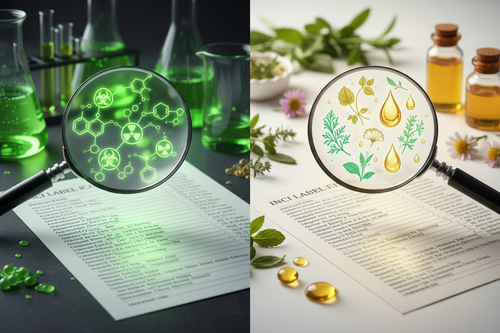
If you scan the INCI list (the list of ingredients) on the back of your bottle, some names should immediately alert you. Here are the five most frequent "culprits":
-
Phthalates (especially Diethyl phthalate, DEP): these are the texturizing agents that allow the perfume to "stick" to your skin all day.
-
The danger: These are major endocrine disruptors. They mimic natural hormones and can disrupt your reproductive system and your thyroid.
-
-
Synthetic musks (galaxolide, tonalide): created to imitate the smell of animal musk at a lower cost.
-
The danger: They are bioaccumulative. This means that your body does not know how to break them down. Traces are now found in adipose tissue (body fat) and even in breast milk.
-
-
Oxybenzone (or benzophenone): used as a UV filter to prevent the color of the perfume from turning in the light.
-
The danger: Strongly suspected of being estrogenic, it can interfere with hormonal balance, particularly in women.
-
-
Synthetic aldehydes: they bring that prized "clean" and sparkling note.
-
The danger: These are notorious irritants for the respiratory tract and can trigger silent inflammatory reactions in sensitive people.
-
-
BHT (Butylated Hydroxytoluene): an antioxidant used to extend the shelf life of the product.
-
The danger: Classified as a potential endocrine disruptor, it is also suspected of having toxic effects on the liver in the long term.
-
Want an opinion on your situation? During a vitality assessment, we review together your diet, your sleep, your stress, and your goals, then we build a plan adapted to your pace.
3. The "Tissue Test": Is Your Perfume Too Loaded?
How to know if your favorite perfume is a chemical bomb without being a chemist? There is a simple and revealing method you can do at home: the forced persistence test.
The protocol:
-
Take a white cloth tissue (clean and without laundry detergent smell).
-
Spray two sprays of your perfume at a distance of 10 cm (4 in).
-
Leave the tissue in a neutral room (not in your bathroom) for 24 hours.
How to interpret the results?
-
Is the smell "linear"? If, after 12 or 24 hours, the smell is exactly the same as at the time of spraying (just less strong), that is a bad sign. A natural perfume evolves, it "lives". A smell that remains frozen and ultra-effective indicates a saturation of synthetic fixatives (phthalates) designed to prevent the evaporation of molecules.
-
The visual aspect: observe the tissue in the daylight. If you see a greasy stain or a marked yellowing, it often indicates the presence of heavy synthetic oils or artificial dyes that get embedded in the fibers... and therefore in your pores.
-
The "saturation" test: if the smell still seems "aggressive" to the nose after a full day on the tissue, imagine the workload you impose on your nervous system and your olfactory receptors to filter this information continuously.
4. The Invisible Impact: Brain Fog and Hormones
Beyond the skin, it is your central nervous system that is on the front line. Perfumes are by definition Volatile Organic Compounds (VOCs). Because they are designed to evaporate and travel in the air, they penetrate your body without filter.
The "Hacked" Blood-Brain Barrier
The nose is the only part of the body where the nervous system is in direct contact with the outside via the olfactory nerve. Some small synthetic molecules have the ability to cross the blood-brain barrier, this membrane supposed to protect your brain from toxins circulating in the blood.
-
The "brain fog": this exposure can cause a low-grade inflammation of the nervous system, resulting in this famous "brain fog", difficulties concentrating, or unexplained fatigue after getting ready in the morning.
-
Chronic migraines: for many, headaches are not a "sensitivity to smells", but a rejection reaction of the brain to inhaled neurotoxins.
5. Transition Guide: How to Smell Good Without Poisoning Yourself?
Switching to "clean" does not mean giving up sensory pleasure. It is a question of retraining your nose and your habits.
Prioritize Trusted Labels
Forget the "green" marketing on the bottles and trust independent certifications:
-
Slow cosmetics: guarantees the absence of petrochemistry and abusive marketing.
-
Cosmebio / Ecocert (cosmos Organic): imposes a minimum of 95% ingredients of natural origin and prohibits the majority of synthetic fixatives.
The DIY Solution: The Oil Perfume
It is the safest method to avoid the massive inhalation of alcohol and VOCs.
-
The recipe: mix 10 ml of Jojoba oil (stable and odorless) with 15 to 20 drops of high-quality essential oils (Sandalwood for woody, Bergamot for fresh, Neroli for floral).
-
Advantage: the oil naturally fixes the smell on the skin without the need for phthalates.
The Clothing Trick
If you are not yet ready to give up your favorite perfume, change its application method: never spray it on your skin. Apply it on the inside of a garment or on a scarf. This limits skin absorption and direct interaction with your body heat, which accelerates the evaporation of toxins.
Your Body Is Not an Armor
It is essential to remember that your skin and your lungs are sponges, not insurmountable barriers. Every spray of synthetic perfume is an additional demand addressed to your liver and your hormonal system to filter, neutralize, and eliminate foreign molecules.
Taking back control of your scent trail is offering your body a purer environment and preserving your mental clarity. Start by scanning your current bottle with an app like INCI Beauty: awareness is often the first step toward improved health.
Frequently Asked Questions
1. Are "high-end" perfumes safer than cheap perfumes? Not necessarily. The price of a perfume often reflects the marketing and the prestige of the brand, but they almost all use the same synthetic molecules from petrochemistry to guarantee the hold and stability of the smell. The "hidden" ingredients are present in luxury as in the entry-level.
2. Why is the word "Fragrance" or "Parfum" enough on the label? It is a legal exception to protect the "industrial secret". If brands had to list the 100 to 200 components of their formula, competitors could easily copy them. The flip side is that it allows hiding endocrine disruptors under a generic name.
3. Are essential oils safe for everyone? Although they are natural, essential oils are concentrates of effective active ingredients. They are not recommended for pregnant women, nursing women, and young children. Some (like citrus) are photosensitizing: do not apply them before sun exposure.
4. My perfume does not give me headaches, is it still toxic? The absence of immediate symptoms (migraine, sneezing) does not mean the absence of impact. Endocrine disruptors like phthalates act at very low doses and in the long term (accumulation effect). This is what we call chronic toxicity.
5. How to know if my perfume contains phthalates? If it is not certified "Organic" or "Slow Cosmétique", there is a high chance that it contains them to fix the smell. A simple clue: if the smell remains impregnated on your clothes even after several days, it is a sign of a massive presence of synthetic fixatives.
6. Is spraying perfume on hair a good alternative? It is a bit better than skin, but it is not ideal. The alcohol present in the perfume dries out the hair fiber, and you continue to inhale the volatile organic compounds (VOCs) throughout the day since they are close to your nose.
7. Are there safe perfumes from major brands? The industry is evolving, but slowly. Some niche brands are starting to offer 100% transparent compositions. The golden rule remains to scan the product with an app like INCI Beauty to check for the presence of polymers or suspicious fixatives.
8. If I stop synthetic perfume, how long does it take for my body to detoxify? Some compounds like phthalates are eliminated fairly quickly (a few days) by the kidneys if you stop exposure. On the other hand, synthetic musks are stored in fatty tissues and take much longer to be eliminated. The best time to stop, therefore, is today.
Want daily support? Le Terrier's personalized follow-up, at €10 per month, allows you to ask us questions in writing and move at your pace.

2 comments
Bonjour vos analyses sont très intéressantes .
Étant en première ligne dès effets secondaires du au produits lessiviels ,parfums et autres produits au senteurs synthétiques .
J ai une hyperosmie très développée qui me procure de très grand soucis de santé.
Je peut répondre à certaine questions qui pourrait être posée .
Bonjour. Je suppose que vous parlez également des parfums d’ambiance. J’ai appris avec l’IA gémini que les dangers viennent aussi des gaz pulvérisateurs. Salutations.