

Household products and indoor pollution: risks and alternatives
Share
Reading time: 11 minutes
The paradox of the "smell of cleanliness"
Close your eyes for a moment. Imagine that smell of "freshness," of "cleanliness," of "blooming spring" that fills your kitchen after a good cleaning. Reassuring, isn't it?
What if that smell is precisely the sign that you are poisoning yourself?
This scent that we instinctively associate with cleanliness is actually nothing more than a chemical construct, a cocktail of synthetic molecules designed to trick our brains. For here is the cruel paradox of modern cleaning: while thinking we are sanitizing our homes, we are contaminating the air we breathe.
The numbers are clear. According to the U.S. Environmental Protection Agency (EPA), pollutant levels inside our homes are 2 to 5 times higher than outdoor levels, and sometimes up to 100 times higher in extreme cases. The World Health Organization (WHO) now classifies indoor air pollution as a major global health risk.
Your home, this supposed sanctuary protecting you from the outside world, has become a slow-motion gas chamber.
Here is what household sprays contain, their possible effects on health, and simple, affordable alternatives.
Volatile Organic Compounds (VOCs): these invisible enemies
What exactly is a VOC?
Volatile Organic Compounds, or VOCs, are chemical molecules that evaporate easily at room temperature. It is precisely this volatility that makes them so dangerous: they instantly pass from a liquid state (your spray) to a gaseous state (the air you breathe).
Among the most common VOCs in household products are:
- Formaldehyde: A known carcinogen (Group 1, IARC/WHO), present in many disinfectants
- Benzene: A known carcinogen, used as a solvent
- Toluene: Neurotoxic, present in degreasers
- Xylene: A major respiratory irritant
- Limonene: Present in "lemon" fragrances, it reacts with ozone to form formaldehyde
- Glycol ethers: Suspected endocrine disruptors
INERIS (the National Institute for Industrial Environment and Risks) in France confirms that cleaning and disinfection products are major sources of VOCs in indoor environments.
The everyday chemical cocktail
The problem does not come from a single product, but from their accumulation.
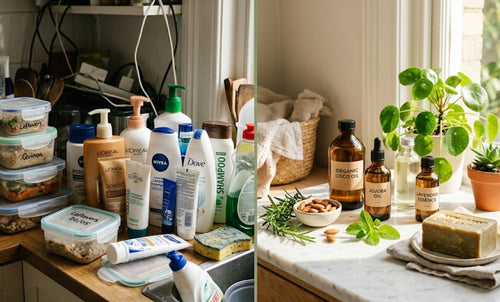
Take inventory of your household cabinet: multi-surface spray, glass cleaner, toilet disinfectant, descaler, scented laundry detergent, fabric softener, air freshener, electric diffuser...
Each of these products releases its own cocktail of VOCs. By using them daily, you create a permanent chemical saturation of your indoor air.
And here is the question no one asks: if a substance is designed to be a deadly poison for bacteria, why would it be harmless to us?
The answer is simple: it is not.
The biological impact: when cleaning becomes a poison
Respiratory system: the equivalent of 20 cigarettes a day
In 2018, a team of researchers from the University of Bergen (Norway) published a study that had the effect of a bombshell in the scientific community.
Titled "Cleaning at Home and at Work in Relation to Lung Function Decline and Airway Obstruction," published in the American Journal of Respiratory and Critical Care Medicine, this study followed 6,235 participants for 20 years.
Its findings are striking:
Regular use of cleaning sprays causes a decline in lung function comparable to smoking 20 cigarettes a day over the same period.
Reference: Svanes, Ø. et al. (2018). American Journal of Respiratory and Critical Care Medicine, 197(9), 1157-1163.
Inhaled VOCs directly irritate the bronchial mucous membranes, cause chronic inflammation, and gradually impair respiratory capacity. People with asthma or chronic bronchitis are particularly vulnerable.
The liver and toxic load: enzymatic overload
When you inhale VOCs, these molecules do not remain confined to your lungs. They pass into the bloodstream and must be neutralized by your detoxification system, primarily the liver.
Simplified biochemical mechanism:
The liver detoxifies foreign substances (xenobiotics) in two phases:
Phase I (Activation): Cytochrome P450 enzymes transform toxins into intermediate metabolites, sometimes more reactive than the original molecule.
Phase II (Conjugation): These metabolites are linked to molecules (glutathione, glucuronic acid) to become water-soluble and excretable through urine or bile.
The problem: these enzymatic systems have a limited capacity. Daily exposure to household VOCs can:
- Saturate Phase I enzymes, creating a bottleneck
- Deplete glutathione reserves (a major antioxidant)
- Generate oxidative stress through the accumulation of free radicals
- Promote low-grade liver inflammation
This is what naturopaths call the "toxic load": your body knows how to detoxify itself perfectly, provided we stop overloading it daily.
Hormonal disruption: the silent attack
Many household products contain phthalates (fragrance fixatives) and synthetic musks (persistent fragrances). These molecules are recognized as endocrine disruptors.
How do they work?
- They mimic the action of estrogens (estrogen-like effect)
- They block hormone receptors
- They interfere with thyroid function
Effects that have been studied, some still debated in humans, include:
- Fertility disorders (male and female)
- Early development in children
- Thyroid dysfunction
- Increased risk of certain hormone-dependent cancers
Pregnant women and young children are particularly at risk, as their hormonal system is still developing or is particularly sensitive.
Comparison table: industrial products vs. natural alternatives
This table summarizes the fundamental differences between conventional household products and natural alternatives:
| Criterion | Industrial products | Natural alternatives |
|---|---|---|
| Respiratory toxicity | High (VOCs, formaldehyde) | None to very low |
| Endocrine disruptors | Present (phthalates, musks) | Absent |
| Liver impact | Enzymatic overload | None |
| Disinfectant efficacy | High | Sufficient for household use |
| Degreasing efficacy | High | Good (with baking soda) |
| Average monthly cost | €15-30 | €3-8 |
| Environmental impact | Water pollution | Biodegradable |
| Safety for children/pets | High risk | Safe |
| Indoor air quality | Degradation | Preservation |
Want an opinion on your situation? During a vitality assessment, we review your diet, sleep, stress, and goals together, then build a plan tailored to your pace.
The magic trio for a healthy home
The good news: nature has already provided everything. Three simple, affordable ingredients available everywhere can replace 90% of your household products.
White vinegar: the versatile natural acid
White vinegar (or alcohol vinegar) consists of acetic acid diluted to about 8%. This natural acidity gives it remarkable properties:
Properties:
- Effective descaler: Dissolves limescale deposits (faucets, shower, kettle)
- Disinfectant: Effective against many bacteria and mold
- Mild degreaser: For lightly soiled surfaces
- Descaler: Perfect for coffee makers or dishwashers
Use:
- Undiluted for intensive descaling
- Diluted (50/50 with water) for general cleaning
- Heated for enhanced action
What science says:
The Journal of Environmental Health confirms that white vinegar is effective against many common household pathogens without the toxicological risks of synthetic detergents.
Precaution: Never mix with bleach (releases toxic chlorine gas). Avoid on marble and limestone (damages the surface).
Baking soda: the mild alkaline abrasive
Baking soda (sodium bicarbonate) is an alkaline mineral salt with complementary properties to vinegar.
Properties:
- Mild abrasive: Scrubs without scratching (sinks, stovetops, ovens)
- Deodorizer: Neutralizes acidic odors (refrigerator, trash can, litter box)
- Mild fungicide: Limits mold growth
- Water softener: Improves laundry detergent effectiveness
Use:
- As a paste (with a little water) for scrubbing
- Sprinkled on surfaces before scrubbing
- Diluted in water for general cleaning
- In laundry detergent to soften clothes
The vinegar + baking soda duo:
Mixed together, they produce an effervescent reaction (CO2 release) useful for unclogging slightly obstructed drains. However, this reaction partially neutralizes their respective properties; for optimal cleaning, use them separately or sequentially.
Lemon and tea tree essential oil: the fragrance and antifungal
For those who want a pleasant smell after cleaning (and rightly so!), two natural options are available:
Fresh lemon:
- Natural deodorizer
- Mild degreaser
- Brightener (stains on light wood)
- Mild antibacterial
Tea Tree Essential Oil:
It is one of the few natural ingredients whose antifungal and antibacterial properties are scientifically documented.
Reference: Carson, C.F. et al. (2006). "Melaleuca alternifolia (Tea Tree) Oil: a Review of Antimicrobial and Other Medicinal Properties". Clinical Microbiology Reviews, 19(1), 50-62.
Use: 5 to 10 drops in your homemade spray (vinegar + water) for a fresh fragrance and enhanced antimicrobial action.
Essential oil precautions: Keep out of reach of children. Some essential oils are contraindicated for pregnant or breastfeeding women, children under 6 years old, and pets (especially cats).
Going further: soda crystals and percarbonate
For more demanding tasks (laundry, dishes, intensive degreasing), two other ingredients complete your kit:
Soda crystals (sodium carbonate):
- More alkaline than baking soda
- Effective degreaser
- Perfect for homemade laundry and cleaning very dirty ovens
- Recommended to wear gloves (skin irritant)
Sodium percarbonate:
- "Solid hydrogen peroxide"
- Natural whitener (alternative to bleach for white laundry)
- Effective disinfectant
- Activates from 40°C (104°F)
Transition guide: how to detox your home in 7 days
Switching to natural cleaning does not happen overnight. Here is a gradual one-week plan:
Day 1-2: inventory and sorting
- Gather all your household products
- Identify those containing: "Parfum/Fragrance", "Danger", "Irritant", danger pictograms
- Finish the opened products (in well-ventilated rooms) or drop them off at a waste disposal center
- Never pour them down the sink (water pollution)
Day 3: natural shopping
- White vinegar (5L container at a supermarket: ~€3)
- Food-grade baking soda (1kg (2.2 lb): ~€3)
- Fresh lemons or lemon essential oil
- Tea tree essential oil (10ml: ~€5)
- Empty spray bottle (reused or purchased)
Day 4-5: preparing homemade products
Multi-surface spray:
- 500ml water
- 250ml white vinegar
- 10 drops of tea tree or lemon essential oil
- Mix in a spray bottle
Scrubbing cream:
- 3 tablespoons of baking soda
- 1 tablespoon of water
- Mix to obtain a paste
Day 6: the big airing out
- Open all windows for at least 30 minutes
- Create a cross-breeze
- Allow residual VOCs to escape
- Clean once with your new products
Day 7: new habits
- Air out for 10 minutes every day (morning and evening)
- Clean regularly (prevents the accumulation of dirt requiring harsh products)
- Read the labels of the new products you buy
- Prioritize labels (Ecocert, Nature & Progrès)
The naturopath's eye: supporting your body after exposure
If you have used chemical products for years, you may want to gently support your body's elimination organs. Here is how to naturally support your detoxification organs:
Supporting the liver
The liver is your detoxification center. To help it:
- Milk thistle (Silybum marianum): Silymarin may help protect liver cells (hepatocytes), based mostly on lab studies
- Artichoke: Stimulates bile secretion (choleretic)
- Desmodium: Traditionally used to support liver function
- Black radish: Hepatobiliary drainer
In practice: a 3-week course at the change of season, in the form of an herbal tea, capsules, or ampoules.
Before starting an herbal course, check with your doctor or pharmacist if you are pregnant or breastfeeding, have liver or gallbladder problems (such as gallstones), or take any medication: milk thistle, artichoke, and black radish are not right for everyone.
Supporting the lungs
Your lungs were the first exposed:
- Deep breathing: 5 minutes of conscious abdominal breathing every day
- Moderate physical activity: Promotes gas exchange and pulmonary lymphatic drainage
- Eucalyptus and Thyme (as an infusion): Traditionally used for the respiratory tract
- Humidified environment: Too dry air irritates the mucous membranes
Supporting the lymphatic system
Lymph transports cellular waste to the elimination organs:
- Stay hydrated: 1.5 to 2L of water per day
- Move daily: Lymph has no pump; it circulates through muscle movement
- Dry brushing: Stimulates cutaneous lymphatic circulation
- Hot/cold alternating in the shower: Activates circulation
Take back control of your environment
We spend 90% of our time indoors. The air we breathe at home has a direct impact on our health, far more than the outdoor air we fear so much.
The good news? You have the power to change that.
Unlike urban pollution, over which you have little control, you are the absolute master of what enters your home. Every chemical spray you replace with white vinegar, every synthetic fragrance you give up in favor of an essential oil, every window you open to ventilate is a victory for your lungs, liver, and hormonal system.
Natural cleaning is not a nostalgic step backward. It is an informed choice, based on science and common sense. It is recognizing that nature has already provided simple, effective, and safe solutions.
And the best part? It is cheaper, simpler, and just as effective for 90% of household needs.
So, where do you start?
Scientific sources and references
Institutional studies and reports
1. Indoor air pollution, EPA
- U.S. Environmental Protection Agency
- “Introduction to Indoor Air Quality”
- Indoor pollutant levels are 2 to 5 times (sometimes 100 times) higher than outdoor levels
- Website: epa.gov/indoor-air-quality-iaq
2. Global health risk, WHO
- World Health Organization
- “Household Air Pollution and Health”
- Indoor air pollution classified as a major global health risk
- Website: who.int
3. Indoor VOC sources, Ineris
- National Institute for Industrial Environment and Risks (France)
- Cleaning products identified as major sources of VOCs (formaldehyde, acetaldehyde)
- Website: ineris.fr
4. Respiratory impact of cleaning, Bergen Study
- Svanes, Ø. et al. (2018)
- “Cleaning at Home and at Work in Relation to Lung Function Decline and Airway Obstruction”
- American Journal of Respiratory and Critical Care Medicine, 197(9), 1157-1163
- DOI: 10.1164/rccm.201706-1311OC
- Regular use of sprays = lung decline comparable to 20 cigarettes/day over 20 years
5. Effectiveness of natural alternatives
- Journal of Environmental Health
- White vinegar and baking soda effective against common household pathogens
6. Antimicrobial properties of Tea Tree
- Carson, C.F., Hammer, K.A., & Riley, T.V. (2006)
- “Melaleuca alternifolia (Tea Tree) oil: a Review of Antimicrobial and Other Medicinal Properties”
- Clinical Microbiology Reviews, 19(1), 50-62
- DOI: 10.1128/CMR.19.1.50-62.2006
Toxicological classifications
7. Formaldehyde, CIRC/IARC
- International Agency for Research on Cancer (WHO)
- Classification: Group 1 (Known human carcinogen)
- Website: monographs.iarc.fr
8. Benzene, CIRC/IARC
- International Agency for Research on Cancer (WHO)
- Classification: Group 1 (Known human carcinogen)
Disclaimer
Transparency note: This article is written for educational and informational purposes. It does not constitute personalized medical advice. The natural alternatives proposed are effective for common household use but do not replace medical disinfection in a specific healthcare context. In case of respiratory or liver disease, consult a healthcare professional.
Want daily support? Le Terrier's personalized follow-up, at €10 per month, allows you to ask us questions in writing and progress at your own pace.
FAQ: Your questions about household products
Are chemical household products dangerous for children?
Yes, children are particularly vulnerable to chemical household products. Their respiratory system is still immature, they breathe faster than adults (inhaling proportionally more pollutants), and their liver detoxification system is less developed. In addition, young children play on the floor where product residues accumulate and frequently put their hands in their mouths. It is strongly recommended to use natural alternatives in households with children.
Is white vinegar as effective as bleach for disinfecting?
White vinegar is effective against many common bacteria and molds in a household context. However, it does not have the same spectrum of action as bleach (sodium hypochlorite), which is a more powerful biocide. For daily use at home, vinegar is sufficient. Bleach remains necessary in certain medical contexts or in case of specific contamination. Warning: never mix vinegar and bleach, as this releases toxic chlorine gas.
How to read a household product label to identify hazards?
To identify hazards on a household product label, look for: hazard pictograms (skull and crossbones, exclamation mark, flame); "Danger" or "Warning" statements; hazard statements (H followed by numbers); and the terms "Perfume" or "Fragrance" which hide undisclosed compositions. Avoid products containing formaldehyde, benzene, phthalates, glycol ethers, or quaternary ammonium compounds. Ecocert or Nature & Progrès labels guarantee safer compositions.
Can you mix white vinegar and baking soda?
Yes, the mixture of white vinegar and baking soda is harmless and produces an effervescent reaction (release of CO2) useful for unclogging slightly obstructed drains. However, this reaction partially neutralizes the acidity of the vinegar and the alkalinity of the baking soda, reducing their respective properties. For optimal cleaning, use them separately or successively rather than mixed.
Are essential oils safe for household use?
Essential oils are generally safer than synthetic fragrances because they do not contain phthalates or synthetic musks. However, they have their own precautions: some are contraindicated for pregnant or breastfeeding women, children under 6 years old, people with epilepsy, and animals (especially highly sensitive cats). Use them in small quantities (5-10 drops per spray) and in ventilated rooms.
How long do you need to ventilate after using a household product?
After using a chemical household product, it is recommended to ventilate for at least 15 to 30 minutes by creating a draft (opening windows on opposite sides). Ideally, ventilate during and after cleaning. For daily use with natural products, 10 minutes of ventilation morning and evening is enough to maintain good indoor air quality. In winter, short intensive ventilations are preferable to a permanently cracked window.
Is natural cleaning really effective against bacteria?
Yes, for common household use, natural cleaning is effective against bacteria. White vinegar (acetic acid) and tea tree essential oil have scientifically documented antibacterial properties. Baking soda also limits microbial growth. In a standard household, the goal is not sterility (impossible and undesirable) but the control of the microbial load, which natural alternatives accomplish very well.
Are pets sensitive to chemical household products?
Yes, pets are very sensitive to chemical household products. Cats, in particular, have a liver detoxification system different from ours and do not metabolize certain molecules (phenols, essential oils). Dogs frequently lick treated floors. Birds have a respiratory system ultra-sensitive to VOCs. Favor white vinegar and baking soda, avoid essential oils in the presence of cats, and rinse surfaces before allowing your animals access to them.
1 comment
Merci de partager cet article. Je l’ai trouvé très approfondi, instructif et facile à utiliser. Rien de nouveau pour moi sur ke côté pratique et pourtant il a eu beaucoup d’impact grâce au context et aux informations précises avec des sources solides. Bravo et bonne continuation. J’aime également l’énergie que vous apportez aux sujets que vous partagez 🤩