
Irritable bowel syndrome: what if a parasite were to blame?

Daily bloating, abdominal pain, roller-coaster bowel movements, fatigue that sets in and won't let go... Millions of people live with these symptoms, and after a series of "normal" tests, are often told: "it's irritable bowel syndrome, you just have to live with it." For many, this is the beginning of a long journey. But research over the last ten years opens up an interesting lead: behind some IBS diagnoses may lie microscopic parasites, long considered harmless, and which routine tests do not detect. Their names: Blastocystis and Dientamoeba fragilis. Be careful, this is not about falling into the latest parasitic sensationalism: we are going to sort through it, with rigor and supporting sources, between what is false, what is solid, and what you can concretely do, always starting with your doctor.
The great illusion of irritable bowel syndrome
A diagnosis of exclusion that sometimes hides culprits
Irritable bowel syndrome is what we call a diagnosis of exclusion: it is often diagnosed when tests have revealed nothing else. It is a useful category, but also a form of admission: "we have not found an identifiable cause." However, the absence of a found cause does not mean the absence of a cause. As detection tools advance, science is discovering that some of these "cause-less" IBS cases actually hid a triggering factor that flew under the radar, sometimes a treatable parasite.
Intestinal worms vs microscopic protozoa
Let's put an end right now to a widespread myth on social media: no, the vast majority of French people do not harbor "big worms" in their intestines. In France, classic parasitic infections are mainly limited to pinworms in children. Tapeworms and the like have become rare. But the real issue lies elsewhere, at the microscopic scale: protozoa, single-celled organisms invisible to the naked eye. Depending on detection methods and populations, Blastocystis and Dientamoeba may colonize a significant portion of the population, around 10% in countries like France, and up to much higher rates in certain populations according to studies. They are not worms, they are microorganisms, and that is precisely what makes them so discreet.
Blastocystis and Dientamoeba: what science reveals today

The end of the myth of the completely harmless parasite
For decades, Blastocystis and Dientamoeba were considered mere harmless tenants of the intestine. This view is now nuanced. As described by the landmark work of Tan (Clinical Microbiology Reviews, 2008) and more recent reviews, Blastocystis actually comprises many subtypes (ST1, ST4, ST7...), some of which appear pathogenic and others perfectly benign. This is a crucial distinction, and that is also why we must remain measured: the majority of carriers are asymptomatic and have no treatment to receive. Carrying is not the disease. The question is therefore not "do I have a parasite?" (many do without any problem), but "is this parasite, in me and with my terrain, responsible for my symptoms?". Stensvold & Clark (Parasitology International, 2016) also remind us how much the clinical status of Blastocystis remains an active subject of scientific debate.
Low-grade inflammation: the invisible fire
The mechanism advanced to explain the link with symptoms is low-grade inflammation: a discreet and chronic immune response of the intestinal mucosa, without the signs of a frank acute infection. Some recent studies (such as the work exploring low-grade inflammation in patients suffering from functional digestive disorders, Pant et al., 2025) explore how enteric parasites could maintain this "invisible fire". However, chronic low-grade inflammation does not necessarily remain confined to the intestine: it is associated, more broadly, with various health imbalances, which we explore in our article on insulin resistance and inflammation. Let's clarify, however, with scientific honesty: this field is emerging, the studies are often observational or small in size, and the causal links are not all established. We are here on a serious and promising lead, not on a definitive truth.
Want an opinion on your situation? During a vitality assessment, we review together your diet, your sleep, your stress, and your goals, then we build a plan adapted to your pace.
Do you have an intestinal parasite? Symptoms and diagnostic errors
The trap with these parasites is that their symptoms are perfectly ordinary and blend in with classic IBS. Here is a comparison table to make things clearer, bearing in mind that only a doctor can tell the difference.
| Element | Classic "IBS" | Possible symptomatic parasite |
|---|---|---|
| Bloating | Frequent | Frequent |
| Bowel habits | Alternating diarrhea/constipation | Alternating, sometimes dominant diarrhea |
| Chronic fatigue | Possible | Sometimes marked and persistent |
| Skin signs (hives, itching) | Rare | Sometimes present |
| Response to usual IBS measures | Variable | Sometimes insufficient |
| Detection | No cause found | Requires a specific PCR |
Unexplained chronic fatigue is a particularly interesting signal: clinical observations, including a note published in the British Journal of General Practice (2013), have reported cases combining persistent fatigue and carriage of these protozoa. Once again, association does not equal proof of cause, but the signal deserves to be explored with your doctor rather than ignored.
Why standard tests miss these parasites (and what to ask for)
The limitations of the standard parasitological examination
Here is the heart of the practical problem. The classic parasitological examination of stool, still widely prescribed, relies on observation under the microscope. However, these protozoa are fragile, shed intermittently, and are difficult to identify visually: the result is very often a false negative. You are then told "your stool is normal, no parasites", when the test was simply not sensitive enough to see them. This is one of the main reasons why these parasites go unnoticed for years.
Molecular PCR: the gold standard test
The reliable method today is molecular PCR analysis (searching for the parasite's DNA), which is much more sensitive and specific. Not all laboratories offer it routinely, and sometimes you have to explicitly ask for it. This is the most actionable advice in this article: if you suffer from unexplained chronic digestive symptoms, go back to your doctor and discuss with them the usefulness of a molecular search (PCR) for Blastocystis and Dientamoeba fragilis. It is a medical process, to be carried out with a professional who will judge its relevance in your case.
The golden rule, never to be forgotten The identification and possible treatment of a parasite is exclusively the responsibility of your doctor. Chronic digestive symptoms or lasting fatigue can have many causes, some serious, which must be ruled out by a medical assessment (differential diagnosis). Do not self-diagnose, do not self-treat, and do not start any "antiparasitic protocol" based solely on an article or a video. The first step is always medical. The naturopathic approach that follows comes as a complement, never as a replacement.
The naturopathic approach: making your terrain inhospitable

Microbiota and local immunity: the first line of defense
This is where naturopathy makes full sense, in perfect complementarity with medicine. Research on Blastocystis shows that it interacts closely with the intestinal microbiota: an unbalanced ecosystem (dysbiosis) seems to offer a more favorable environment for problematic colonization, while a rich and diverse microbiota constitutes a first line of defense. The naturopathic logic is therefore not to "kill the parasite", that is the role of medical treatment if necessary, but to make the intestinal environment less hospitable and to support local immunity. The mouth and tongue being a first indicator of digestive health, you can also consult our article on the meaning of tongue color, a reflection of your internal balance.
3 natural allies studied by science (as a complement)
Some plants and foods contain compounds whose antimicrobial or antiparasitic properties have been studied, mainly in the laboratory and in preclinical models. It is essential to see them as support for the body, and not as an independent curative treatment.
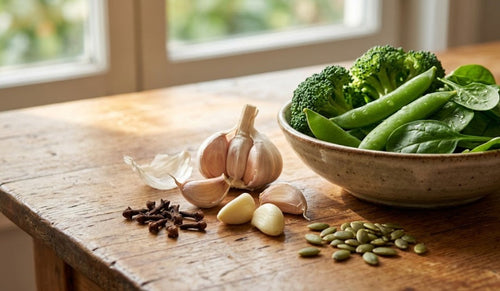
Garlic (allicin) Garlic contains allicin, a sulfur compound with studied antimicrobial properties. Traditionally used to support the cleansing of the digestive terrain, it integrates simply and deliciously into the daily diet (raw or lightly cooked to preserve its active compounds).
Pumpkin seeds (cucurbitacin) Pumpkin seeds contain cucurbitacin, a compound traditionally renowned for its properties against certain intestinal parasites (especially worms). Nutritious and rich in zinc and magnesium, they are a healthy snack that also supports the immune system.
Cloves (eugenol) Cloves are rich in eugenol, a molecule with studied antimicrobial properties. Used as a spice or in a light infusion, it complements a body-focused approach. Use in moderation and respecting contraindications (especially in case of anticoagulant treatment or pregnancy, ask for advice).
The importance of bitter and fermented foods
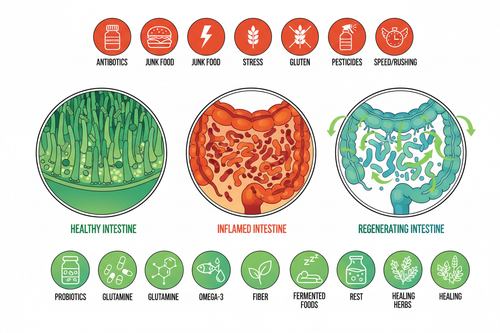
Beyond these targeted allies, two families of foods sustainably support the digestive terrain. Bitter foods (arugula, endive, dandelion, artichoke) stimulate choleretic action (bile production) and digestive secretions, which strengthens the natural defenses of the digestive tract. Lacto-fermented foods (raw sauerkraut, kefir, fermented vegetables) provide beneficial microorganisms that feed a diverse and resilient microbiota. Supporting good stomach acidity and vigorous digestion is making the entire digestive tract less welcoming for unwanted guests. These dietary habits are beneficial for everyone, parasite or not.
Are you exhausting yourself looking for the cause of your digestive disorders, alone after years of inconclusive medical visits? Join Le Terrier's personalized naturopathic follow-up for ten euros a month: a caring and long-term support to support your digestive terrain, in perfect complementarity with your medical follow-up. You will no longer be alone with your questions.
FAQ on intestinal parasites and IBS
Can irritable bowel syndrome be caused by a parasite?
This is a possibility that recent research takes seriously. Irritable bowel syndrome is a diagnosis of exclusion, made when no cause is found. However, some microscopic parasites like Blastocystis and Dientamoeba, not detected by routine tests, could be involved in some patients. This is not systematic and the field is emerging. If your symptoms are chronic and unexplained, talk to your doctor to consider an appropriate molecular test.
What is Blastocystis hominis?
Blastocystis is a microscopic single-celled intestinal parasite (a protozoan), very widespread in the world population. It comprises many subtypes: some appear pathogenic, others perfectly benign. The majority of carriers are asymptomatic and need no treatment. The relevant question is not just its presence, but its possible role in symptoms, which only a doctor can assess. Its clinical status is still the subject of scientific debates.
Why is my stool analysis negative despite my symptoms?
The classic parasitological examination of stool, based on observation under the microscope, often misses these parasites: they are fragile, shed intermittently, and difficult to see. The result is frequently a false negative. The more reliable method is molecular PCR analysis, which detects the parasite's DNA. Not all laboratories offer it routinely: you sometimes have to explicitly ask your doctor.
What test should I ask my doctor for?
In case of unexplained chronic digestive symptoms, you can discuss with your doctor the usefulness of a molecular search (PCR) for Blastocystis and Dientamoeba fragilis, more sensitive than the classic microscopic examination. It is they who will judge its relevance according to your situation and interpret the results. This process is part of a global medical assessment intended to first rule out other possible causes of your symptoms.
What is low-grade inflammation?
Low-grade inflammation is a discreet and chronic inflammation, without the frank signs of an acute infection (fever, sharp pain). At the intestinal level, it can maintain digestive symptoms and fatigue. More broadly, chronic low-grade inflammation is studied for its links with various health imbalances. Some parasites could maintain it, but this field is still being explored and the causal links are not all established.
Should I do a natural antiparasitic protocol?
No, not on your own initiative. The first step is always medical: diagnosis and possible treatment are the responsibility of your doctor. The naturopathic approach does not aim to "kill the parasite" but to support the digestive terrain (microbiota, local immunity, diet) as a complement. Some foods (garlic, pumpkin seeds, cloves, bitter and fermented foods) have studied compounds, but they come as support, never as a replacement for medical management.
How to naturally support your digestive terrain?
To support your microbiota and digestion: prioritize bitter foods (arugula, endive, artichoke) that stimulate digestive secretions, incorporate lacto-fermented foods (raw sauerkraut, kefir) that nourish a diverse microbiota, support good stomach acidity, and limit ultra-processed foods and sugar, which promote dysbiosis. These habits strengthen the natural defenses of the digestive tract and are beneficial for everyone, regardless of the presence of a parasite.
Are these parasites dangerous?
For the vast majority of carriers, Blastocystis and Dientamoeba are asymptomatic and harmless: carriage is very common and requires no treatment. In some people, certain subtypes may contribute to digestive symptoms and low-grade inflammation. Therefore, there is no need to panic or dismiss it: the right approach is to speak to your doctor if you have unexplained chronic symptoms, without becoming alarmed if you do not.
A serious lead, to be explored systematically
If you are going through a long period of digestive distress, the idea that an invisible parasite could be to blame is both troubling and hopeful: troubling because it could have been overlooked, hopeful because an identified factor is one that can be addressed. Let's stick to the essentials, without sensationalism: Blastocystis and Dientamoeba are very widespread and most often harmless, but certain subtypes may, in some people, sustain low-grade inflammation and symptoms mistaken for IBS; routine tests often miss them, and only a molecular PCR, ordered by your doctor, can reliably detect them; finally, the naturopathic approach of supporting the body's terrain (microbiota, bitter and fermented foods) is always complementary, never a replacement for medical care. The right approach is systematic: first the doctor, then the terrain. Let's say it one last time: this content is educational and does not replace medical advice. In case of persistent symptoms, consult a doctor.




2 comments
Excellent travail ! Que dirait des personnes qui vivent en Afrique où il y’a une plus grande probabilité d’être infecté par des gros vers tel que le ténias…
Merci pour ce merveilleux travail que vous faites tous les deux.